
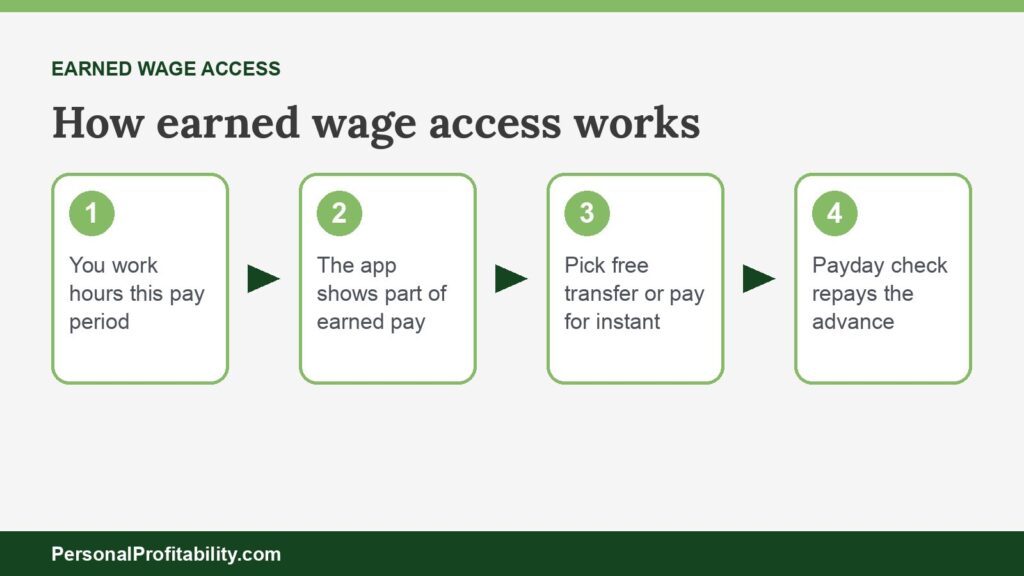
Earned wage access lets you take part of the pay you’ve already earned before payday, usually through your employer’s app, and the provider takes it back from your next paycheck. You can often get the money free if you wait a day, but an instant transfer usually costs $1.99 to $5. Before you use it, check what earned wage access fees cost in APR terms, because a $3 fee on a $100 advance adds up fast.
Eric Rosenberg, who founded Personal Profitability, wrote for Payactiv as a freelancer and later worked there as a marketing manager, until June 2026. Nobody at Payactiv reviewed this page. We held Payactiv to its own published fees and terms, the same standard we used for every other company here.
Personal Profitability may earn a commission from partner links on this page, at no cost to you. Partners don’t decide what we recommend or where it ranks. Fees and terms are each company’s as of 2026-10-24. Confirm them on the company’s site before you sign up.
What’s in this guide (fees, laws, and lawsuits last checked October 24, 2026):
- What EWA is
- How it works, step by step
- Employer apps vs. direct-to-consumer apps
- What it costs, with the APR math
- Is it a loan, and which states regulate it
- Providers at a glance and how to choose
- EWA vs. payday loans, overdraft, and credit cards
- When to skip it
- FAQ
What is earned wage access?
Earned wage access (EWA) is a service that pays you some of the wages you’ve already worked for, before your employer’s regular payday. You’ll also see it called on-demand pay, daily pay, instant pay, early wage access, or an earned wage advance. Employers usually offer it as a workplace benefit, and employees withdraw the money through the provider’s app. The idea is the same under every name. Payroll companies offer on-demand pay through partner providers too: Paychex uses Payactiv, Gusto and QuickBooks Payroll use Clair, and ADP lists DailyPay, Payactiv, Tapcheck, and Immediate in its marketplace. You worked Monday through Thursday, your paycheck doesn’t land until next Friday, and an EWA provider fronts you part of those four days of pay now.
The market got big fast. The Consumer Financial Protection Bureau counted about 7.2 million workers who used employer-partnered EWA at least once in 2022, moving $22.8 billion across 214 million transactions. Add the roughly 3 million people who used direct-to-consumer apps, and the CFPB put the total at about 10 million workers and more than $31.9 billion that year.
EWA doesn’t raise your pay. It moves part of your paycheck earlier. That makes it useful for a timing problem, like rent due on the 1st and payday on the 5th. You can’t use it to fix a budget problem, where your monthly bills cost more than your monthly take-home pay. If you’re short every pay period, EWA just moves the shortfall around, and fees make it a little bigger each time.
Spend less, earn more and grow your wealth
Get my free 2026 Playbook with a checklist for your budget, credit, investing and side income, plus the free 7-day Bootcamp.
How does earned wage access work?
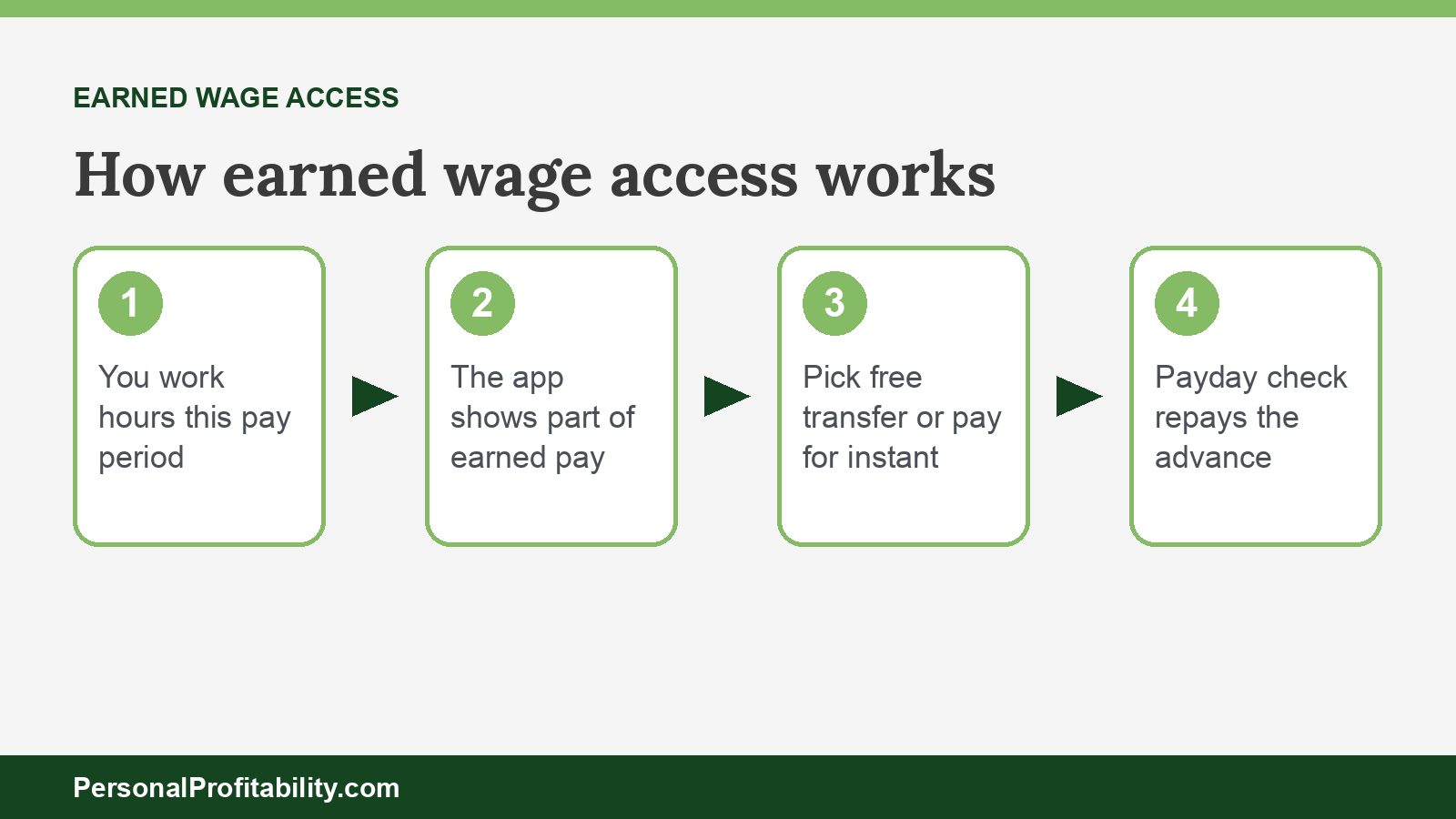
EWA works by tracking the hours or salary you’ve earned so far this pay period, letting you transfer part of it early, and collecting that amount from your next paycheck. With an employer program, the steps look like this:
- Your employer signs up with a provider such as DailyPay, Payactiv, Branch, or Rain, and connects it to the payroll system and timekeeping.
- You download the provider’s app and link where you want the money to go: a bank account, a debit card, or the provider’s own card.
- You see an available balance based on hours you’ve worked or salary you’ve accrued. Providers cap it, often at 50% of what you’ve earned so far, and caps vary by employer.
- You request a transfer and pick a speed. The slower option is usually free. The instant option usually costs a flat fee.
- Payday arrives and your employer’s payroll deducts what you took, plus any fee, from your check. You get the rest.
A worked example
Say you earn $18 an hour on a two-week pay cycle. By the end of week one you’ve worked 40 hours, so you’ve earned $720 before taxes. Under a 50% cap, you’d see $360 available in the app. Your car insurance payment of $100 is due tomorrow.
- Free route: you request $100 by standard bank transfer. It arrives in one to three business days and costs $0.
- Instant route: you pay a $3.49 fee to get the $100 in minutes.
- On payday: say your normal net check would have been $1,150. It arrives as $1,050 on the free route, or $1,046.51 if you paid the fee and your provider collects it from your check.
Those numbers are illustrative. Your employer and provider set the cap and the fee, and both show in the app before you confirm.
What the paystub deduction looks like
Most employer programs show the repayment as a line on your paystub. Rain and Tapcheck both describe it that way. Your employer withholds taxes on your full paycheck as usual, then subtracts the amount you already took, so the line sits among your after-tax deductions. DailyPay works a little differently. After your first transfer, your employer sends your whole net pay directly to DailyPay, and DailyPay forwards the remainder to you on payday. If you see a line you don’t recognize, our guide to the earned wage access deduction on your paystub walks through each version.
Taxes don’t change. An EWA transfer is part of the same wages you’d get on payday, so it’s taxable income either way. The IRS hasn’t issued guidance specific to EWA. Treasury’s fiscal 2023 budget proposal notes that in practice employers treat the wages as paid on the regular payday.
Employer-integrated vs. direct-to-consumer EWA apps
With employer-integrated EWA, the provider reads your hours from payroll and collects repayment through a payroll deduction. Direct-to-consumer companies estimate your pay from your bank account and pull repayment from that account on payday. That difference drives cost, risk, and how regulators treat each one.
| Feature | Employer-integrated | Direct-to-consumer |
|---|---|---|
| Examples | DailyPay, Payactiv, Branch, Rain, Tapcheck, ZayZoon, OnePay @Work | EarnIn, Dave, MoneyLion, Brigit, Chime MyPay |
| Needs your employer | Yes | No |
| How it knows your pay | Payroll and timekeeping data | Bank deposits, work email, or GPS location |
| How it gets repaid | Payroll deduction | Debit from your bank account |
| Overdraft risk | Low | Higher, if the debit hits an empty account |
| Usual costs | Instant fee, free slower option | Instant fee, tips, or monthly subscription |
| Federal status | Not credit if it meets the CFPB’s four conditions | Unsettled |
Employer programs win on most counts. Employer-partnered providers charged off just 0.3% of advances in 2021 and again in 2022, the CFPB found. Its direct-to-consumer sample ran 6.5% in 2021 and 6.3% in 2022. The GAO flagged unexpected overdraft fees when direct-to-consumer companies debit your bank account, and it found that some of them estimate your wages with GPS location data. Most direct-to-consumer apps also require a checking account with regular direct deposits. Chime, for example, requires $200 or more in qualifying direct deposits for MyPay. If your employer offers EWA, start there. If it doesn’t, our roundup of the best earned wage access apps covers both kinds and names the catch on each.
Why employers offer EWA, and what it costs them
Employers offer EWA as an employee benefit to hire and keep hourly staff, and most of them pay nothing for it. For the employee, the benefit works like a paycheck you can tap a few days early. Payactiv, Tapcheck, Branch, and OnePay all say employers can offer their service at no cost, and Branch says it requires no pre-funding. The provider fronts the funds and recovers them through the employer’s payroll systems on payday. That business model explains why workers pay the fees: someone has to cover the provider’s cost of moving money early.
Data on adoption comes mostly from private surveys. The Federal Reserve Bank of Kansas City relayed a 2022 Citizens survey in which 71% of 200 middle-market firms said they offer EWA, and a 2022 ADP survey in which 96% of employers offering it said it helps recruiting. A 2022 Financial Health Network survey, cited in the same brief, found that 43% of employees whose employer offered EWA had used it. Treat those as industry numbers rather than government data, since no federal survey tracks employer benefits like this one. If you run payroll for a small business, our guide to EWA providers for employers compares integration requirements and costs.
Many employer providers bundle other financial services with the pay advance. Payactiv lists bill pay, savings tools, and financial counseling. DailyPay offers a prepaid card and in-app financial counseling, and Rain adds savings and a low-balance alert. Those extras can help, but the core consumer question stays the same: can you get your earned wages without paying for speed?
Cash advance apps and early direct deposit aren’t the same thing
Many direct-to-consumer EWA apps also call themselves cash advance apps, and the line between the two is blurry. Chime describes MyPay as “a line of credit,” and Dave runs ExtraCash as an overdraft product, so both work more like short-term credit than a withdrawal of wages you’ve earned. Read the terms to see which model you’re signing up for.
Early direct deposit is different again. Chime, Varo, Current, SoFi, and Capital One 360 all say they can release your paycheck up to two days early once your employer sends the payroll file. You pay nothing, you owe nothing, and you don’t need an EWA provider. If your bank doesn’t offer it, switching to a checking account that does is typically the cheapest fix for a two-day gap.
What does earned wage access cost?
EWA costs $0 if you take the slower transfer or the provider’s own card, and usually $1.99 to $5 per instant transfer otherwise. Some direct-to-consumer apps add a monthly subscription or ask for a tip. Most employer programs cost the employer nothing, so workers pay the fees.
Few people take the free option. In the CFPB’s 2024 data spotlight, about 90% of workers in its employer-partnered sample paid at least one fee, and expedited transfers made up 96.6% of the fee revenue workers paid. Employers covered less than 5% of total fees. Here’s what the CFPB found:
| CFPB measure (2022 data) | Figure |
|---|---|
| Average transfer | $106 |
| Average fee when a worker paid one | $3.18 |
| Average fee across all transfers | $2.60 |
| Transfers per worker per year | 27 |
| Workers using EWA at least monthly | 47.9% |
| Illustrative APR on an average transfer | 109.5% |
The APR math on a “small” fee
EWA providers typically charge flat fees rather than interest, and a flat fee looks tiny until you price it like a loan. Divide the fee by the amount, then scale it to a year. A $3.18 fee on $106 is 3% of the money. Spread over the roughly 10 days until payday, that works out to the 109.5% APR the CFPB published. The shorter the wait, the worse the rate:
| Advance | Fee | Days to payday | APR equivalent |
|---|---|---|---|
| $106 | $3.18 | 10 | 109.5% |
| $100 | $3.49 | 14 | 91% |
| $100 | $3.49 | 7 | 182% |
| $50 | $3.18 | 4 | About 580% |
| $20 | $2.99 | 7 | Over 750% |
The $50 row comes from the CFPB, and the $20 row is the New York attorney general’s description of DailyPay’s most common transfer. Now count a year. At the CFPB’s average of 27 transfers and $3.18 each, you’d pay $85.86 a year to get your own money early. Pay $3.49 every two weeks and it’s $90.74. That’s a car insurance payment, spent on speed. Our provider-by-provider fee breakdown lists every major provider’s charges side by side.
Tips are fees with better marketing
Some apps, EarnIn among them, ask for an optional tip instead of charging a set price. California’s financial regulator studied 2021 data and found that workers tipped 73% of the time on tip-based transactions, with an average tip of $4.09. It calculated an average APR of 334% for tip-based companies, tips included. You owe no tip, and you should pay $0. Maryland banned tips on EWA outright on October 1, 2026.
Is earned wage access a loan? The federal and state rules
Under federal lending law, employer-integrated EWA that meets four conditions isn’t a loan, direct-to-consumer apps remain unsettled, and three states treat EWA as a loan with carve-outs. The answer matters because loan rules bring APR disclosures and rate caps. The CFPB changed its regulatory position several times between 2020 and 2025, so older articles on this question are often wrong.
The CFPB set the current federal position in a December 23, 2025 advisory opinion. To fall outside the Truth in Lending Act, a provider must cap each transfer at wages you’ve accrued based on payroll data, collect repayment through a payroll deduction, give up any claim against you if the deduction falls short, and skip any credit check. The CFPB took no position on apps that debit your bank account. Congress hasn’t settled it either. H.R. 9330, which would declare compliant EWA “not credit, a loan, debt,” cleared the House Financial Services Committee 29 to 22 and has sat on the Union Calendar since September 1, 2026, according to Congress.gov. Our full guide to whether earned wage access is a loan covers the timeline and the lawsuits.
Which states regulate EWA
Twelve states have EWA-specific laws or regulations, by the Urban Institute’s count, and they split three ways:
- Loan or credit, with carve-outs: California, Connecticut, and Maryland. Connecticut caps finance charges at $4 per advance and $30 a month, and Maryland caps delivery fees at $5 for advances of $75 or less and $7.50 above that.
- Not a loan, license or registration required: Indiana, Kansas, Missouri, Nevada, South Carolina, Utah, and Wisconsin. Wisconsin added the same $5 and $7.50 fee caps as Maryland in April 2026.
- Not a loan, product rules only: Arkansas and Louisiana.
Arizona and Montana have attorney general opinions instead of statutes. New York has no EWA law, but its attorney general sued DailyPay and MoneyLion in April 2025 under the state’s usury laws. Colorado, Minnesota, and Washington, D.C., have sued direct-to-consumer apps too. Our earned wage access laws by state tracker lists every statute, effective date, and fee cap.
EWA providers at a glance
Most employer providers offer a free transfer and charge $1.99 to $5 for instant delivery, while direct-to-consumer apps charge percentages, subscriptions, or tips. The table lists each company’s own published terms, in alphabetical order within each group, not as a ranking.
| Provider | Free option for workers | Instant fee | Access cap |
|---|---|---|---|
| Employer-integrated | |||
| Branch | Instant to Branch Wallet, or ACH in 3–5 business days | $2.99–$4.99 to a debit card (W-2). 2%, $2.99 minimum (1099) | 50% of projected earned wages, $1,000 per pay period, $500 per request |
| DailyPay | Standard transfer, or instant to a DailyPay Card with direct deposit | $1.99–$3.99 in its program terms, $3.49 on its fees page, varies by employer | Up to 100% of the app’s available balance, $1,000 a day |
| OnePay @Work | All options free if your employer configured free instant | “Small fee” otherwise, amount not published | Part of net earnings, no figure published |
| Payactiv | ACH in 1–3 business days, or Payactiv Card with $200+ direct deposit per pay period | $2.49 to Payactiv Card without that deposit. $3.49 to other cards, Venmo, PayPal, or Walmart pickup | “A portion,” up to 50% and $500 a pay period in most cases |
| Rain | ACH in 1–3 days | “Small fee” to a card, amount not published | 50% of current-period earnings |
| Stream | Standard transfer in 1–3 business days | “Small flat convenience fee,” amount not published | 50% of earnings |
| Tapcheck | Fee waived for gift cards | One flat fee, amount not published | 70% of net earnings |
| ZayZoon | ZayZoon Visa Card or gift cards | Up to $5 ($4 in Connecticut) | $200 per payout in a 2024 help article |
| Direct-to-consumer | |||
| Brigit | Advance without a subscription only if you email Brigit and ask | Plus plan $8.99 a month plus an express fee Brigit doesn’t publish. Premium $15.99 a month with free express | $25–$500 |
| Chime MyPay | Scheduled transfer within 24 hours | 3%, $2 minimum, $5 maximum | Up to $750 advertised, limits $20–$1,000 |
| Dave ExtraCash | None. Dave charges an overdraft fee of 5% ($5 minimum, $15 maximum) plus membership up to $5 a month | 1.5% extra to an external debit card | $25–$500 |
| EarnIn | Standard transfer in 1–2 business days | From $3.99 (Lightning Speed), tips optional | $200 a day, $1,000 per pay period |
| MoneyLion Instacash | Standard to a MoneyLion Spend account | 7.5% to Spend (capped at $14.99), 9% to an external account | $500, or $1,000 with qualifying direct deposit |
Fees and terms verified 2026-10-24. Chime calls MyPay a line of credit, and Dave calls ExtraCash an overdraft product, so neither one meets the CFPB’s definition of covered EWA.
How to choose an EWA app
If you have a choice, pick by the free path first and the instant fee second. Ask four questions before you sign up:
- Can I get my money for $0? Every employer provider above has a free route, either a slower bank transfer or its own card. Use it.
- What does the instant fee cost as an APR? Run your own numbers with the fee and the days until payday.
- How will I pay it back? A payroll deduction can’t overdraw your bank account. A bank debit can.
- Does it push tips or subscriptions? A monthly fee you pay whether or not you use the service makes EWA expensive in slow months.
Employees whose employer offers nothing should start with our best on-demand pay apps list, which adds gig-platform cashouts and early direct deposit. HR teams comparing vendors should read the best earned wage access providers for employers. For single companies, see our DailyPay review, Payactiv review, and EarnIn review, plus the head-to-head Payactiv vs. DailyPay comparison and our list of apps like Payactiv.
Alternatives to other pay-early apps
If you already use a pay-early app, pick it below to see the alternatives we compared for its users.
- Apps like DailyPay
- Apps like Branch
- Apps like Rain
- Apps like ZayZoon
- Apps like Tapcheck
- Apps like Clair
- Apps like EarnIn
- Apps like Dave
- Apps like Brigit
- Apps like MoneyLion
- Apps like Cleo
- Apps like Klover
EWA vs. payday loans, overdraft, and credit cards
Free or cheap EWA beats a payday loan and an overdraft fee, but it loses to a credit card you pay in full by the due date. The GAO compared costs in 2023 and found that getting $100 cost $0 to $10.08 across four EWA products, against $10 to $30 for a typical payday loan.
| Option | Typical cost for $100 until payday | Main risk |
|---|---|---|
| EWA, free transfer | $0 | You start the next pay period short |
| EWA, instant transfer | About $2 to $5 | Triple-digit APR if used often |
| Payday loan | $10 to $30 per GAO, or 261% to 782% APR over 14 days | Rollovers and debt traps |
| Bank overdraft | Your bank’s overdraft fee, per item | Several fees in one bad day |
| Credit card, paid in full | $0 interest if you pay the full statement balance by the due date | Interest if you carry a balance |
Payday lenders are the worst choice on that table, and we’ve said so for years in why payday loan companies are like the mafia. Our earned wage access vs. payday loan comparison goes deeper on the trade-offs. If an overdraft already hit, try getting your overdraft fees refunded before you pay for speed. A credit card only works here if you pay the whole balance every month. Carry it, and the interest erases the advantage.
When to skip EWA and build an emergency fund
Skip EWA when you’d need it every pay period, when only the instant option would help, or when a direct-to-consumer app would debit an account that’s already near zero. In those cases, EWA treats a symptom and charges you for the treatment.
Repeat use is common. The CFPB’s average worker made 27 transfers a year, and nearly half used EWA at least monthly. The GAO cited a study that found more than 70% of users drew wages in back-to-back semimonthly pay periods. Once you do that, every paycheck starts short, so you draw again. The fee becomes a permanent cut in your pay.
A small cash buffer breaks the loop, and it costs nothing to access. In the Federal Reserve’s 2025 household survey, 63% of adults said they’d cover a $400 emergency with cash or its equivalent, so 37% would not. Start with one paycheck’s worth of float, even if it takes a few months:
- Use the free EWA transfer only, never instant, while you build the buffer.
- Set an automatic transfer of $25 or $50 each payday into savings. Our emergency fund guide covers how much to aim for.
- Keep it in a high-yield savings account you can reach in a day.
- Cut one recurring bill. Our list of ways to cut your monthly expenses starts with phone, insurance, and subscriptions.
- If your pay swings week to week, follow our plan for budgeting with irregular income.
Once you have a $100 to $400 cushion, you can wait for payday on your own schedule. For the occasional gap that a cushion can’t cover, a free EWA transfer is a fine tool. Our guide to getting money in a hurry lists other options if you’re in a bind right now.
Earned wage access FAQ
Use earned wage access for timing, not as a budget
EWA is a reasonable tool when a bill lands a few days before payday and you take the free transfer. It gets expensive when you pay for speed every pay period, because a $3 fee on a $100 advance is a triple-digit APR. Employer programs beat direct-to-consumer apps, and both beat payday loans and overdraft fees. A starter emergency fund beats all of them. Start with our beginner’s guide to budgeting, and browse the full earned wage access section for reviews, fees, and state rules.
Free guide
Spend less, earn more and grow your wealth
Get my free 2026 Playbook with a checklist for your budget, credit, investing and side income, plus the free 7-day Bootcamp.
- Track your money with the tools that still work in 2026
- The order to invest in, with the 2026 401(k) and IRA limits
- Three ways to earn your first $100 on the side this month
Bonus: The 7-day Personal Profitability Bootcamp, one short lesson in your inbox each day