
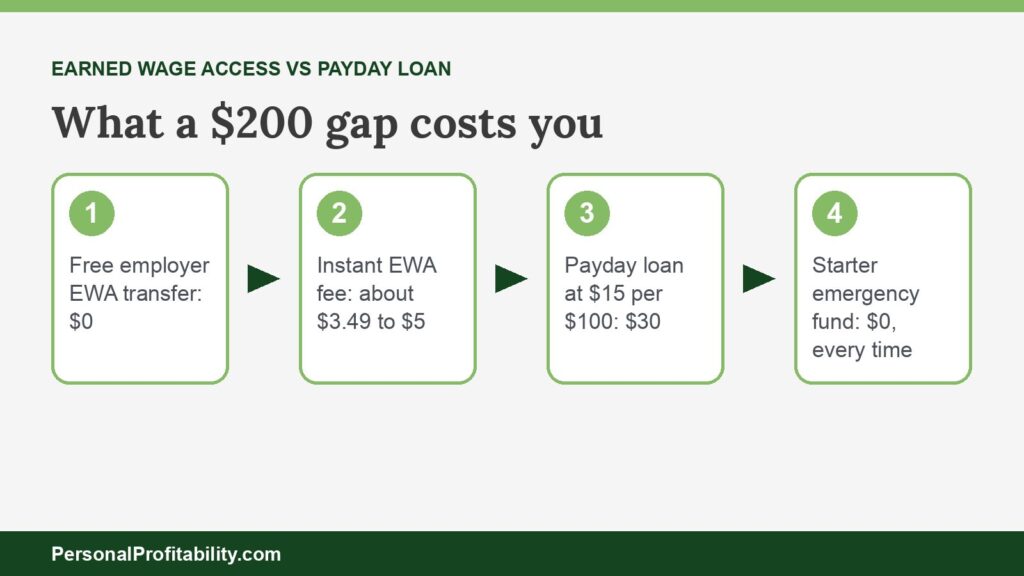
In the earned wage access vs payday loan matchup, employer EWA wins because you can often use it free and nobody can send you to collections, while a common payday loan fee of $15 per $100 equals almost 400% APR. A small emergency fund beats both. You can only get employer EWA if your employer offers it, so our guide to earned wage access explains how to find out.
Personal Profitability may earn a commission from partner links on this page, at no cost to you. Partners don’t decide what we recommend or where it ranks. Fees and terms are each company’s as of 2026-10-24. Confirm them on the company’s site before you sign up.
Earned wage access vs payday loan, side by side
With earned wage access, you take pay you’ve already earned before payday. With a payday loan, a lender gives you money you’ll repay with a fee on your next payday. Direct-to-consumer cash advance apps sit between the two, so the table includes them too. Employer EWA programs and cash advance apps charge no interest, while payday lenders charge fees that work like very high interest rates.
| Employer earned wage access | Direct-to-consumer advance app | Payday loan | |
|---|---|---|---|
| Who provides the money | A third-party provider your employer picks (DailyPay is one) | An app company (EarnIn is one) | A payday lender |
| How much | Capped at wages you’ve earned. Branch allows 50% of projected earned wages, up to $1,000 a pay period. | $10 to $1,000, set by the app from your bank deposits | Generally $500 or less, per the CFPB |
| Cost | A free option at most providers, or an instant fee of about $2 to $5 | Express fees, subscriptions of up to $15.99 a month, and tip prompts | $10 to $30 per $100 borrowed, with $15 common |
| APR on a typical example | 0% on the free option. The CFPB’s illustrative APR is 109.5% on a paid $106 advance. | About 290% on the CFPB’s $144 example with about $8 in tips and fees | Almost 400% on a two-week loan at $15 per $100 |
| Repayment | Payroll deduction from your next paycheck | Debit from your bank account on payday | One payment due in two to four weeks, by post-dated check or bank debit |
| Credit check | None under the CFPB’s definition of covered EWA | None at EarnIn, Dave, Chime MyPay, or MoneyLion, per their own pages | Lender’s choice |
| Collections | None. Covered EWA providers give up any claim against you. | Varies. MoneyLion says it may retry failed debits. | The lender can cash your check or debit your account |
| If you can’t repay | You get a smaller paycheck, and the provider absorbs any shortfall | The company pauses or blocks new advances | You roll over or renew the loan and pay another fee |
| Legal status | Not credit under federal lending law, per the CFPB’s December 2025 opinion. 12 states have EWA laws. | Unsettled. State attorneys general in Colorado, Minnesota, New York, and D.C. have sued. | Legal under state law, with rate caps in many states |
Fees and terms verified 2026-10-24.
Spend less, earn more and grow your wealth
Get my free 2026 Playbook with a checklist for your budget, credit, investing and side income, plus the free 7-day Bootcamp.
How earned wage access works
With earned wage access, you pull a portion of the earnings you’ve already made this pay period, and your employer takes it back out of your paycheck on payday. Your employer signs up with a third-party provider, the provider reads your hours from payroll, and you see an available balance in an app. Most employers allow employees to take part of their earned pay, not all of it, and some providers set daily limits. You pick a free transfer that arrives in a day or a few days, or you pay a fee to get the money instantly. Some employers call the benefit on-demand pay or early wage access.
Here’s what that looks like in published terms. DailyPay’s fees page lists a $0 transfer in 1 to 3 business days and a $3.49 instant transfer, and DailyPay says fees vary by employer. Branch’s help center lists free instant transfers to the Branch Wallet and $2.99 to $4.99 for instant transfers to an outside debit card. On payday, your employer deducts what you took, and the line shows up on your pay stub, which our explainer on the earned wage access deduction decodes.
The legal piece matters for your risk. In a December 2025 advisory opinion, the Consumer Financial Protection Bureau (CFPB) said “covered EWA is not credit” when the provider caps advances at payroll-verified wages, collects through a payroll deduction, skips any credit check, and promises in advance that it has no claim against you if the deduction falls short. That last condition means no debt collector, no sale of your account as debt, and no credit reporting. Our page on whether earned wage access is a loan covers the state exceptions.
The catch is frequency. The CFPB’s 2024 Data Spotlight found the average worker took 27 earned wage transactions a year, and 47.9% of workers used EWA at least monthly in 2022. About 90% of workers paid at least one fee. Free only helps if you pick the free option.
How a payday loan works
A payday loan is a short-term, high-cost loan you repay in one lump sum on your next payday, and people often take one to cover a car repair or a bill that can’t wait, usually with a fee of $10 to $30 for every $100 you borrow. The CFPB’s page on what a payday loan is says the loans are generally $500 or less and come due two to four weeks after you borrow. You give the lender a post-dated check for the full balance plus fees, or you authorize the lender to debit your bank account.
The CFPB’s page on payday loan costs says a charge of $15 per $100 is common, and that fee “equates to an annual percentage rate of almost 400 percent for a two-week loan.” If you can’t pay on the due date, the lender can cash your check or pull the money from your account, and many borrowers renew the loan and pay a new fee instead.
Borrowers who renew pay the most. In a 2014 study, the CFPB found that borrowers rolled over or renewed more than 80% of payday loans within two weeks, and that three out of five payday loans went to borrowers whose fees ended up larger than the amount they borrowed. We’ve called payday loan companies what they act like for years, and the CFPB’s numbers back that up.
States decide whether payday loans exist at all. Colorado voters capped the payday loan interest rate at 36% APR with Proposition 111 in 2018, which our post on Colorado payday loan legislation covers. Other states cap small-loan rates too, including 36% in Connecticut, 33% in Maryland, and 24% in D.C., according to state and local officials.
What a $200 shortfall costs with each option
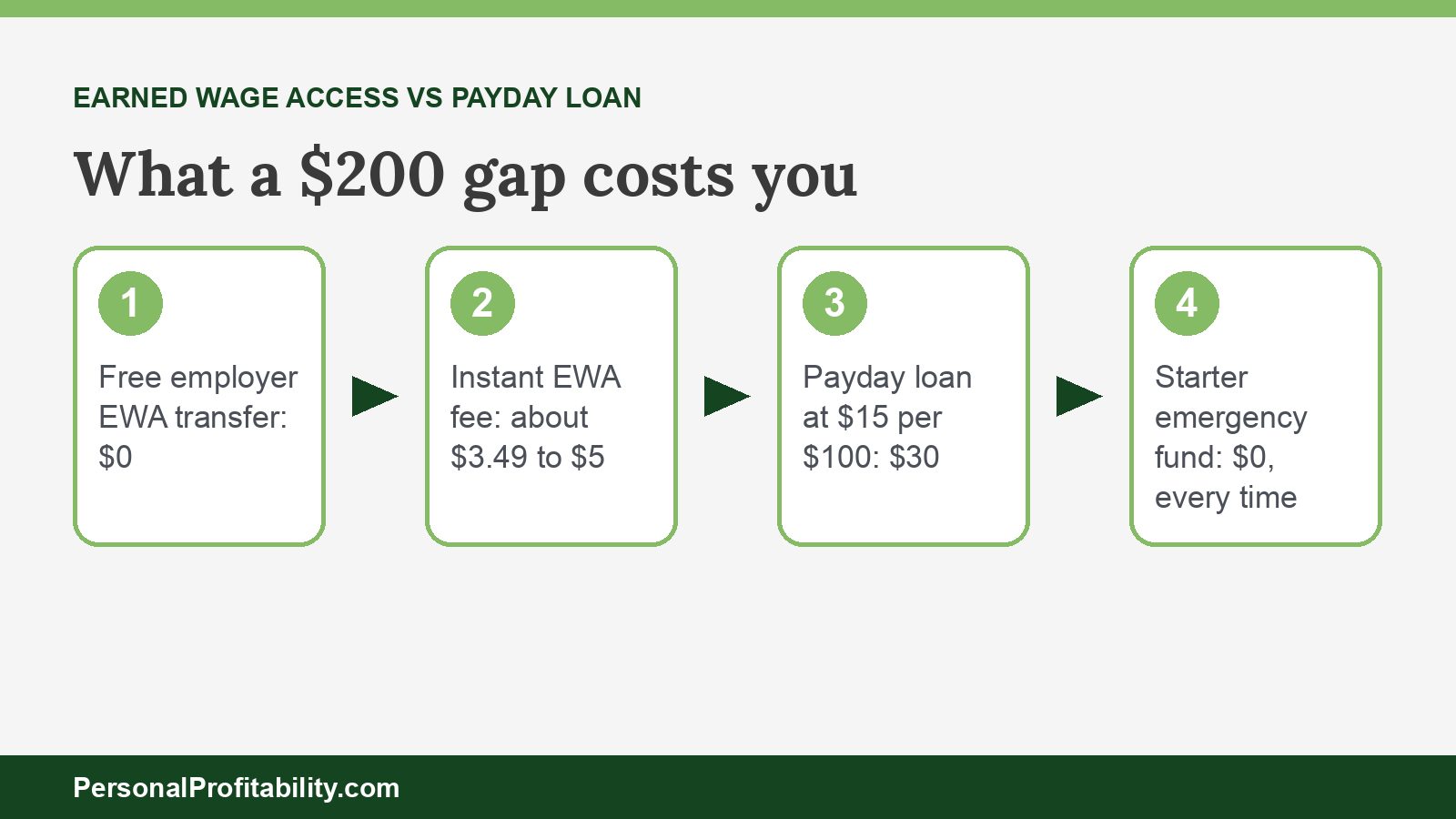
Covering a $200 cash flow gap for two weeks costs $0 with free employer EWA, $3.49 to $5 with paid instant EWA, and $30 with a typical payday loan. The table runs the same $200 need through every option, using each company’s published fees and a 14-day gap. APR equivalent here means the fee divided by the $200, scaled to a year.
| Option for $200 over 14 days | Fee | APR equivalent |
|---|---|---|
| Employer EWA, free transfer (DailyPay standard, Branch Wallet) | $0 | 0% |
| Employer EWA, DailyPay instant at $3.49 | $3.49 | 45% |
| Employer EWA, Branch instant to a debit card at $4.99 | $4.99 | 65% |
| Chime MyPay instant (3%, capped at $5) | $5 | 65% |
| Dave ExtraCash (greater of $5 or 5%, plus up to $5 membership) | $10 to $15 | 130% to 196% |
| MoneyLion Turbo to an outside bank (9%, two $100 disbursements) | $18 | 235% |
| Payday loan at $15 per $100 | $30 | 391% |
| Payday loan at $30 per $100, the top of the CFPB’s range | $60 | 782% |
| Payday loan renewed six times at $15 per $100 | $210 in fees | More than the $200 you borrowed |
Every paid option looks worse over a shorter gap. The same $3.49 fee on a $200 advance repaid in 7 days works out to about 91% APR. New York’s attorney general made that point in its April 2025 suit against DailyPay, saying the company’s most common advance, $20 for seven days with a $2.99 fee, works out to more than 750% APR. DailyPay disputes that it makes loans, and we found no ruling as of October 2026.
Over a year, the gap grows. At the CFPB’s averages, 27 paid EWA transfers at $3.18 each cost $85.86 a year. A $200 payday loan renewed every two weeks for a year costs $780 in fees, and you’d still owe the $200. The GAO reached the same ranking in a 2023 report: getting $100 cost $0 to $10.08 across four EWA products, against $10 to $30 for a typical payday loan. For more fee math by provider, see our breakdown of earned wage access fees.
Where cash advance apps fall between EWA and payday loans
Direct-to-consumer cash advance apps cost less than payday loans and usually more than employer EWA, and they carry a risk employer EWA doesn’t: a debit from your bank account on payday. EarnIn, Dave, MoneyLion, and Brigit offer their services without your employer, which helps people whose employers offer no early pay program. These companies require a linked checking account with steady deposits. Each company estimates your pay from those deposits, sends a small advance, and pulls the money back when your paycheck lands. If your pay arrives late or short, you can end up overdrawn, a risk the GAO flagged in its 2023 report.
The CFPB’s numbers show the gap. Employer-partnered EWA had a 0.3% charge-off rate in 2021 and 2022, while the direct-to-consumer sample ran 6.5% in 2021 and 6.3% in 2022. The CFPB’s example of a $144 direct-to-consumer advance with about $8 in tips and fees came to roughly 290% APR.
Regulators haven’t settled whether these apps make loans. The CFPB’s December 2025 opinion covered only employer-integrated EWA and took no position on apps that debit your bank. State officials have gone to court instead:
- Colorado’s attorney general sued EarnIn on Aug. 27, 2026, saying EarnIn made more than 3.1 million loans to Coloradans with APRs “of several hundred percent.” The case is pending.
- Minnesota’s attorney general sued Brigit on June 10, 2026, calling it an unlicensed lender with APRs regularly above 300%, against a 50% state cap. The case is pending.
- New York’s attorney general sued MoneyLion on April 14, 2025, saying more than half of its advances topped 500% APR. The case is pending.
- The FTC and the Justice Department sued Dave in 2024 over its advance claims and fees. The FTC’s case page lists the case as pending.
If you use one of these apps, take the free standard transfer and skip the tip. Our EarnIn review and our list of the best earned wage access apps compare the free paths. Rules differ by state, and our earned wage access laws tracker lists them.
Overdrafts and credit card cash advances
An overdraft or a credit card cash advance can cost as much as a payday loan, so check the fee schedule before you treat either one as the cheap option. Banks set their own overdraft fees, and consumers paid more than $5.8 billion in reported overdraft and NSF fees in 2023, according to a CFPB Data Spotlight. If your bank charges $35 per overdraft, one overdraft on a $200 shortfall costs more than the $30 payday loan fee, and two overdrafts cost more than twice as much.
Some banks offer a linked line of credit that covers overdrafts for interest instead of a flat fee, which our guide to an overdraft line of credit compares. If a fee already hit, call and ask for a refund. Our walkthrough on getting overdraft fees refunded has the script.
Credit card issuers set their own cash advance terms, and the CFPB says the cost depends on the issuer’s policy. Before you take cash from a card, find three numbers in your cardholder agreement: the cash advance fee, the cash advance APR, and the date interest starts. Then pay the balance off in full on your next statement. If you carry a card balance month to month, a two-week problem becomes a long one.
Warning signs you’re stuck in a cycle
You’re in a cycle when each advance or loan exists to cover the hole the last one left in your paycheck. The GAO found that users of one employer-sponsored provider averaged about 10 to 24 uses a year, and users of one direct-to-consumer app averaged about 26 to 33. EWA fixes a timing gap between work and payday. It doesn’t fix a budget gap, and neither does a payday loan. Watch for these signs:
- You take an advance every pay period, or close to it.
- You pay the instant fee every time instead of waiting a day for the free transfer.
- Your paycheck arrives smaller than your bills because of last period’s advances, so you advance again.
- You use two or more apps at once to reach a bigger total.
- You’ve renewed or rolled over a payday loan.
- An app’s payday debit has overdrawn your account.
- You leave tips, which cost the same as fees.
One sign is enough to change course. Cut the paid speed first, then cap yourself at one advance a month while you build a buffer. If your hours swing, our guide to budgeting with irregular income shows how to plan around a lumpy paycheck.
What to do instead of EWA or a payday loan
A starter emergency fund of a few hundred dollars beats EWA, cash advance apps, and payday loans, because the money is yours and costs nothing to use. With one, a car repair becomes an annoyance instead of a financial emergency. The Federal Reserve’s 2025 household survey found 63% of adults would cover a $400 emergency expense with cash or its equivalent, which leaves 37% who wouldn’t. Our guide to building emergency funds starts with that first $400.
When you need money this week, work down this list before you borrow:
- Ask your employer for a payroll advance or an off-cycle check, or ask HR whether it offers an earned wage access program so employees can get paid early.
- Call the company you owe and ask whether it will move the due date or split the bill.
- Sell something you don’t use, or pick up a shift or a gig. Our list of ways to get money in a hurry has more.
- Use employer EWA with the free transfer if you have it.
- Use a cash advance app’s free standard transfer, with no tip, if you don’t.
- Skip the payday loan.
Once the crunch passes, set up an automatic transfer to savings on payday, even $20, and trim one recurring bill. Our guide to cutting your monthly expenses starts with the recurring ones, since every cut there saves you money each month.
Earned wage access vs payday loan FAQ
Use the free option, then build the buffer
Between earned wage access and a payday loan, pick employer EWA with the free transfer every time you have it. A direct-to-consumer app’s free standard transfer comes next, and a payday loan comes last. Then put the next few paychecks toward a starter emergency fund, so the next $200 surprise costs you nothing.
Free guide
Spend less, earn more and grow your wealth
Get my free 2026 Playbook with a checklist for your budget, credit, investing and side income, plus the free 7-day Bootcamp.
- Track your money with the tools that still work in 2026
- The order to invest in, with the 2026 401(k) and IRA limits
- Three ways to earn your first $100 on the side this month
Bonus: The 7-day Personal Profitability Bootcamp, one short lesson in your inbox each day