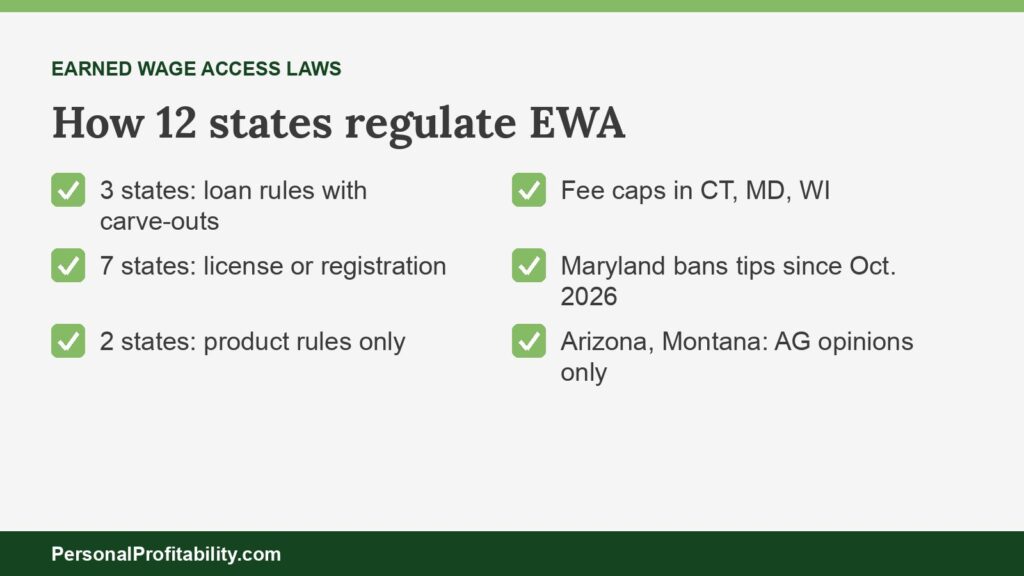
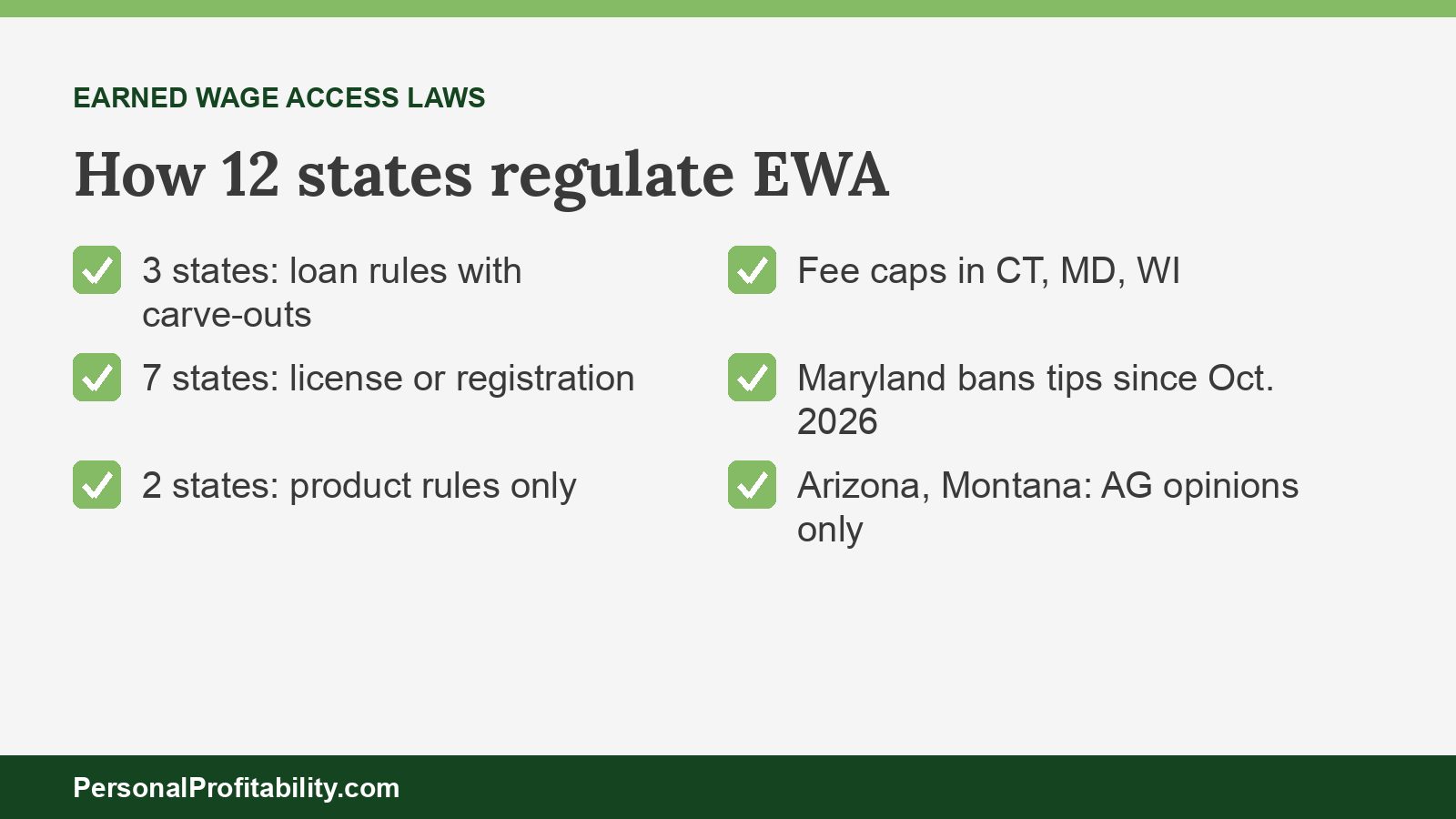
Earned wage access laws now cover 12 states: three treat EWA as a loan with carve-outs, seven say it isn’t a loan but require a license or registration, and two set product rules only. Every other state leaves earned wage access products to general consumer laws, attorney general opinions, or lawsuits. This tracker lists each law, its citation, its effective date, and the fee rules that affect what you pay.
Last checked 2026-10-24. We update this tracker when a state acts. This page summarizes state law in general terms and isn’t legal advice. Confirm the current rules with your state’s regulator before you rely on them.
Which states have earned wage access laws?
Arkansas, California, Connecticut, Indiana, Kansas, Louisiana, Maryland, Missouri, Nevada, South Carolina, Utah, and Wisconsin have EWA-specific laws or regulations. The Urban Institute counts those 12, with data as of March 2026, and McGuireWoods’ October 6, 2026 tracker also counts 12. We found no state that passed its first EWA legislation in 2026. Instead, Maryland, Missouri, Utah, and Wisconsin amended the laws they already had.
| State | Law or rule | Effective | Loan or not | License or registration | Fee and tip rules |
|---|---|---|---|---|---|
| Arkansas. | Act 347 of 2025 (HB 1517), Ark. Code 23-52-201 et seq. | Aug. 5, 2025. | Not lending. | None. | No-cost option, voluntary tips, no late fees or interest. |
| California. | DFPI rules under the CCFPL, 10 CCR sec. 1461. | Registration due Feb. 15, 2025. | Loan under the California Financing Law, with an exemption for registered providers. | DFPI registration, annual report. | Reports must count tips as charges, along with fees. No cap. |
| Connecticut. | Public Act 25-155 (2025), CGS 36a-555 et seq. | Oct. 1, 2025. | Small loan. | Small loan license. | Cap of $4 per advance, $30 a month, on advances under $750. |
| Indiana. | HEA 1125 (2025), IC 28-8-6. | Jan. 1, 2026. | Separate EWA category, not a small loan. | DFI license through NMLS. | Branch says state fee caps may apply. We couldn’t confirm a figure in the statute text. |
| Kansas. | HB 2560 (2024), Kansas Earned Wage Access Services Act. | July 1, 2024. | Not a loan or credit. | Registration with the State Bank Commissioner, $100,000 bond. | No “unreasonable” expedite fee, no-cost option disclosed, tips voluntary. |
| Louisiana. | Act 496 of 2025 (HB 368), La. R.S. 9:3591.1–3591.7. | Aug. 1, 2025. | Not lending. | None. Fee-charging providers report to the OFI. | No-cost option, tip disclosures, no late fees or interest. |
| Maryland. | HB 1294, Ch. 847 (2025), and SB 94, Ch. 170 (2026), Com. Law 12-1501–12-1507. | Oct. 1, 2025, and Oct. 1, 2026. | Loan under the Consumer Loan Law. | Consumer loan license, unless exempt. | $5 fee cap at $75 or less, $7.50 above. Tips banned. |
| Missouri. | RSMo 361.749 (2023 SB 103), amended by HB 2423 (2026). | Aug. 28, 2023. | Not a loan or credit. | Registration, converted to a license in 2026. | Fees aren’t interest. Neither are tips. |
| Nevada. | SB 290 (2023), NRS Chapter 604D. | License required for existing providers after Dec. 31, 2024. | Exempt from lending laws. | License, $35,000 bond. | No late fees, interest, or penalties. No fee sharing with employers. |
| South Carolina. | Act 190 of 2024 (S. 700), Title 39, Ch. 5, Art. 8. | Nov. 21, 2024. | Not a consumer loan. | Registration with Consumer Affairs, $30,000 bond. | No-cost option, fee schedule on file, tips may be zero. |
| Utah. | HB 279 (2025), Utah Code 13-78. | May 7, 2025. | Not a loan, credit, or debt. | Registration with Consumer Protection. | Fees aren’t interest. Neither are tips. |
| Wisconsin. | 2023 Act 131, Wis. Stat. ch. 203, amended by 2025 Act 199. | March 23, 2024, fee cap April 5, 2026. | Exempt from parts of the Wisconsin Consumer Act. | DFI license, $25,000 bond. | $5 fee cap at $75 or less, $7.50 above, plus a no-cost option. |
We built this table from statutes and regulator pages on October 22, 2026, and rechecked the uncertain rows on October 24, 2026. Arkansas has no emergency clause, so Arkansas’s attorney general puts the effective date at August 5, 2025, the default date for 2025 acts. Kansas’s date comes from the legislature’s bill page.
State legislation on EWA products splits along a policy fight between the industry and consumer groups. The Financial Technology Association, an industry group, argues EWA isn’t a loan because workers have no absolute obligation to repay. The Center for Responsible Lending and other consumer advocates want these apps held to the same 36% APR limit that many states apply to small loans. Most of the 12 states sided with the industry on the label, which lets EWA providers serve workers without a lender license, then wrote consumer rules into the law: a free option, voluntary tips, no late fees, and no collections. For consumers, those rules matter more than the label, because they set what a provider can charge you.
Spend less, earn more and grow your wealth
Get my free 2026 Playbook with a checklist for your budget, credit, investing and side income, plus the free 7-day Bootcamp.
States that treat earned wage access as a loan
California, Connecticut, and Maryland treat EWA as a loan or credit, but each one carves out a path that lets licensed or registered providers keep operating. These three states also set the strictest rules for EWA products on fees and tips.
California
California regulates EWA by regulation, not statute. The Department of Financial Protection and Innovation (DFPI) announced rules on October 22, 2024, under the California Consumer Financial Protection Law. Income-based advance providers, which include EWA companies, had to register with the DFPI by February 15, 2025, and file annual reports by March 15, starting in 2026. Optional tips, expedite fees, and subscription fees all count as charges in those reports.
The loan question gets a two-part answer in California. Section 1461 of the rules calls income-based advances loans under the California Financing Law, whether the provider collects through payroll or a bank debit. But registered providers are exempt from that law’s licensing, and from its rate caps. Before the rules, the DFPI signed data-sharing agreements with 11 EWA companies. Its analysis of 2021 data found an average APR of 334% at tip-based companies, tips included.
Connecticut
Connecticut treats EWA as a small loan and has the tightest fee cap of any EWA state. In 2023, Public Act 23-126 and Department of Banking guidance put EWA under the Small Loan Act, which meant a small loan license and the state’s 36% APR cap. Public Act 25-155, effective October 1, 2025, exempts advances under $750 from the 36% cap. Instead, Connecticut caps total charges at $4 per advance and $30 a month.
Providers in Connecticut must hold a small loan license, verify income with payroll data, offer a no-cost option on every transaction, let you cancel free, and let you set any voluntary charge to $0. They also have to block duplicate advances across providers and refund certain overdraft fees. A provider that charges a fee must either let you access at least 75% of your earned pay or limit you to one advance per pay period. ZayZoon’s terms reflect this: $4 for an expedited transfer, one per pay period. Several direct-to-consumer apps, including Cleo, FloatMe, and Tilt, don’t operate in Connecticut at all.
Maryland
Maryland folded EWA into its Consumer Loan Law in 2025 and banned tips in 2026. HB 1294 became Chapter 847 without the governor’s signature on May 25, 2025, and took effect October 1, 2025. Maryland lawmakers wrote that “loan” includes earned wage access. Providers need a consumer loan license or an exemption, and they can charge no more than $5.00 for delivery of an advance of $75 or less, or $7.50 above $75.
SB 94, Chapter 170, took effect October 1, 2026. Maryland now bars EWA providers and lenders from accepting tips. The state also requires a no-cost option when a provider charges fees, free cancellation, and refunds of overdraft fees within five business days, and Maryland bans late fees, credit reporting, lawsuits, and debt sales. A 2024 state market inquiry found that Marylanders paid more than $35 million in fees on 5.5 million EWA transactions from 2019 to 2024. Providers owed their first reports to the Office of Financial Regulation by July 1, 2026.
States that say EWA isn’t a loan but require a license
Seven states say compliant EWA products aren’t loans, then require providers to register or get a state license. Indiana, Nevada, and Wisconsin require a license. Kansas, Missouri, South Carolina, and Utah started with registration, and Missouri switched to licensure in 2026.
Indiana
Gov. Mike Braun signed HEA 1125, the Indiana Earned Wage Access Act, on May 6, 2025. Indiana codified it at IC 28-8-6, effective January 1, 2026. Providers need a license from the Department of Financial Institutions, which opened applications on NMLS on October 1, 2025, and gave applicants until April 30, 2026. The DFI says EWA is its own license category, separate from small loans and money transmission. Branch says state-specific fee caps may apply in Indiana, but we couldn’t confirm a cap in the statute text, so we left any figure out.
Kansas
Kansas passed the Kansas Earned Wage Access Services Act inside HB 2560, approved April 19, 2024, and the legislature lists it as effective July 1, 2024. Providers register with the Office of the State Bank Commissioner, post a $100,000 surety bond, and renew by December 31 each year. Section 49 says EWA “shall not be considered” a loan or other form of credit. Kansas sets no dollar cap, but providers can’t charge “an unreasonable fee” for expedited delivery. They must disclose all fees and a no-cost option, keep tips voluntary, skip late fees, and treat every advance as non-recourse, which rules out lawsuits and debt sales.
Missouri
Missouri’s law, section 361.749 RSMo, took effect August 28, 2023, through SB 103. Missouri says compliant EWA isn’t “a loan or other form of credit,” and that fees and tips aren’t interest. Providers first registered with the Division of Finance for $1,000 a year. HB 2423, which Gov. Mike Kehoe signed in April 2026, converts registration to a license. The Division’s new fees took effect August 28, 2026: $2,000 for the first location, $300 for each additional one, and $300 for small operations with fewer than 100 active accounts.
Nevada
Nevada passed the first EWA licensing law, SB 290 in 2023, now NRS Chapter 604D. Providers get a license from the Commissioner of Financial Institutions, post a $35,000 surety bond, and renew by December 31. Companies already operating on January 1, 2023, could keep going without a license through December 31, 2024, if they applied. The law bans sharing fees or tips with employers, using credit reports to decide eligibility, and charging late fees, interest, or penalties. FloatMe has excluded Nevada since January 1, 2025.
South Carolina
South Carolina enacted S. 700 on May 21, 2024, as Act 190, with an effective date of November 21, 2024. Providers register with the Department of Consumer Affairs, pay $1,000 to start and $1,000 to renew, post a $30,000 bond, and file an annual report. Compliant advances aren’t consumer loans under the listed Title 37 sections. South Carolina sets no numeric fee cap, but providers file their fee schedule with the department. They must offer at least one no-cost option, skip late fees and interest, let tips be zero, disclose that before every transaction, and never tie your access to a tip.
Utah
Utah’s Earned Wage Access Services Act, HB 279, took effect May 7, 2025. Lawmakers enacted it as Utah Code 13-75, and the state has since renumbered it as 13-78. Providers register with the Division of Consumer Protection, which opened registration May 20, 2025, and required it by October 6, 2025. Principals go through background checks, and the Division can fine providers up to $1,000 per violation. A compliant provider “is not offering a loan or other form of credit or debt,” and its fees and tips aren’t interest. SB 38, effective May 6, 2026, changed registration rules for statutes the Division enforces.
Wisconsin
Wisconsin licenses EWA providers under chapter 203, created by 2023 Act 131. Wisconsin published the act on March 22, 2024. Under Wisconsin law, an act without its own date takes effect the next day, March 23. Providers get a license from the Department of Financial Institutions’ Division of Banking, post a $25,000 surety bond, and file an annual report by July 1. They must offer a no-cost option, let you cancel free, skip credit checks, share no fees with employers, and refund overdraft fees their mistimed debits cause.
2025 Act 199, published April 4, 2026, added a fee cap: $5 for an advance of $75 or less, and $7.50 above $75. The DFI will adjust those caps for inflation every five years, starting January 1, 2030. The same act exempts licensed, compliant providers from parts of the Wisconsin Consumer Act. EarnIn dropped tipping in Wisconsin and Colorado in July 2025 and now charges $4.99 to $9.99 for Lightning Speed there, by amount.
States with product rules only: Arkansas and Louisiana
Arkansas and Louisiana say compliant EWA products aren’t lending and require no license, but they still set rules for the product itself. Both laws took effect in 2025.
Arkansas
Arkansas approved HB 1517 as Act 347 on March 20, 2025, creating the Earned Wage Access Services Act at Ark. Code 23-52-201 et seq. A complying provider “shall not be deemed to be engaging in lending.” Providers must offer at least one no-cost option, keep tips voluntary, skip late fees and interest, refuse repayment by credit card, and avoid misleading ads. The law doesn’t apply to banks or credit unions. Lawmakers attached no emergency clause, and Arkansas’s attorney general set August 5, 2025, as the effective date for 2025 acts without one.
Louisiana
Louisiana’s HB 368 became Act 496 without the governor’s signature on July 1, 2025, and took effect August 1, 2025, at La. R.S. 9:3591.1 to 3591.7. Providers that charge fees or ask for tips must offer a no-cost option and disclose tip terms. They can’t charge late fees or interest, require a credit score, or take repayment by credit card. Louisiana’s attorney general enforces the law under the state’s Unfair Trade Practices Act. Fee-charging providers must file an annual report with the Office of Financial Institutions, starting by March 1, 2027, or lose the law’s protection.
Attorney general opinions, states with no law, and pending bills
Arizona and Montana rely on attorney general opinions instead of statutes, New York has no EWA law at all, and bills in Oklahoma, New York, Colorado, and Massachusetts haven’t passed.
Arizona and Montana: attorney general opinions
Arizona’s attorney general concluded in Opinion I22-005, dated December 16, 2022, that no-interest, non-recourse EWA isn’t a consumer loan that requires a lender license. Montana’s attorney general reached a similar answer in Opinion Vol. 59, No. 2 in December 2023: providers don’t need a Consumer Loan Act or Deferred Deposit Loan Act license if the product is non-recourse, limited to earned wages, and free of mandatory fees. The CFPB cited both opinions in its December 2025 advisory opinion. An attorney general opinion guides state officials, but a legislature or court can override it.
New York: no law, two lawsuits
New York has no EWA statute. Instead, Attorney General Letitia James sued DailyPay and MoneyLion on April 14, 2025, arguing their advances violate state usury laws. Both cases went back to state court, and we found no ruling on the companies’ January 2026 motions to dismiss. On the legislative side, lawmakers filed a licensing bill, S3332A, in 2025, and trade press reports a “STOP Act” introduced in January 2026 that would classify EWA as a loan with a 16% cap. Neither has passed. EarnIn caps New York users at $100 a day.
Pending and failed bills
- Oklahoma: SB 1469, the Oklahoma Earned Wage Access Services Act, cleared a Senate committee 7 to 1 on February 24, 2026. The Senate placed it on General Order two days later, and we found no action on the bill page since.
- Colorado: lawmakers postponed HB25-1020 indefinitely on February 27, 2025, according to secondary reports. Colorado’s attorney general sued EarnIn in August 2026 under the state’s existing lending laws.
- Massachusetts: the legislature sent S. 725 to study.
- Minnesota and Washington, D.C.: neither has an EWA law, but both attorneys general have sued direct-to-consumer apps, Brigit in Minnesota and EarnIn in D.C.
Our guide to whether earned wage access is a loan tracks those lawsuits in more detail.
How federal rules sit on top of state EWA laws
Federal rules and state earned wage access laws run side by side today, and a pending House bill would let federal law win. The CFPB’s December 2025 advisory opinion says employer-integrated EWA that meets four conditions isn’t credit under the Truth in Lending Act. The CFPB didn’t preempt state law, so California, Connecticut, and Maryland can still treat EWA as a loan.
H.R. 9330, the Earned Wage Access Consumer Protection Act, would change that by setting national rules for EWA products. Under the bill, Congress would preempt state laws that treat compliant EWA as credit or a loan, while keeping general state fraud and consumer-protection law. The bill’s authors left out a dollar fee cap. The House Financial Services Committee approved it 29 to 22 on June 30, 2026, and as of October 24, 2026, Congress.gov shows the bill on the Union Calendar since September 1, with no floor vote.
What to check in your own state
Before you use an EWA app, check whether your state licenses EWA providers, caps their fees, and requires a free option. You can do it in about five minutes:
- Find your state in the table above. If it’s one of the 12, note the fee cap and the license rule.
- Look up the provider’s license. Most providers post state licenses in their terms or website footer. Tapcheck, for example, lists its license numbers by state, and ZayZoon names the 10 states where it’s licensed or registered. You can also search NMLS Consumer Access.
- Compare the fee to your state’s cap. In Maryland or Wisconsin, an instant fee over $5 on a $75 advance exceeds the state cap. In Connecticut, the cap is $4 per advance.
- Find the free option. Most of these laws require one. If you can’t find it in the app, ask the provider in writing.
- Skip the tip. Maryland bans tips, and most other EWA laws require tips to be voluntary. Tip $0.
- Complain to the right office. Your state’s financial regulator or attorney general handles EWA complaints, and you can also file with the CFPB.
State law protects you from some charges, but your own math protects you from the rest. Our earned wage access fees guide shows the APR on each provider’s instant fee. To compare apps that follow these rules, see the best earned wage access apps and our EWA vs. payday loan comparison.
Earned wage access laws FAQ
State rules set the floor, your math sets the price
Twelve states now regulate earned wage access, and the split between loan states and not-a-loan states will keep shifting as lawsuits and H.R. 9330 play out. In most of the 12, you’re entitled to a free option and a $0 tip, so use both. If you need EWA every pay period in any state, the law can’t fix that, but a small emergency fund can. Check back here, since we update this tracker when a state acts.

Free guide
Spend less, earn more and grow your wealth
Get my free 2026 Playbook with a checklist for your budget, credit, investing and side income, plus the free 7-day Bootcamp.
- Track your money with the tools that still work in 2026
- The order to invest in, with the 2026 401(k) and IRA limits
- Three ways to earn your first $100 on the side this month
Bonus: The 7-day Personal Profitability Bootcamp, one short lesson in your inbox each day