
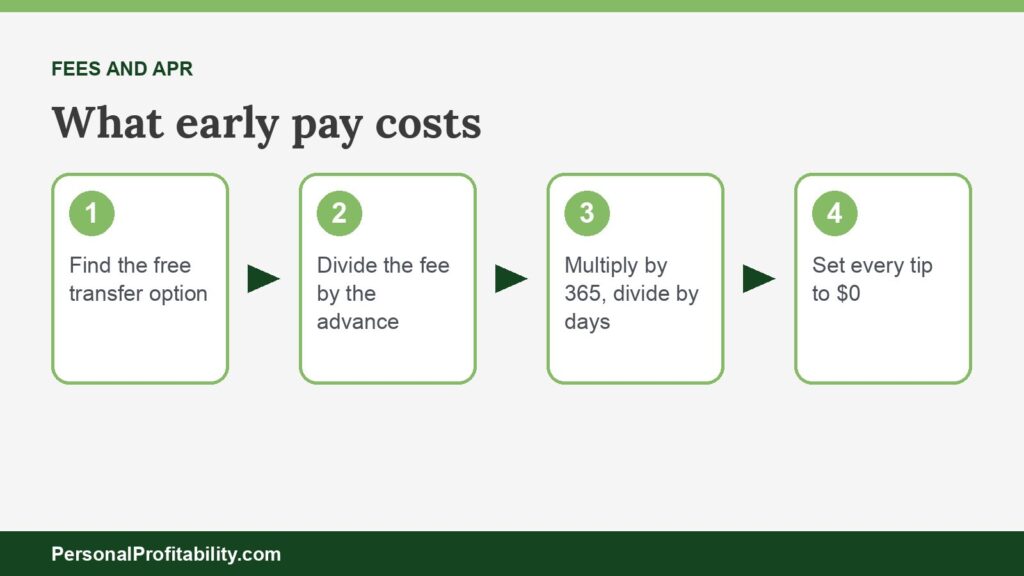
Earned wage access fees run $0 when you wait a day or use the provider’s card, and about $1.99 to $5 when you want money instantly. Learn how the product works in our earned wage access guide.
Eric Rosenberg, who founded Personal Profitability, wrote for Payactiv as a freelancer and later worked there as a marketing manager, until June 2026. Nobody at Payactiv reviewed this page. We held Payactiv to its own published fees and terms, the same standard we used for every other company here.
Personal Profitability may earn a commission from partner links on this page, at no cost to you. Partners don’t decide what we recommend or where it ranks. Fees and terms are each company’s as of 2026-10-24. Confirm them on the company’s site before you sign up.
Facts verified 2026-10-24. A few dollars sounds small. But a $3.49 fee on a $100 advance you repay in a week works out to a 182% APR. And the CFPB found the average worker used EWA 27 times a year. Below you’ll find every provider’s published fee and the APR math. You’ll also find the free path at each company.
Key takeaways
Most EWA products let you reach earned wages early for free if you can wait a day, and the fees start when you want cash in your bank account right now.
- Employer-linked apps charge $1.99 to $5 for instant delivery and $0 for standard delivery or a transfer to their own card.
- Cash advance apps that work without your employer often add a monthly subscription, and some ask for tips.
- A $3.49 fee on $100 repaid in seven days equals a 182% APR. The same fee over 14 days equals 91%.
- At the CFPB’s averages, a typical user pays about $86 a year.
- Repayment comes out of your next paycheck at employer apps. Cash advance apps debit your bank account on payday instead.
Spend less, earn more and grow your wealth
Get my free 2026 Playbook with a checklist for your budget, credit, investing and side income, plus the free 7-day Bootcamp.
Earned wage access fees by provider: employer apps
Employer-linked EWA apps don’t charge subscriptions, and each one offers a free option. So the instant transfer charge is usually the only fee employees face.
| Provider | Free path | Instant fee | Subscription | Tips | Access cap |
|---|---|---|---|---|---|
| DailyPay | Next-business-day ACH, or the DailyPay Card with direct deposit | $1.99–$3.99 in its Program Terms, $3.49 on its fees page. Set by your employer | None listed | None listed | 100% of available pay, $1,000 a day |
| Payactiv | ACH in 1–3 days, or its Visa card with $200+ direct deposit each pay period | $2.49 to its card without that deposit. $3.49 to other cards, Venmo, PayPal, or Walmart cash pickup | None | “Never any tips” | “A portion,” up to 50% and $500 a pay period in most cases |
| UKG Wallet (Payactiv-powered) | Bank transfer in 1–3 days, or the UKG Visa card with $200+ direct deposit | $2.49 or $3.49, same as Payactiv | None | None listed | Not published |
| ZayZoon | ZayZoon Visa card or gift cards | Up to $5. Connecticut $4 | None | None listed | $200 per payout in a 2024 help article |
| Branch | Instant to Branch Wallet, or ACH in 3–5 days | $2.99–$4.99 by amount. 1099 accounts 2%, $2.99 minimum | None listed | None listed | 50% of projected pay, $1,000 a period |
| Rain | Bank ACH in 1–3 days | “Small fee,” amount not published | None listed | None listed | 50% of current-period pay |
| Tapcheck | Gift cards through Prizeout only | “One flat ATM-like fee,” amount not published | None listed | None listed | 70% of net pay |
| Clair in Gusto | Standard in 2–3 business days | $4.50 to Gusto Spending, $4.99 to a debit card | None listed | None listed | $800 a period to Gusto Spending |
| Clair in QuickBooks | Standard in 1–3 business days | Up to $4.99 | None listed | None listed | Based on payroll data |
| Chime Enterprise | Instant to a Chime account | None advertised | None listed | None listed | Not published |
| OnePay @Work | Every option, and instant if your employer sets it up | “Small fee” if not configured | None listed | None listed | “Part of your net earnings” |
| Stream | Standard in 1–3 business days | “Small flat convenience fee” | None listed | None listed | 50% of earnings |
| Immediate | Next-day ACH, paycard, merchant cards | “One flat, nominal fee” | None listed | None listed | Not published |
Fees and terms verified 2026-10-24. “None listed” means we found no subscription or tip on the company’s pages. Sources: DailyPay, Payactiv, ZayZoon, Branch, Rain, Tapcheck, Gusto, and each company’s own help pages. Employers choosing a provider can compare these in our best earned wage access providers roundup.
DailyPay publishes two different numbers. Its June 3, 2026 Program Terms list a $1.99 to $3.99 instant fee, and its employee fees page says $3.49. Both say your employer’s contract sets the fee. Our DailyPay review and Payactiv review cover each fee schedule line by line.
Fees at cash advance apps and other direct-to-consumer EWA products
Apps that work without your employer cost more. Many add a monthly subscription and an instant fee, and some ask for tips on top. These cash advance apps estimate your paycheck from your bank account, then debit the advance on payday.
| App | Free path | Instant fee | Subscription | Tips | Advertised max |
|---|---|---|---|---|---|
| EarnIn | Standard in 1–2 business days | Lightning Speed from $3.99, varies by state | None | Optional | $200 a day, $1,000 a pay period |
| Brigit | Advance by emailing support, no subscription | “Small fee” on Plus, free on Premium | $8.99 Plus, $15.99 Premium | None listed | $25–$500 |
| Dave ExtraCash | None. Every ExtraCash carries a 5% overdraft fee ($5 minimum, $15 maximum) | Free to Dave Checking. 1.5% more to an outside debit card | Up to $5 a month | None found | $25–$500 |
| MoneyLion Instacash | Standard to MoneyLion Spend | Turbo 7.5% to Spend (cap $14.99), 9% to an outside account | Optional | Optional | $500, up to $1,000 |
| Chime MyPay | Scheduled advance within 24 hours | 3%, $2 minimum, $5 maximum | None | None listed | Up to $750 advertised |
| Cleo | Standard in 3–4 days | $4.49–$14.99 | $5.99–$14.99 | None listed | $20–$250, up to $500 |
| Klover | Standard in 2–5 business days | Up to $3.99 on $25, up to $37.49 on $750 | $4.99 optional | None listed | $750 |
| Albert | Advance lands in Albert Cash free. ACH out in 2–3 days | Greater of $5.99 or 1.75%, cap $25 | Not required | None listed | $25–$1,000 |
| FloatMe | Standard Float (fee not listed) | $1 on $10 up to $10 on $200 | $6.99, not required | None listed | $200 |
| Tilt (formerly Empower) | Not stated | In Tilt’s terms, not on its site | $8 a month after a 14-day trial | None listed | $10–$500 |
| Varo Advance | None, every advance has a flat fee | $1.60 on $20 up to $100 on $500 | None | None listed | $250, up to $700 |
Fees and terms verified 2026-10-24. Chime calls MyPay “a line of credit,” and Varo calls its advance “a small dollar line of credit.” Dave structures ExtraCash as an overdraft. Treat all three as credit, not EWA. EarnIn’s fee table changes by state: Indiana and Florida pay 5% with a $3.99 minimum, and Colorado and Wisconsin pay $4.99 to $9.99. Our EarnIn review walks through each state, and our best earned wage access apps list ranks the whole field.
How to calculate the APR on an earned wage access fee
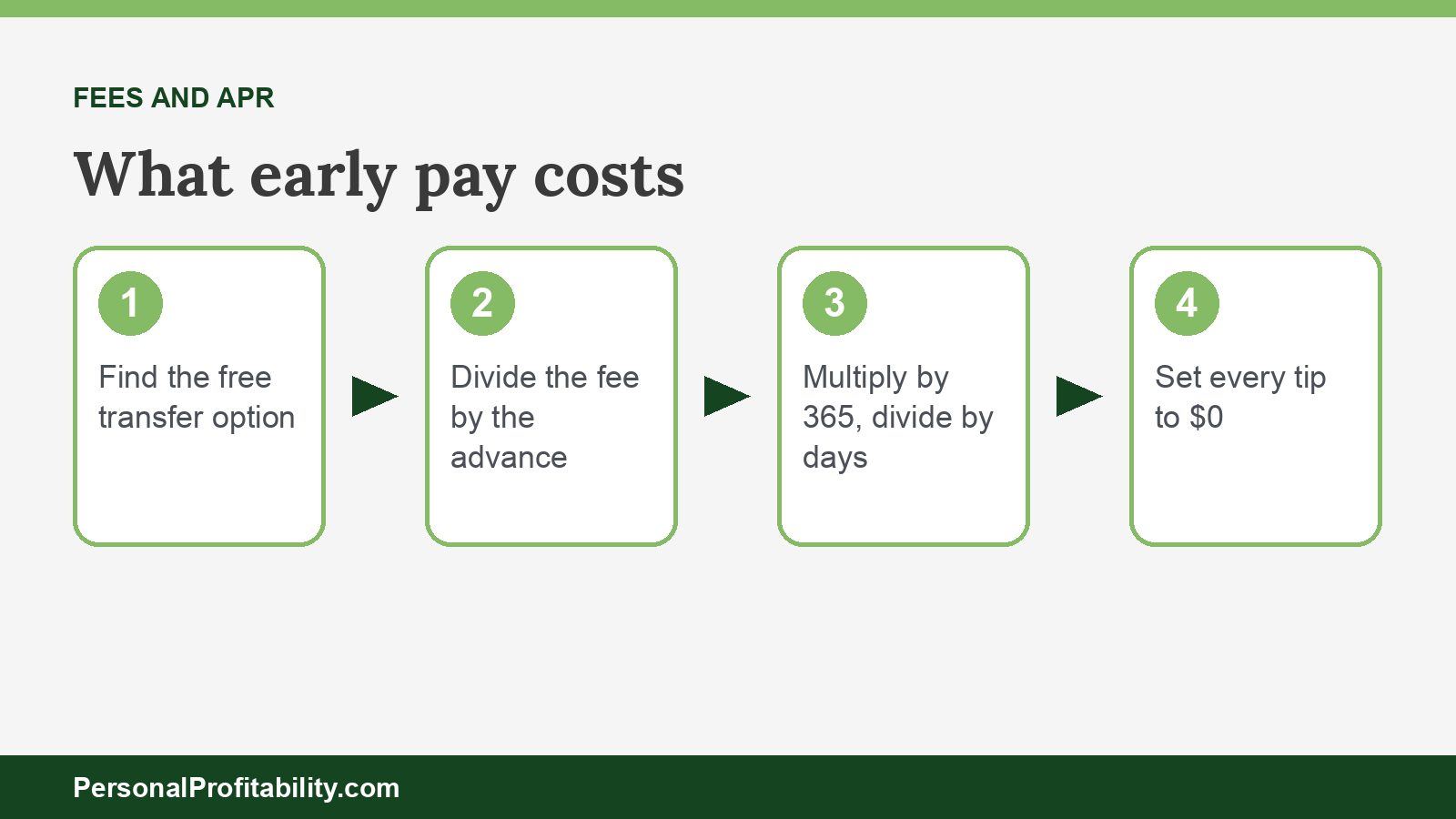
You find the APR equivalent by dividing the fee by the advance, scaling that to a year, and multiplying by 100.
APR = fee ÷ amount × 365 ÷ days × 100
“Days” means the days between the advance and the payday that repays it. Take a $3.49 fee on $100 repaid in seven days: 3.49 ÷ 100 = 0.0349. Then 0.0349 × 365 ÷ 7 = 1.82. Multiply by 100 and you get 182%. Federal Truth in Lending rules treat covered EWA as something other than credit, so providers don’t have to show you an APR. The math still tells you what the money costs.
| Fee | Advance | Days to payday | APR equivalent | Where the example comes from |
|---|---|---|---|---|
| $3.49 | $100 | 7 | 182.0% | DailyPay and Payactiv’s $3.49 tier |
| $3.49 | $100 | 14 | 91.0% | Same fee, two weeks out |
| $2.49 | $100 | 7 | 129.8% | Payactiv card without direct deposit |
| $4.99 | $50 | 7 | 520.4% | Clair’s instant fee on a small draw |
| $4.99 | $50 | 14 | 260.2% | Same fee, two weeks out |
| $4.99 | $200 | 14 | 65.0% | Bigger draw, same fee |
| $5.00 | $100 | 7 | 260.7% | ZayZoon’s maximum |
| $3.18 | $106 | 10 | 109.5% | CFPB’s average fee and advance |
| $3.18 | $50 | 4 | 580.4% | CFPB’s small-draw example |
| $2.99 | $20 | 7 | 779.5% | New York AG’s DailyPay example |
Two patterns jump out. A flat fee hurts most on small advances, and it hurts more the closer you are to payday. A $4.99 fee on $200 two weeks out costs 65% APR, while the same fee on $50 a week out costs 520%. The CFPB’s own 2024 data spotlight computed the 109.5% and 580.4% figures in the table. It also warned that the average-based 109.5% “understates APRs for smaller transactions with shorter terms.”
What earned wage access fees cost in a year
An average EWA user pays about $86 a year in fees, based on the CFPB’s figures of 27 transactions a year and a $3.18 average fee when a fee applied.
| How often you pay for instant access | Fee per use | Uses a year | Yearly cost |
|---|---|---|---|
| CFPB average user | $3.18 | 27 | $85.86 |
| CFPB average, counting free transfers | $2.60 | 27 | $70.20 |
| Every biweekly pay period | $3.49 | 26 | $90.74 |
| Every week | $3.49 | 52 | $181.48 |
| Never, using the free path | $0 | Any | $0 |
The $2.60 figure is the CFPB’s average across all employer-partnered transactions, including free ones. Those data cover 2021 and 2022. By 2022, 47.9% of workers used EWA at least monthly. About 90% of workers paid at least one fee, and expedite fees made up 96.6% of the fees workers paid.
Heavy users pay far more. New York Attorney General Letitia James’s April 2025 suit against DailyPay describes a Washington Heights worker who paid nearly $1,400 in fees. That worker took more than 450 advances in under two years. The AG says DailyPay’s most common advance is $20 for seven days with a $2.99 fee, which the AG puts at over 750% APR. Our math above gets 779.5%. DailyPay disputes that its product is a loan, and the case had no ruling as of October 2026.
Maryland’s 2024 market inquiry found Marylanders paid more than $35 million in fees on 5.5 million EWA transactions from 2019 to 2024, per the Maryland Department of Labor. That’s more than $6 a transaction.
How do earned wage access companies make money?
EWA companies earn most of their money from instant transfer fees. After that come card interchange, employer payments, subscriptions or tips at consumer apps, and the cash they hold along the way.
- Instant fees. The CFPB found 96.6% of consumer-paid fee revenue at employer-partnered providers came from expedited transfers. That’s why most free paths take a day or more.
- Interchange on their cards. Every time you swipe a provider’s debit or prepaid card, the merchant pays a fee. The CFPB says EWA firms “typically earn a percentage of interchange fee revenue from these cards.” That helps explain why Payactiv, DailyPay, ZayZoon, and Branch waive instant fees when you use their card or wallet.
- Card fees. DailyPay’s card charges $2.50 at an out-of-network ATM and $3.99 to move money out instantly. Branch charges $2.00 per ATM withdrawal after eight free in-network ones a month and up to $5.00 a month after 12 months of inactivity.
- Employer fees. Employers covered less than 5% of total fees in the CFPB’s data. ZayZoon’s terms let an employer pay workers’ fees. Payroll platforms that offer Clair earn “a share of every advance.”
- Subscriptions and tips. Consumer apps lean on these. Brigit charges $8.99 or $15.99 a month. California’s DFPI found that tip-based EWA companies collected a tip 73% of the time across 5.8 million tip-based transactions in 2021, at an average of $4.09.
- Float. DailyPay’s model sends your full net pay to a DailyPay account first, then forwards what’s left on payday. Any provider that holds money between payroll and payout can earn interest on it, though none we checked publishes float income.
How to pay $0 for earned wage access
You pay $0 by picking the slower transfer or by sending the money to the provider’s own card or wallet. Never tip.
- Plan one day ahead. DailyPay’s next-business-day ACH, Payactiv’s 1–3 day ACH, Rain’s ACH, and Clair’s standard transfer all cost $0.
- Use the house card if you’ll use it anyway. Payactiv’s real-time transfer to its Visa card is free with $200 or more of direct deposit per pay period. DailyPay waives instant fees to the DailyPay Card with direct deposit. Branch Wallet and the ZayZoon Visa card are free too.
- Check whether your employer pays. OnePay @Work makes instant free when your employer configures it, and ZayZoon lets employers cover fees.
- Set every tip to $0. Tips are fees with better marketing. Maryland banned EWA tips on October 1, 2026, and EarnIn dropped tips in Colorado and Wisconsin in July 2025.
- Skip subscriptions. FloatMe and Albert let you advance without one, and Brigit gives a free advance if you email its support team.
If you’re paying for speed every pay period, the problem is the budget, not the app. A starter emergency fund of a few hundred dollars ends the fees for good. Our guide to budgeting with irregular income helps when your hours swing.
EWA fees vs overdraft fees vs payday loans
A $3.49 instant EWA fee costs far less than a $35 overdraft fee or a typical payday loan, but a free transfer beats all three.
| Option for a $100 gap | Typical cost | Repaid in | APR equivalent |
|---|---|---|---|
| EWA free path | $0 | Next payday | 0% |
| EWA instant transfer | $3.49 | 7 days | 182.0% |
| Payday loan | $15 per $100 | 14 days | 391.1% |
| Overdraft fee | $35 median at large banks | 7 days | 1,825.0% |
The CFPB says payday lenders typically charge $10 to $30 per $100 borrowed, that $15 per $100 is common, and that $15 on a two-week loan equals an APR of almost 400%. The CFPB’s December 2023 overdraft report put the median overdraft fee at $35 for banks and credit unions with more than $10 billion in assets. A $35 fee on a $100 shortfall you cover in a week works out to 1,825%.
So paying $3.49 to dodge a $35 overdraft is the cheaper move that week. Doing it 26 times a year isn’t. If an overdraft already hit you, try our steps to get overdraft fees refunded. Then read earned wage access vs payday loan before you borrow from a storefront lender.
State caps on earned wage access fees
Connecticut, Maryland, and Wisconsin cap EWA fees in dollars, and several other states require a free option without setting a dollar limit.
- Connecticut: Public Act 25-155 caps finance charges on advances under $750 at $4 per advance and $30 a month, effective October 1, 2025. That’s why ZayZoon charges Connecticut workers $4.
- Maryland: Commercial Law 12-1505 caps delivery or expedite fees at $5.00 for advances of $75 or less and $7.50 above $75, effective October 1, 2025. SB 94 banned tips starting October 1, 2026.
- Wisconsin: 2025 Act 199 caps fees at $5 for advances of $75 or less and $7.50 above $75, effective April 5, 2026, and Wisconsin also requires a no-cost option.
- Kansas bars “an unreasonable fee” for expedited delivery. South Carolina, Arkansas, and Louisiana require at least one no-cost option.
See every state’s rules in our earned wage access laws by state tracker, and the federal side in is earned wage access a loan.
Earned wage access fees FAQ
Conclusion: the cheapest transfer is the one you planned
Earned wage access fees look small and add up fast. At the CFPB’s averages, a typical user pays about $86 a year, and a $3.49 fee on a one-week $100 advance carries a 182% APR. Every employer-linked provider in our table offers a $0 path, so plan a day ahead, use the provider’s card only if you’d use it anyway, and set tips to $0. Then put the money you save toward a buffer, so payday stops being an emergency.
Free guide
Spend less, earn more and grow your wealth
Get my free 2026 Playbook with a checklist for your budget, credit, investing and side income, plus the free 7-day Bootcamp.
- Track your money with the tools that still work in 2026
- The order to invest in, with the 2026 401(k) and IRA limits
- Three ways to earn your first $100 on the side this month
Bonus: The 7-day Personal Profitability Bootcamp, one short lesson in your inbox each day