
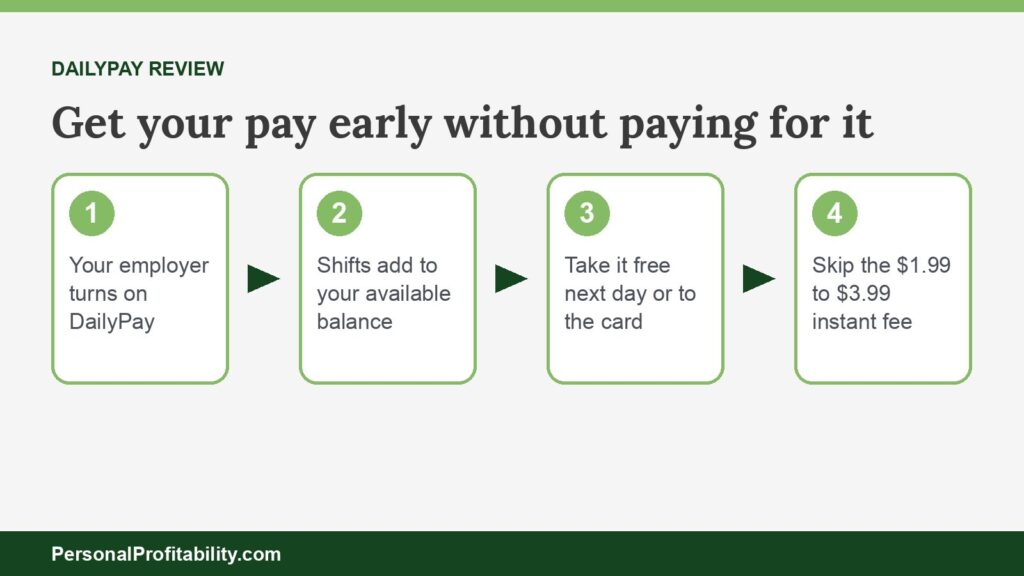
This DailyPay review comes down to one rule: DailyPay costs you nothing if you wait a business day or send pay to its own card, and $1.99 to $3.99 a transfer if you want the cash in your bank right now. Your employer has to offer DailyPay, and your employer’s contract sets the instant fee. Use it to close a short gap before payday. If you reach for it every pay period, work on the budget or a small cash buffer first. For the bigger picture, start with our guide to earned wage access.
Eric Rosenberg, who founded Personal Profitability, wrote for Payactiv as a freelancer and later worked there as a marketing manager, until June 2026. Nobody at Payactiv reviewed this page. We held Payactiv to its own published fees and terms, the same standard we used for every other company here.
Personal Profitability may earn a commission from partner links on this page, at no cost to you. Partners don’t decide what we recommend or where it ranks. Fees and terms are each company’s as of 2026-10-24. Confirm them on the company’s site before you sign up.
DailyPay review: the key numbers
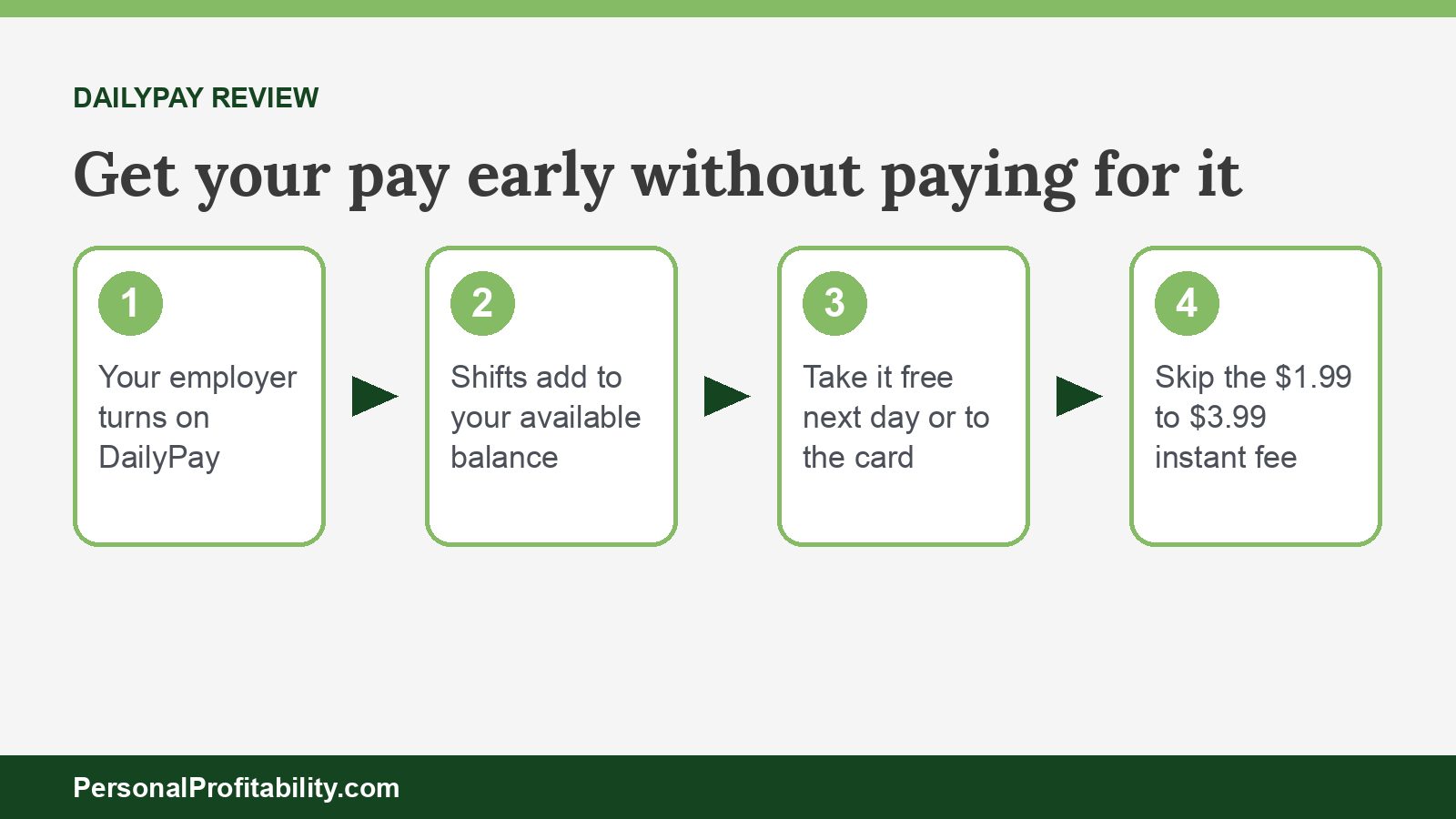
DailyPay gives you free next-day transfers, free instant transfers to its own card, and a paid instant transfer to your bank that your employer prices. Every number in this DailyPay review comes from DailyPay’s own fee page, FAQ, and Program Terms.
| Item | DailyPay |
|---|---|
| Free transfer | $0 by ACH, next business day (its fee page says 1–3 business days) |
| Free instant transfer | $0 to a DailyPay Card set up with direct deposit |
| Instant fee to your bank | $1.99–$3.99 in the Program Terms, $3.49 flat on the Our Fees page, set by your employer’s contract |
| How much you can take | Up to 100% of the available balance in the app |
| Daily limit | $1,000 a day, or $1,500 a day to the DailyPay Card, up to five transfers a day |
| Subscription or tips | None listed |
| Card | DailyPay Visa Prepaid Card from The Bancorp Bank, no monthly fee |
| Credit check | None for the card (DailyPay verifies your ID) |
| Cost to employers | “No cost,” with no price published |
| Integrations | 180+ HR, payroll, and time systems, including Workday, SAP, ADP, and Oracle |
| Licenses | Nevada EWA00004, Wisconsin 2587396EWA, NMLS 2587396 |
| App ratings | 4.8 on the App Store (508,616 ratings), 4.7 on Google Play, as of October 2026 |
| Legal | New York AG lawsuit filed April 14, 2025, still pending, no ruling found. |
We verified every fee and term in this DailyPay review on 2026-10-24.
Spend less, earn more and grow your wealth
Get my free 2026 Playbook with a checklist for your budget, credit, investing and side income, plus the free 7-day Bootcamp.
What you get: how DailyPay works
DailyPay lets you move pay you’ve already earned out of your next paycheck and into your account before payday. Your employer connects its payroll and timekeeping systems to DailyPay. Each time your employer confirms a completed shift and DailyPay processes it, your balance grows.
The available balance
DailyPay calls the number in the app your available earnings. DailyPay figures it “after accounting for taxes, deductions, and your employer’s settings.” You can transfer up to 100% of that number. The catch sits in the last part of that quote. Your employer decides how much of your gross pay shows up as available, and neither DailyPay nor most employers publish that setting. So a $1,000 week of work might show far less than $1,000 in the app. Ask HR what share your company releases.
What happens on payday
After your first transfer, your direct deposit routes to DailyPay. Your employer sends your whole net paycheck to a DailyPay account. DailyPay keeps what you already took plus any instant fees, then sends the rest (it calls this Remainder Pay) directly to your primary bank account or linked debit card on your regular payday. Your bank may show the deposit coming from Wells Fargo or PNC, DailyPay’s partner banks. Our guide to the earned wage access deduction explains how that line reads on a paystub.
DailyPay’s Program Terms call the arrangement non-recourse. If your employer never pays DailyPay, “you will owe us nothing.” DailyPay says it won’t send you to collections, report you to a credit bureau, or sell the balance to a debt buyer. One exception: if a technical error overpays you by $20 or less, DailyPay can take it back from your next paycheck.
The DailyPay Card (once called Friday)
DailyPay launched its prepaid card and app as Friday on September 7, 2022, then renamed it the DailyPay Visa Prepaid Card. The Bancorp Bank issues the card. The card is the key to free instant pay: DailyPay waives its On-Demand Pay fee on every transfer to a DailyPay Card set up with direct deposit. The card also raises your daily limit from $1,000 to $1,500.
| DailyPay Card fee | Amount |
|---|---|
| Monthly fee | $0 |
| In-network (Allpoint) ATM withdrawal | $0 |
| Out-of-network ATM withdrawal | $2.50 |
| Cash reload at Green Dot | $5.95 |
| Allpoint+ ATM cash load | $1.99 |
| Instant transfer out of the card | $3.99 |
| Foreign transaction | 3% |
| Replacement card / express shipping | $0 / $25 |
| Inactivity fee | $0 |
Watch the $3.99 line. If you take a free instant transfer to the card and then push the money to your bank instantly, you pay $3.99 and lose the free path. Spend from the card, or use a standard bank transfer out, which DailyPay lists at $0.
Other features
- Cycle: off-cycle pay your employer can send outside the normal schedule.
- Tips: digital tip payouts for restaurant and hospitality workers.
- Perks and Reward: discounts and cash back.
- Bill Manager and a savings balance inside the app.
- Financial counseling from a third party, plus pay planning tools, all listed at $0.
What it costs, and the catch
DailyPay costs $0 on the slow path and on its card, and a flat instant fee anywhere else. DailyPay charges no subscription and asks for no tips. The instant fee is the only cost most users ever see, and DailyPay publishes two different versions of it.
Two fee pages, two answers
DailyPay’s Program Terms (last updated June 3, 2026) list a next-business-day ACH transfer at $0.00 and an instant transfer at $1.99 to $3.99, and say “instant transfer fees vary by employer.” On its Our Fees page, DailyPay shows $3.49 flat for instant access and gives the free transfer 1–3 business days. DailyPay’s FAQ says your employer’s contract sets the fee and that DailyPay always charges it as a flat amount, never a percentage. So $3.49 is the typical number (DailyPay itself calls $3.49 its “typical fee” in its press release on the New York case), and your employer may land anywhere from $1.99 to $3.99. Check the fee in the app before you tap confirm.
The APR math on a flat fee
A flat fee looks small until you annualize it. DailyPay charges no interest, so you won’t find an APR on any DailyPay disclosure. Regulators use this yardstick to compare a fee against a loan. The formula: fee divided by the amount, times 365, divided by the days until payday.
| Instant fee | $100 for 7 days | $106 for 10 days | 27 uses a year |
|---|---|---|---|
| $1.99 | 104% | 69% | $53.73 |
| $3.49 | 182% | 120% | $94.23 |
| $3.99 | 208% | 137% | $107.73 |
| $0 (next day or DailyPay Card) | 0% | 0% | $0 |
The $106 and 27-use columns come from the CFPB’s July 2024 Data Spotlight on employer-partnered earned wage access. The CFPB found the average transfer ran $106, the average fee (when workers paid one) ran $3.18, and the average worker made 27 transfers a year. At $3.18 a pop, that worker spent $85.86 a year to see each paycheck a few days early. The CFPB also found nearly all workers paid a fee for expedited access. That’s the habit to break. A $3.49 fee is far cheaper than a $35 overdraft, but $0 beats both. Our earned wage access fees guide runs the same math for every major provider.
Daily limits
DailyPay caps transfers at $1,000 a day, or $1,500 a day to the DailyPay Card, with up to five transfers a day. State law can also limit the amount and the speed options, according to the Program Terms. Most hourly workers will hit the employer’s available-balance setting long before they hit $1,000.
Is DailyPay legit? The New York lawsuit and DailyPay’s countersuit
DailyPay is a licensed, established company, and New York’s attorney general is suing it, alleging its transfers are illegal payday loans. Both things are true at once, and no court has ruled on the merits as of October 24, 2026.
- April 7, 2025: DailyPay sued first. In DailyPay LLC v. James in federal court in Manhattan, DailyPay asked a judge to declare that its service “is not a loan and therefore not subject to usury laws.”
- April 14, 2025: Attorney General Letitia James sued DailyPay (and, separately, MoneyLion), alleging violations of New York usury and wage assignment laws. The AG says DailyPay’s most common transfer is a seven-day, $20 advance with a $2.99 fee, which the AG puts at over 750% APR. The AG also says DailyPay collects fees on about 90 percent of its advances. The state wants the practice stopped in New York, plus restitution and civil penalties.
- September 2025: A federal judge sent the AG’s case back to New York state court, according to Payments Dive.
- January to April 2026: DailyPay moved to dismiss in January, and briefing closed in April, per Payments Dive. We found no ruling.
Federal regulators have moved the other way. On December 23, 2025, the CFPB published an advisory opinion saying “Covered EWA” is not credit under the federal Truth in Lending Act. Covered EWA caps each transfer at accrued wages, collects through payroll, gives the provider no claim against the worker, and skips credit checks. The CFPB named no company, and its opinion covers federal law only. New York’s case rests on state usury law. Our explainer on whether earned wage access is a loan walks through both sides, and the earned wage access laws tracker shows where each state stands.
User DailyPay reviews run high, at 4.8 on the App Store from 508,616 ratings and 4.7 on Google Play as of October 2026. On security, DailyPay says it uses 256-bit encryption and follows SOC 2 compliance standards. DailyPay also says more than 6 million employees have had access to DailyPay through their jobs. On licensing, DailyPay holds an earned wage access license in Nevada (EWA00004) and Wisconsin (2587396EWA), registers with NMLS (2587396), and says more than 2,000 companies offer it. DailyPay itself is not a bank and not FDIC-insured. Money on the DailyPay Card sits at The Bancorp Bank, and FDIC coverage there protects you only if that bank fails.
The employer side: cost and integrations
Employers offer DailyPay as a financial wellness benefit, so employees can reach earned wages before payday. DailyPay tells employers it modernizes payroll “with no cost or disruption to your business,” and it publishes no employer price. That wording matters to you as a worker. If the employer pays nothing, the instant fees you pay fund the service, and the employer’s contract decides where in the $1.99 to $3.99 range your fee lands.
- Integrations: DailyPay says its platform connects to 180+ HR, payroll, and time management software systems, and names Workday, SAP, ADP, and Oracle.
- Workday: Workday named DailyPay its strategic on-demand pay partner for the US and Canada on August 19, 2025.
- ADP: ADP lists DailyPay on its Marketplace. Its DailyPay Preferred for Wisely version gives one no-fee instant transfer a week when your direct deposit goes to a Wisely card, then $3.49 for extra instant transfers and $0 for next-business-day ACH.
- Funding: DailyPay funds the transfers itself. It lists $960 million in borrowing capacity for 2026.
Employers on DailyPay’s homepage include Waste Management, Goodwill, Tractor Supply, Dollar Tree, Lidl, and HCA Healthcare. If you run payroll and want to compare vendors, our list of the best earned wage access providers covers employer pricing and setup.
Who it’s for, and who should skip it
DailyPay suits an hourly worker whose employer offers it, who needs cash a few times a year, and who will wait a day or use the DailyPay Card to keep the cost at $0.
DailyPay review: pros and cons
| Pros | Cons |
|---|---|
| Two $0 paths: next-day ACH and the DailyPay Card | Instant fee to your bank of $1.99 to $3.99 per transfer |
| Up to 100% of your available balance | Your employer sets the available balance and doesn’t publish it |
| Collects through payroll, with no recourse against you | Your direct deposit routes through DailyPay |
| No tips, subscription, or credit check | Two DailyPay pages list different instant fees |
| Fast instant transfers, even on weekends | New York lawsuit still pending |
DailyPay fits you if
- A car repair or a stack of bills lands three days before payday, and next-day money solves it.
- You’ll set up the DailyPay Card with direct deposit and spend from it.
- You want an employer-integrated option that collects through payroll, not one that debits your bank account on payday.
Skip it if
- You’d use it every pay period. At 27 transfers a year, a $3.49 fee costs $94.23. Steady use points to a budget gap, and our beginner’s guide to budgeting will do more for you than any app.
- You always need the money in your bank this minute. You’ll pay the instant fee every time.
- You count on a bank’s direct deposit bonus or early-pay feature. Your remaining pay arrives through DailyPay’s partner bank. Ask your bank whether that deposit still qualifies.
- Your employer doesn’t offer DailyPay. You can’t sign up on your own. See our best earned wage access apps instead.
How DailyPay compares
DailyPay offers the highest published access cap among the big employer-integrated providers, with an instant fee in the middle of the pack. This DailyPay review lines it up against four rivals on the numbers each company publishes. Cash advance apps like Dave and Brigit lend against your bank deposits, while DailyPay works through your employer’s payroll, so we left those out of the table.
| Provider | Free path | Instant fee | Access cap |
|---|---|---|---|
| DailyPay | Next-day ACH, DailyPay Card | $1.99–$3.99 ($3.49 typical) | 100% of available balance, $1,000 a day |
| Payactiv | ACH in 1–3 days, Payactiv Card with $200+ direct deposit | $2.49 to its card, $3.49 elsewhere | “A portion,” up to 50% and $500 a pay period in most cases |
| Branch | Branch Wallet, ACH in 3–5 days | $2.99–$4.99 (W-2) | 50% of projected wages, $1,000 a pay period |
| Rain | ACH in 1–3 days | “Small fee,” amount not published | 50% of current-period earnings |
| EarnIn (no employer needed) | Standard in 1–2 days | From $3.99 | $200 a day, $1,000 a pay period |
Your employer picks the provider, so most readers won’t choose between these. If your job offers both, our Payactiv vs DailyPay comparison breaks down fees, limits, and cards side by side, and our Payactiv review covers its catches. EarnIn works without an employer, but EarnIn pulls repayment from your bank account on payday, and you can overdraft if the timing slips. Our EarnIn review and our roundup of apps like Payactiv cover the options if your employer offers nothing. If you’re leaving a DailyPay employer, you can compare eight alternatives in our guide to apps like DailyPay.
The Personal Profitability test
DailyPay passes four of our six checks and gets partial credit on the other two. For this DailyPay review, we judged DailyPay by its published terms and skipped its marketing claims.
| Check | Result | Why |
|---|---|---|
| Is there a $0 path? | Pass | Next-business-day ACH and the DailyPay Card both cost $0. |
| No tips, no subscription? | Pass | DailyPay lists neither. |
| Repaid through payroll, with no recourse? | Pass | Program Terms say you owe nothing if your employer doesn’t pay. |
| Employer-integrated? | Pass | Only employers can offer it. |
| One clear, published fee? | Partial | Two pages give two answers, and the employer sets the final number. |
| Clear access limit? | Partial | 100% of an available balance your employer sets and doesn’t publish. |
The pending New York case doesn’t change the score, but it’s worth watching. If New York wins, DailyPay’s fee model in that state could change.
How to sign up for DailyPay
You sign up through your employer, and DailyPay charges nothing to open an account. If you get stuck, DailyPay lists customer support at no cost.
- Ask payroll or HR whether your company offers DailyPay, and what share of your earnings it makes available.
- Download the DailyPay app or go to get.dailypay.com, then enter your name, email, phone number, and employee ID.
- Check your available balance after your employer confirms your shifts.
- Pick the free path: a next-business-day transfer, or the DailyPay Card set up with direct deposit for free instant transfers.
- Expect your direct deposit to route through DailyPay after your first transfer, with the remainder landing on payday.
Before you take a transfer, keep a starter emergency fund in mind as the end goal. Even $500 in savings means you’d never pay an instant fee again.
DailyPay review FAQ
DailyPay review: is it worth it?
DailyPay is worth using if your employer offers it and you stick to the free paths. Wait a business day or use the DailyPay Card, and DailyPay costs you $0. Pay $3.49 to your bank once in an emergency, and you’ve still beaten an overdraft fee or a payday loan by a wide margin. Pay it every pay period, and you’re spending about $91 a year to get your own money early.
After this DailyPay review, we’d keep an eye on two items: the gap between DailyPay’s two fee pages, and the New York case. Check the fee in the app before every instant transfer. Then put the next few paychecks toward a small buffer, so DailyPay becomes a backup instead of a habit. Compare it against the field in our guide to the best earned wage access apps, or see how it stacks up against payday lenders in earned wage access vs payday loan.

Free guide
Spend less, earn more and grow your wealth
Get my free 2026 Playbook with a checklist for your budget, credit, investing and side income, plus the free 7-day Bootcamp.
- Track your money with the tools that still work in 2026
- The order to invest in, with the 2026 401(k) and IRA limits
- Three ways to earn your first $100 on the side this month
Bonus: The 7-day Personal Profitability Bootcamp, one short lesson in your inbox each day