
Learning how to budget with irregular income comes down to three moves: build your plan around your lowest normal month, pay yourself a fixed amount from a separate holding account, and set taxes aside before you spend anything. Everything above that baseline goes to a buffer, then to goals. A standard first budget assumes a paycheck that shows up on the same day for the same amount. Freelance, gig, commission, and seasonal income doesn’t, so the plan has to work differently.
Why a regular budget breaks when your income swings
A regular budget fixes every category to a monthly number and assumes the money arrives to fund it. Your landlord charges the same rent after a $7,000 month and after a $2,800 month. The budget fails in the slow month, and you end up charging groceries to a card.
Two habits cause most of the damage. The first is treating a big month as your normal income and raising your spending to match. The second is paying yourself whatever is left in the checking account, which means your own pay swings as hard as your clients’ payments do.
The fix is to separate when money arrives from when you spend it. You collect income in one place, then move a steady amount to your everyday account on a schedule. That’s the same idea behind paying yourself as a business owner, and it works for any lumpy paycheck.
Find your baseline number
Every plan for how to budget with irregular income starts with a baseline, the amount you can count on in a bad month. Pull the last 12 months of income after your tax set-aside and business expenses. Write down the lowest month, the highest month, and the average. Then budget on a number near the low end, not the average.
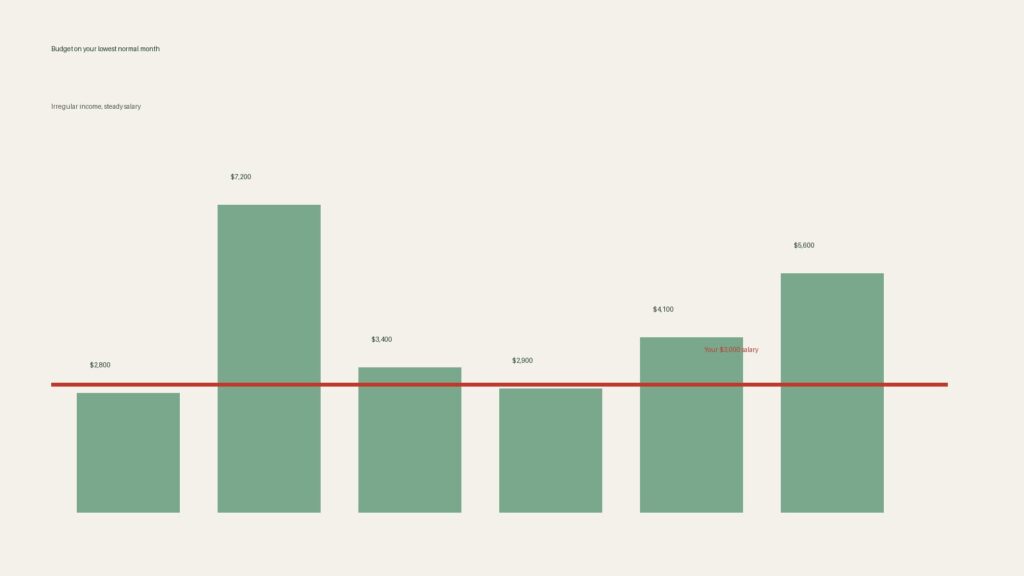
Say your last 12 months ranged from $2,800 to $7,200 and averaged $4,600. A budget built on $4,600 breaks in every month that comes in below it. A budget built on $3,000 works in every month, and the extra income in good months becomes savings instead of a surprise.
If you have less than 12 months of history, use what you have and round down. If your income is brand new, use a conservative guess and revise it after three months of actual results.
Pay yourself a steady salary from a holding account
Open a separate savings or checking account and deposit every payment there first. Then transfer your baseline amount to your everyday checking account on the 1st and 15th, like a paycheck. You pay all your bills from the everyday account.
You get most of the benefit from this one move. Your everyday balance looks like a normal paycheck, so you can budget by category the usual way. You let the holding account take the swings. In a $7,200 month its balance grows, and in a $2,800 month you draw the difference from it.
You don’t need to track every dollar for this to work. Conscious spending beats a rigid line-item budget, and once you pay yourself first and automate the transfer, you only need to watch two numbers: your everyday balance and your holding balance. If you like a stricter system, a zero-based budget works on top of the salary, and the 50/30/20 rule gives you percentages to start from.
This table shows four sample months with a $3,000 monthly salary. The income column is what’s left after the tax set-aside.
| Month | Income after taxes set aside | Salary paid to you | Holding account change |
|---|---|---|---|
| January | $2,800 | $3,000 | -$200 |
| February | $7,200 | $3,000 | +$4,200 |
| March | $3,400 | $3,000 | +$400 |
| April | $2,900 | $3,000 | -$100 |
Those figures are an illustration, not averages for any job. Your salary never moves. Only the holding account balance does.
Set taxes aside before you spend anything
If you earn money without an employer withholding tax, you probably owe estimated taxes. The IRS says individuals, including sole proprietors, generally have to make estimated payments if they expect to owe $1,000 or more when they file their return.
Move a percentage of every payment into a tax account the day it lands. A common starting placeholder is 25 to 30 percent, which is a rule of thumb and not an IRS figure. Check it against your last return, and adjust once you see what you owe. Your own rate depends on your income, deductions, and state.
The IRS sets four due dates for tax year 2026: April 15, June 15, and September 15, 2026, and January 15, 2027. The full walkthrough is in our guide to paying quarterly estimated taxes.
Irregular income has a built-in perk here. In Tax Topic 306, the IRS says most people avoid the underpayment penalty if they pay at least 90% of this year’s tax or 100% of last year’s, whichever is smaller, in four equal amounts. Higher earners face special rules, which Form 1040-ES explains. If your income arrives unevenly, the IRS lets you annualize it and make unequal payments, and you use Form 2210 to figure the penalty. That can lower the penalty when most of your income lands late in the year. A tax professional can tell you whether that fits your situation.
Build a buffer so a slow month stays a slow month
A buffer is the money that keeps your salary steady through a drought. It sits in your holding account and it matters more for irregular earners than for salaried workers. Start with one month of baseline expenses, then work toward three to six months. Our post on emergency funds covers where to keep it.
Build the buffer before you pay extra toward debt. An emergency fund comes first and aggressive payoff second. Without cash on hand, a slow month sends you right back to a credit card, and you never get ahead on the balance.
You can keep the holding account and the buffer in a high-yield savings account, so the money stays liquid and earns interest. Check the current rate on the bank’s own page before you open one, since banks change rates often.
Decide in advance where good-month money goes
Good months are where a plan for irregular income pays off. Without a rule, you spend the extra cash. Write down the order before the money shows up, so you don’t decide on the spot.
| Priority | Where the extra money goes | Why |
|---|---|---|
| 1 | Tax account to your target amount | Taxes come due whether the month was good or bad |
| 2 | Holding account up to one salary month | Covers your next slow month |
| 3 | Buffer toward three to six months of expenses | Protects you from a long drought |
| 4 | Retirement and debt payoff | Moves your long-term money forward |
| 5 | A fixed amount for fun | Keeps the plan livable |
That last line matters. Extreme frugality is a bad plan, because you can only cut spending so far, while your earning potential has no ceiling. A small guilt-free spending amount in good months keeps you from quitting the system after three tight ones.
How to budget with irregular income: a worked example
Take a freelance designer whose last 12 months ran from $2,800 to $7,200 after her tax set-aside. She sets her salary at $3,000, a little above her worst month because her buffer covers the gap. Every client payment lands in the holding account. On the 1st and the 15th, $1,500 moves to checking.
Every payment first sends 28 percent to her tax account. In a month that leaves $7,200 after that transfer, she pays herself $3,000 and sends the $4,200 surplus to the buffer. In a $2,800 month she skips the surplus step and covers the $200 gap from the buffer. Her rent, groceries, and car payment never notice either month. The numbers here are made up to show the mechanics, so replace them with yours.
Common mistakes to avoid
- Budgeting on your best month. One great quarter doesn’t make a new normal. Wait for six months of proof before you raise your salary.
- Skipping the tax account. Spending money you owe the IRS creates a bill you can’t pay in January.
- Mixing business and personal money. A separate account keeps the numbers clean and your records simple at tax time.
- Cutting every fun expense. A plan so tight that you quit it in March doesn’t help anyone. Keep a small fixed amount for spending you enjoy.
- Never revisiting the baseline. Review your lowest month and your salary every quarter, and adjust when your income changes for good.
Tools that make irregular-income budgeting easier
You can run this whole system with two bank accounts and a spreadsheet. Set up an automatic transfer for the salary. Then keep a simple sheet with 12 rows of income and one row for your baseline.
Budgeting apps help if you like dashboards, but pick one that lets you set a monthly amount you control instead of forcing a fixed paycheck date. When clients pay faster, your income swings less, so a good invoicing app can be worth its cost. Getting paid faster is the cheapest way to smooth the swings.
A few other ways to reduce the swings: ask for deposits on projects, set up retainers with repeat clients, and invoice the day you finish the work, not the end of the month.
Frequently asked questions
Conclusion
Learning how to budget with irregular income doesn’t take a complicated system. Budget on your lowest normal month, pay yourself a steady salary from a holding account, set taxes aside first, and decide in advance where the extra goes. Start by pulling your last 12 months of income this week.
For more on the building blocks, read our guides to creating your first budget, emergency funds, and quarterly estimated taxes. You can browse more in the Budgeting category or start from the Personal Profitability homepage.