
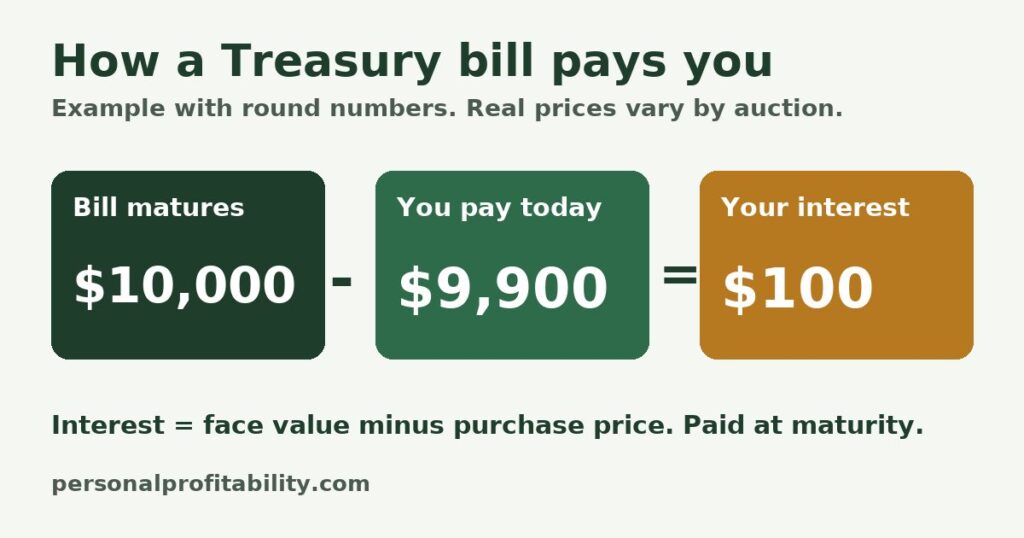
How do treasury bills work? A Treasury bill is a short-term loan to the U.S. government. You pay less than face value today, and the Treasury pays you the full face value when the bill matures in a few weeks or months. The gap between the two is your interest. If you already keep cash in a high-yield savings account, T-bills are another safe place to park money you’ll need soon.
What Is a Treasury Bill?
A Treasury bill, or T-bill, is a government debt security that matures in one year or less. The U.S. Treasury sells bills in terms from four weeks to 52 weeks, according to TreasuryDirect. The standard terms are 4, 6, 8, 13, 17, 26, and 52 weeks.
You don’t get a coupon every six months the way you would on longer Treasury notes and bonds. The Treasury pays you once, at maturity. That makes them simple to plan around. You pick a date you want your cash back and choose the bill that ends close to it.
Bills exist only in electronic form, so no paper certificate shows up in your mailbox. The full backing of the U.S. government stands behind them, which is why many savers treat them as the benchmark for a safe short-term holding. They aren’t bank deposits, so FDIC insurance doesn’t apply. The government’s promise to pay stands in its place.
How Do Treasury Bills Work and Pay Interest?
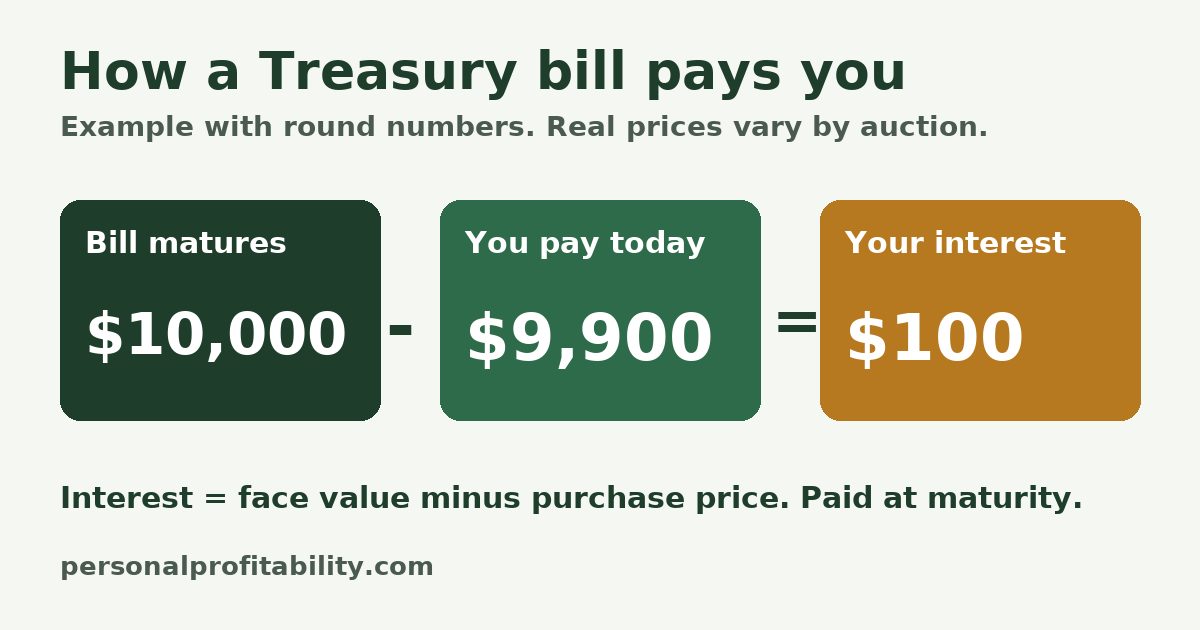
The Treasury pays bill interest as a discount. You buy the bill for less than face value, then collect the full face value at maturity. TreasuryDirect describes the interest as the difference between the price you paid and the face value you receive.
Here is the idea with round numbers. Say you buy a bill with a $10,000 face value for $9,900. When it matures, the Treasury pays you $10,000. Your interest is $100. The prices and rates in this example are made up to show the math. Real prices change at every auction.
| Step | What happens | Example |
|---|---|---|
| Buy | You pay a price below face value | $9,900 |
| Hold | You wait out the term. Nothing arrives in the meantime | 4 to 52 weeks |
| Maturity | The Treasury pays you the full face value | $10,000 |
| Interest | Face value minus the price you paid | $100 |
Bidders at each auction set the price, so your rate depends on the auction where you buy. You can see recent auction results on the TreasuryDirect auctions page. We don’t quote a current rate here because it changes every week.
What Treasury Bill Terms Can You Choose?
You can choose from seven standard terms, and the Treasury auctions most of them every week. TreasuryDirect says it auctions the 4, 6, 8, 13, 17, and 26-week bills weekly and the 52-week bill every four weeks.
| Term | How often the Treasury auctions it |
|---|---|
| 4, 6, 8 weeks | Weekly |
| 13, 17, 26 weeks | Weekly |
| 52 weeks | Every four weeks |
Match the term to your goal. A four-week or eight-week bill suits cash you need for a known bill, like a tax payment or a closing cost. A 26-week or 52-week bill suits money you can leave alone for longer. Shorter terms let you reinvest sooner at whatever rates the market offers then. Longer terms lock in today’s rate for more months.
How Do You Buy a Treasury Bill?
You can buy a Treasury bill straight from the government through TreasuryDirect, or through a bank or broker. To buy direct, you need a TreasuryDirect account, and the Treasury takes only noncompetitive bids there. That means you accept whatever rate the auction sets, and you get the full amount you ask for, up to the limit.
- Open a TreasuryDirect account. You link a bank account to fund purchases.
- Pick the bill and the amount. The minimum is $100, and you can add more in $100 steps.
- Bid before the auction closes. The Treasury lists the cutoff time in each auction announcement, so check it for the bill you want.
- Wait for the auction to settle. The Treasury puts the bill in your account and pays you the full face value at maturity.
Expect a $100 floor and $100 steps. The most you can buy in one noncompetitive bid is $10 million. For most households, that ceiling never comes up.
A broker works too. Many brokers sell new-issue bills at auction and existing bills on the secondary market. Check what your broker charges before you buy, because fees vary. If you want to compare, our guide to buying and selling funds covers how investing accounts handle trades.
How Are Treasury Bills Taxed?
The federal government taxes Treasury bill interest, and your state and local governments do not. TreasuryDirect states that bill interest faces federal tax, with no state or local income tax. States with an income tax generally tax bank-account interest, so this exemption matters most in a high-tax state.
Tax reporting works like this. TreasuryDirect posts a Form 1099-INT in your account at the start of each year, and it reports bill interest in Box 3, not Box 1. If your state asks you to subtract U.S. government interest, you subtract that Box 3 amount on your state return. Check your state’s instructions for the exact line. The IRS explains how interest income works in Tax Topic 403.
You report the interest for the year the bill matures, not the year you buy it. A 52-week bill you buy in November and hold to the next November puts all its interest on next year’s return.
Can You Sell a Treasury Bill Before It Matures?
Yes, you can sell a bill before maturity, but you may get less than you would by waiting. TreasuryDirect doesn’t sell bills for you. You transfer the bill to a bank or broker, and that firm sells it. TreasuryDirect also makes you hold any security you buy there for 45 days before you can transfer it, so you can’t sell a 4-week bill from that account early at all.
The sale price depends on what rates have done since you bought. If rates rose, buyers will pay less for your bill. If rates fell, they’ll pay more. If you think you might sell early, buy through a broker so you skip the transfer.
Because of that, only put money in a bill that you can leave alone until maturity. Emergency money still belongs somewhere you can reach instantly. Our emergency fund guide covers how much to keep in plain savings first.
How Do You Reinvest a Maturing Bill?
TreasuryDirect lets you schedule a bill to roll over automatically when it matures. You can set this up when you place the original bid or later, up to four business days before the bill matures. The new bill has the same term, so a 13-week bill rolls into another 13-week bill.
If you add new money to a reinvestment, you have to hold the new bill for 45 days before you can sell or transfer it. The Treasury doesn’t count a reinvestment toward the $10 million limit for a single auction. Rollover suits money you plan to keep parked. If you want the cash instead, cancel the rollover more than four business days before the next auction.
Who Should Use Treasury Bills?
Treasury bills fit anyone with cash that has a job and a date. Think of a down payment you plan to use in nine months, a quarterly estimated tax payment, or a business expense you know is coming. If you freelance, our guide on SEP IRA vs Solo 401(k) shows where your longer-term retirement money belongs instead.
Long-term goals call for something else. Retirement savings need growth that outpaces inflation over decades, and the default answer stays the same: low-cost S&P 500 index funds or a target-date fund. Bills protect cash. They don’t build wealth over decades.
Money you may need tomorrow belongs in savings, not a bill. Early sales can cost you, and the cash may take time to land.
Treasury Bills vs CDs, I Bonds, and Savings Accounts
A Treasury bill sits between a savings account and a longer-term bond. Compare it on the traits that matter, not just the headline rate.
| Account | Interest style | Access to your money | State income tax on interest |
|---|---|---|---|
| Treasury bill | Discount, paid at maturity | Sell early at the market price | Exempt |
| High-yield savings | Variable, paid regularly | Withdraw any time | Taxable |
| Certificate of deposit | Fixed, set by the bank | Early withdrawal penalty | Taxable |
| Series I bond | Fixed plus inflation rate | Locked for the first year | Exempt |
Each one has a job. T-bills fit cash with a date attached, like next April’s tax bill. A savings account handles everyday flexibility. For a full look at the I bond option, read our post on U.S. savings bonds. Check any rate on the bank’s or Treasury’s own page before you decide, since rates on all four change often.
Frequently Asked Questions About Treasury Bills
Conclusion
How do treasury bills work, in short? You buy a short-term government bill at a discount, hold it, and collect the full face value at maturity. The terms run from four weeks to a year, the minimum is $100, and the interest skips state and local income tax. Use bills for money with a deadline, and keep your emergency cushion in cash you can reach today.
Want more on where to park cash? Read our guide to high-yield savings, browse the investing category, or head back to the Personal Profitability homepage.