
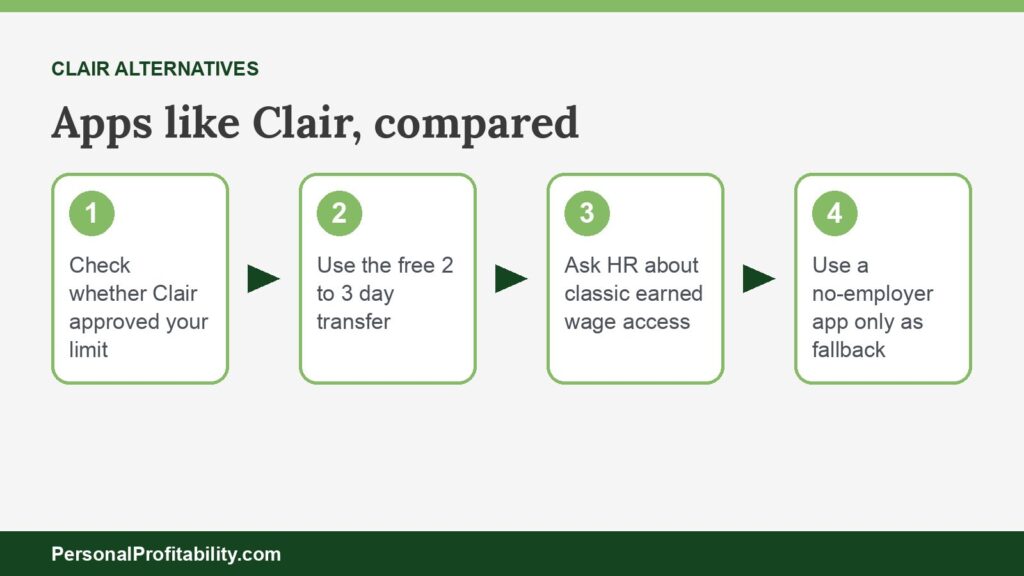
The best apps like Clair are ZayZoon and Tapcheck if your employer will add a classic earned wage access program, Rain or Branch at larger employers, and EarnIn if you have no employer program. Clair runs the on-demand pay inside Gusto and QuickBooks Payroll. But Pathward, a national bank, now originates every Clair advance, and Clair approves you with its own underwriting, so you’re applying for a small loan. Our guide to earned wage access explains how the classic version works.
Eric Rosenberg, who founded Personal Profitability, wrote for Payactiv as a freelancer and later worked there as a marketing manager, until June 2026. Nobody at Payactiv reviewed this page. We held Payactiv to its own published fees and terms, the same standard we used for every other company here.
Personal Profitability may earn a commission from partner links on this page, at no cost to you. Partners don’t decide what we recommend or where it ranks. Fees and terms are each company’s as of 2026-10-24. Confirm them on the company’s site before you sign up.
Clair at a glance
Clair is a New York fintech that builds on-demand pay into payroll, scheduling, and workforce apps, so you never download a separate Clair app. Most workers meet Clair as “On-Demand Pay with Clair” in Gusto or as “On-Demand Pay by Clair” in QuickBooks Workforce. Gusto calls it a free benefit for advances between paydays. QuickBooks says eligible employees can get early access to a portion of their earned wages before payday. Clair says it has 350,000 active businesses on its platform across 41 industries and has raised $69.2 million from investors including Thrive Capital and Upfront Ventures.
| Clair | What Clair, Gusto, and QuickBooks publish |
|---|---|
| Who it’s for | Employees paid through Gusto, QuickBooks Payroll, or another Clair partner app. |
| Needs your employer? | Yes. Your employer’s payroll or workforce software has to offer Clair. |
| Who lends the money | Pathward, N.A., a national bank. Clair arranges and services the advance. |
| Approval | Clair underwrites with its Clair Atlas engine. Clair can turn you down. |
| Free path | Standard transfer: 2–3 business days on Gusto, 1–3 on QuickBooks. |
| Instant fee | $4.99 to a bank or debit card, taken out of the advance. $4.50 to a Gusto Spending account. |
| Limits on Gusto | Debit card: $200 a pay period, $100 an advance. Gusto Spending: up to $800 a pay period, $200 an advance. $25 minimum. |
| Interest or late fees | None, according to Clair, Gusto, and QuickBooks. |
| Repayment | From your next paycheck on Gusto and QuickBooks. From your linked bank account on some non-payroll partner apps. |
| Not available in | Connecticut, Massachusetts, Minnesota, New Mexico, Nevada, and South Dakota on QuickBooks. |
| Legal matters | No regulator action found on official sources. |
Fees and terms verified 2026-10-24, from Clair’s On-Demand Pay page, Gusto’s help article, and QuickBooks support.
Spend less, earn more and grow your wealth
Get my free 2026 Playbook with a checklist for your budget, credit, investing and side income, plus the free 7-day Bootcamp.
What Clair’s move to Pathward bank advances means for you
Clair’s move to Pathward means a Clair advance works like a small, no-interest bank loan that Clair has to approve. You aren’t drawing on wages you’ve already earned. Clair’s site footer reads: “All Advances are originated by Pathward, N.A.” The footer also says Clair’s subsidiary, Maverick Payments, Inc., handles “solicitation, arranging, servicing and/or collecting” under NMLS number 2324313. For Vermont users, the footer goes further: “THIS IS A LOAN SOLICITATION ONLY.” Gusto’s article carries a matching Vermont notice.
Clair explains the choice on its product page. Clair says it put Pathward at the center as “a structure designed to hold up as the regulatory environment changes.” Clair’s Terms of Use, last modified September 2026, say you “may be able to request a loan offer” from Pathward, and that Pathward makes loan offers to people who “satisfy our bank partner’s credit policy.”
How Clair decides whether to approve you
Clair approves advances with Clair Atlas, which Clair calls its “proprietary AI underwriting engine.” According to Clair, Atlas uses real-time employment and cash-flow data, not credit scores. On payroll platforms, Clair pulls paycheck data to calculate your available balance. On scheduling and workforce apps, Clair uses time and attendance data plus “cashflow signals.” Gusto adds that per-pay-period amounts “may vary” based on factors including your repayment history.
Gusto and QuickBooks both say Clair runs no credit check. Clair’s Terms of Use add one detail. Clair’s identity vendor, Method Financial, may pull a consumer report as a soft inquiry, which Clair says won’t affect your score. In its October 14, 2026, launch post for Clair Connect, Clair says it approves users without a payroll link “at far lower rates.” In that post, Clair CEO Nico Simko describes the goal as “a network to make consumer credit more accessible for workers.”
What changes for a worker
- Approval isn’t automatic. Clair can decline you or give you a smaller limit than your hours would suggest, and your limit can move with your repayment record.
- Limits run small. On Gusto, you can take $200 a pay period to an outside debit card, or up to $800 if you open a Gusto Spending account.
- The price stays low. Clair, Gusto, and QuickBooks all say there’s no interest, and the standard transfer is free. Speed costs $4.50 or $4.99 an advance.
- Your direct deposit changes. On Gusto, Clair updates your direct deposit when you take an advance. A slice of your next paycheck then goes to an On-Demand Payment account at nbkc bank.
- Missing a payment locks you out, nothing more. QuickBooks says you can’t borrow again until you repay, Clair charges no late fees, and an unpaid advance won’t hurt your credit score. Clair calls its advances non-recourse.
- Your employer stays out of it. QuickBooks says employers aren’t responsible for advances, even after a termination.
Is Clair still earned wage access?
Clair still calls itself embedded earned wage access, but in our reading Clair no longer fits the federal definition. The CFPB’s December 2025 advisory opinion says “Covered EWA” isn’t credit when the provider caps advances at payroll-verified wages, collects through a payroll deduction, gives up any claim against the worker, and doesn’t assess the worker’s credit risk. Clair’s underwriting engine assesses risk by design, and some partner apps collect from your bank account.
That doesn’t make Clair a bad deal. Clair’s fees sit in the normal EWA range, and its no-interest, no-late-fee terms beat any payday loan. You should still compare Clair with the classic employer programs below, which set your limit from earned pay. Our explainer on whether earned wage access is a loan covers the CFPB opinion and the states that disagree.
Apps like Clair compared
Six of these apps like Clair come through an employer and set your limit from the wages payroll shows you’ve earned. Two work without an employer. We ordered them by fit for a Gusto or QuickBooks worker at a small business, not by commission.
| App | Needs your employer? | How your limit is set | Free path | Cost of speed | Max |
|---|---|---|---|---|---|
| ZayZoon | Yes | Unpaid earnings. No credit checks. | ZayZoon Visa Card or gift cards. | Up to $5 per near-instant transfer. | $200 per payout in an older help article. |
| Tapcheck | Yes | Hours your employer reports. | Prizeout gift cards only. | One flat fee. Amount not published. | 70% of net pay. |
| Rain | Yes | Current-period earnings. | Bank ACH in 1–3 days. | “Small fee” to a card. Amount not published. | 50% of current-period earnings. |
| Branch | Yes | Projected earned wages. | Instant to Branch Wallet. ACH in 3–5 business days. | $2.99–$4.99 to a debit card (W-2). | 50% of projected earned wages. $1,000 a pay period. |
| DailyPay | Yes | Available earnings, set per employer. | Next-business-day ACH. | $1.99–$3.99 in its Program Terms. $3.49 on its fees page. | 100% of your available balance. $1,000 a day. |
| Payactiv | Yes | Earned wages and employer settings. | ACH in 1–3 business days. | $2.49 to its card without direct deposit. $3.49 to other cards. | Up to 50% and $500 a pay period in most cases. |
| EarnIn | No | Earnings and bank deposits. No credit check. | Standard transfer in 1–2 business days. | Lightning Speed from $3.99. Tips optional. | $200 a day. $1,000 a pay period. |
| Chime MyPay | No | Estimated income and risk-based criteria. | Scheduled advance within 24 hours. | 3% instant ($2 minimum, $5 maximum). | Up to $750 advertised. Limits $20–$1,000. |
Fees and terms verified 2026-10-24.
Employer apps like Clair that base access on earned pay
Employer apps like Clair that follow the classic model set your limit from the hours and pay your employer reports, not from a lending decision. The trade-off: your employer has to sign up with a separate provider, since Gusto and QuickBooks build in Clair. Ask whether the provider connects to your employer’s payroll software, and bring this list to your manager if the Clair limits don’t cover your needs.
ZayZoon: best for small businesses that want classic EWA
ZayZoon targets the same small and midsize employers Clair serves through Gusto and QuickBooks, and it works the classic way. ZayZoon’s terms say ZayZoon won’t run a credit check, won’t report your repayment history to a credit bureau, and won’t debit your bank account. ZayZoon collects through your next paycheck and issues payouts on a nonrecourse basis. ZayZoon sells through more than 300 payroll partners.
ZayZoon charges up to $5 for a near-instant transfer, including to Venmo or Zelle. That sits about even with Clair’s $4.99. Transfers to the ZayZoon Visa Card and Boost gift cards cost $0. ZayZoon’s November 2024 help article lists a $200 maximum per payout, double Clair’s $100 per advance to an outside card on Gusto. ZayZoon’s free path keeps you on its card, so you’ll pay to reach your own bank fast. Our apps like ZayZoon page covers its own alternatives.
Tapcheck: best for reaching more of your paycheck
Tapcheck lets you reach up to 70% of your net earnings, far more than Clair’s $200-a-pay-period limit to a debit card on Gusto. Tapcheck says it’s free for employers and connects to more than 300 payroll and timekeeping systems. Tapcheck takes repayment out of your next paycheck, with no direct deposit change. Tapcheck’s employee page says available wages typically run about $100 a day after you clock your hours.
Tapcheck has a weaker free path than Clair. Clair’s standard transfer to your bank costs nothing, while Tapcheck charges “one flat ATM-like fee” for every cash transfer and waives it only for Prizeout gift cards. Tapcheck doesn’t publish the amount. Our apps like Tapcheck guide lists the employer apps that offer free cash.
Rain: best for a free bank transfer without a loan
Rain matches Clair’s free standard transfer and drops the loan structure. Rain’s integrations page says you can move up to 50% of current-period earnings to your bank for free. Rain’s help desk puts the transfer at 1 to 3 days. Rain says it funds every transfer and guarantees positive take-home pay on payday. Its EWA Agreement includes a “No Indebtedness” clause, so you generally owe Rain nothing if payroll falls short.
Rain integrates with Workday, Paylocity, ADP, SAP SuccessFactors, and UKG, so Rain fits employers on those systems. Rain charges a “small fee” for instant transfers to a card and doesn’t publish the amount. Clair publishes its $4.99, which counts in Clair’s favor.
Branch: best for free instant transfers
Branch beats Clair on instant speed, because Branch charges nothing to send an advance instantly to the Branch Wallet. Branch’s help center also lists a free ACH to an outside bank in 3 to 5 business days. W-2 workers pay $2.99 to $4.99 for instant money on another debit card. Branch publishes its limits: 50% of projected earned wages, up to $1,000 a pay period and $500 a request.
Branch gives you 8 free in-network Allpoint ATM withdrawals a month, then charges $2.00 each. Branch can also charge up to $5.00 a month on an account dormant past month 12. If you won’t keep money in the Branch Wallet, the free instant path doesn’t help you. Our apps like Branch page compares it with other wallets.
DailyPay: best for the highest limits
DailyPay offers the most room of any app here, up to 100% of your available balance and $1,000 a day, according to its FAQ. DailyPay’s next-business-day ACH costs nothing, and instant transfers to a DailyPay Card with direct deposit cost nothing too. DailyPay’s own documents disagree on the instant fee to other accounts: $1.99 to $3.99 in its Program Terms and $3.49 on its fees page. Both sit below Clair’s $4.99.
DailyPay routes your whole paycheck through its system after your first transfer, then forwards the remainder on payday. New York’s attorney general sued DailyPay in April 2025, arguing its advances are payday loans, and we found no ruling as of October 2026. DailyPay’s client logos lean toward large brands like Dollar Tree and Tractor Supply. Our DailyPay review has the details.
Payactiv: best for workers on Paychex, Paylocity, or Paycor
Payactiv is the classic EWA engine inside Paychex, Paylocity, Paycor, and UKG Wallet, the small-business payroll rivals to Gusto and QuickBooks. Payactiv’s pricing page lists a free ACH in 1 to 3 business days. Real-time transfers to the Payactiv Visa Card cost $0 with at least $200 a pay period in direct deposit there, or $2.49 without it. Other debit cards, Venmo, PayPal, and Walmart Cash Pickup cost $3.49. Payactiv says it charges no tips and employers pay nothing.
Payactiv’s FAQ puts the usual cap at 50% and $500 a pay period, and your employer’s settings decide the rest. That beats Clair’s $200 debit-card limit on Gusto. If you’re comparing two job offers, one on Gusto and one on Paychex, the Paychex job gives you the classic model. Our Payactiv review covers it.
Clair alternatives without an employer
If your employer offers nothing, a direct-to-consumer app can advance part of your pay. But the company pulls repayment from your bank account on payday. Clair collects through your Gusto or QuickBooks paycheck, so you can’t overdraw. With these apps, a late paycheck plus a bank debit can trigger the overdraft you were trying to avoid. These two have the cheapest free paths, and our apps like EarnIn guide covers more.
EarnIn: best for keeping your current bank
EarnIn works with the checking account you already use and offers a free standard transfer in 1 to 2 business days. EarnIn’s Cash Out page lists up to $200 a day and $1,000 a pay period, five times Clair’s $200 debit-card limit on Gusto. New York residents max out at $100 a day and Maryland residents at $150. Lightning Speed starts at $3.99. EarnIn runs no credit check and doesn’t report Cash Out to the bureaus.
EarnIn asks for tips, and we’d skip them every time. EarnIn also faces lawsuits from Colorado’s attorney general, filed in August 2026, and D.C.’s attorney general, filed in November 2024, both arguing Cash Out is an illegal loan. Our EarnIn review lists its fees by state.
Chime MyPay: best if you’ll move your direct deposit
Chime MyPay is free if you can wait 24 hours. Chime caps instant fees at $5, with a 3% rate and a $2 minimum, according to its MyPay page. Chime charges no subscription, runs no credit check, and doesn’t report your payment history to the credit bureaus. You need $200 or more in qualifying direct deposits into Chime, an activated physical Chime card, and an eligible state.
If Clair’s loan structure bothers you, know that MyPay works the same way. Chime calls MyPay “a line of credit” with limits “based on estimated income and risk-based criteria.” Chime advertises “up to $750,” and its footnote says limits run $20 to $1,000 per pay period.
What a Clair advance costs
A standard Clair advance costs $0, and an instant one costs $4.99, which equals about 130% APR on a $100 advance repaid in 14 days. Clair takes the fee out of the advance, so a $100 instant advance puts $95.01 in your account. The table assumes a biweekly paycheck.
| Clair advance | Fee | APR equivalent over 14 days | Cost over a year |
|---|---|---|---|
| Any amount, standard transfer | $0 | 0% | $0 |
| $200 instant to Gusto Spending | $4.50 | 58.7% | $121.50 at 27 advances |
| $100 instant to a debit card | $4.99 | 130.1% | $134.73 at 27 advances |
| Two $100 instant advances every pay period, the Gusto debit-card maximum | $9.98 a pay period | 130.1% | $259.48 over 26 pay periods |
| $25 minimum, instant | $4.99 | 520.4% | $134.73 at 27 advances |
The 27-advance figure comes from the CFPB’s 2024 Data Spotlight. The CFPB found the average employer EWA user took 27 advances a year, averaging $106, with an average fee of $3.18. A flat fee hits small advances hardest. On Clair’s $25 minimum, $4.99 is almost 20% of the advance.
So wait the two or three days whenever you can. If you’re taking the maximum every pay period, you’re covering a budget gap instead of a timing gap. A basic budget plus a small emergency fund will do more for you than any app. Our page on earned wage access fees runs this math for other providers.
Clair alternatives for Gusto and QuickBooks employers
Gusto and QuickBooks employers get Clair at no cost inside their existing payroll. So the question is whether to add a classic EWA provider beside it or instead of it. Gusto’s general manager said Gusto chose Clair for its compliance framework and technical capabilities, and Clair says it tracks EWA legislation in all 50 states. QuickBooks says you’re not responsible for lending the money or collecting it, even if you fire an employee who still owes Clair. Gusto requires employers to qualify for 2-day payroll, run payroll on time, and report terminations promptly. Platforms that offer Clair earn “a share of every advance,” according to Clair’s homepage, so your payroll company has a stake in the product.
If your workers need more than $200 a pay period, or Clair declines some of them, ask ZayZoon, Tapcheck, and other providers four questions:
- Do you connect to my payroll software, and what does it cost me?
- What do workers pay for an instant transfer, in dollars, and is there a free path to their own bank?
- Do you underwrite workers or check credit?
- Do you ever debit a worker’s bank account?
Our roundup of the best earned wage access providers compares employer costs and integrations, and our earned wage access laws tracker shows which states regulate EWA.
How to choose between apps like Clair
Choose based on why Clair isn’t working for you. Here are the common cases:
- Clair declined you or set a low limit. Ask your employer about ZayZoon or Tapcheck, which set your limit from your earned pay.
- You need more than $200 a pay period. Open a Gusto Spending account for up to $800, or look at Tapcheck’s 70% cap or DailyPay’s $1,000 a day at a larger employer.
- You want instant money for free. Branch’s wallet does that. On Clair, every instant advance costs $4.50 or $4.99.
- You live in a state Clair skips. QuickBooks lists Connecticut, Massachusetts, Minnesota, New Mexico, Nevada, and South Dakota as excluded. Check our state tracker for your rules.
- Your employer offers nothing. EarnIn and Chime MyPay work without an employer, with free standard options.
For a wider list, see our rankings of the best earned wage access apps and the best on-demand pay apps.
How we picked these apps like Clair
Between October 22 and October 24, 2026, we read Clair’s site, footer disclosures, and Terms of Use, plus Gusto’s and QuickBooks’ help articles. We also read each alternative’s own fee pages, terms, and help centers. We didn’t test any app with our own money, and no company paid for a spot. For a Clair user, we favored programs that skip underwriting, publish their fees and limits, offer a free path to your own bank, and collect through payroll. We left out subscription and tip-heavy apps like Dave, Brigit, and MoneyLion, since each costs more than Clair’s free standard transfer.
When none of these apps like Clair fit
If nothing here fits, ask your employer for a payroll advance. Gusto’s help center has a guide for admins on giving one. Call the company you owe and ask for a new due date, and if an overdraft fee already hit, ask your bank to refund it. Our guide on how to get money in a hurry lists more options.
Avoid payday loans. The CFPB says a typical $15 fee per $100 borrowed equals an APR of almost 400% on a two-week loan. That’s three times the APR of a Clair instant advance. Our comparison of earned wage access vs payday loans runs the numbers, and a starter emergency fund ends the need for both.
Apps like Clair FAQ
Use Clair’s free transfer, or ask for classic EWA
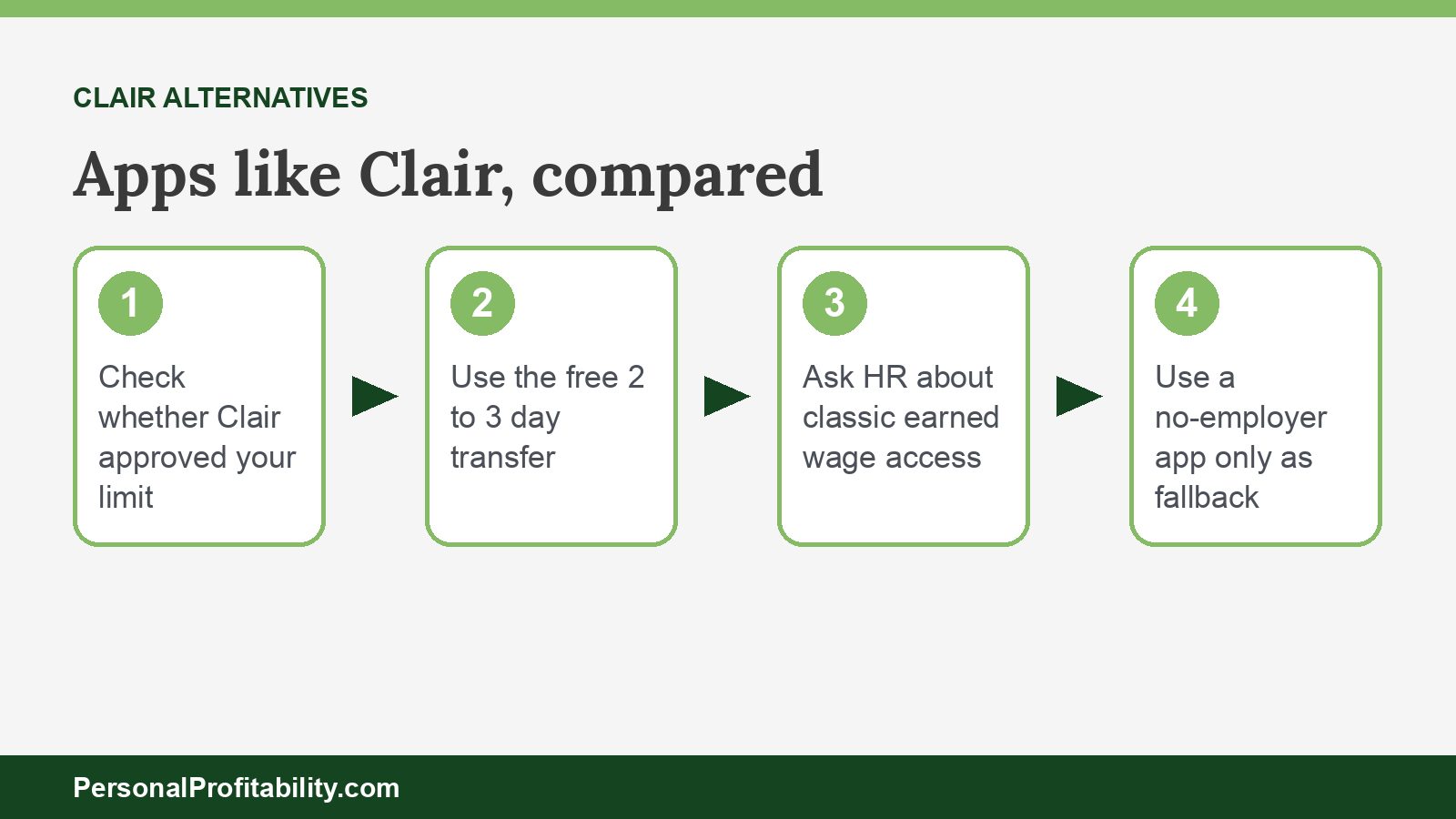
If your employer runs Gusto or QuickBooks, Clair’s free standard transfer can cover a short gap. Know that you’re taking a small bank loan. Skip the $4.99 instant fee when you can wait two or three days. If Clair declines you or the $200 limit falls short, ask your employer about ZayZoon or Tapcheck, which set your limit from your earned pay. With no employer program, EarnIn’s free standard transfer is the fallback. Compare more choices in our best earned wage access apps guide, see apps like Payactiv and apps like DailyPay, and start with our earned wage access basics if this is new.

Free guide
Spend less, earn more and grow your wealth
Get my free 2026 Playbook with a checklist for your budget, credit, investing and side income, plus the free 7-day Bootcamp.
- Track your money with the tools that still work in 2026
- The order to invest in, with the 2026 401(k) and IRA limits
- Three ways to earn your first $100 on the side this month
Bonus: The 7-day Personal Profitability Bootcamp, one short lesson in your inbox each day