
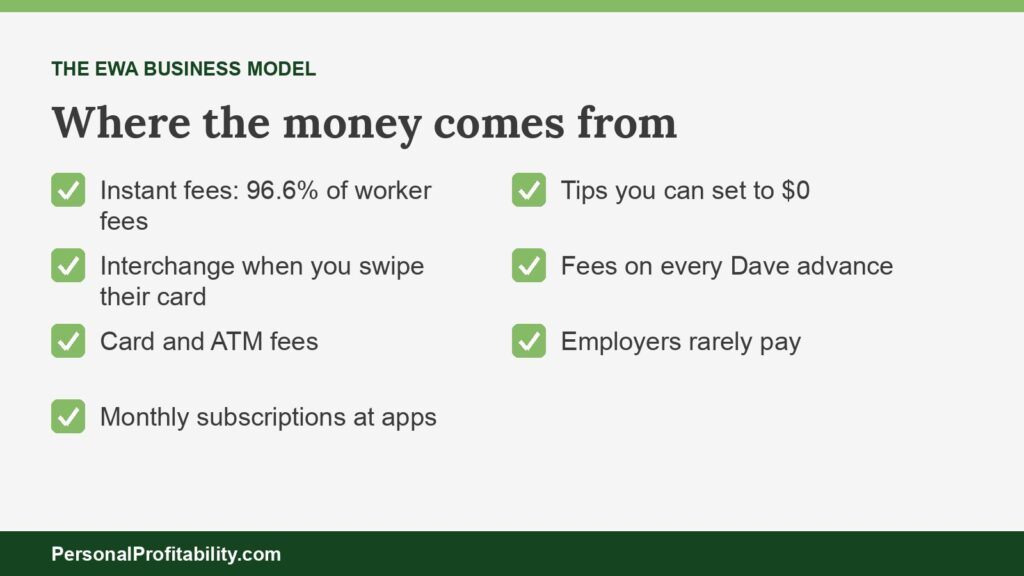
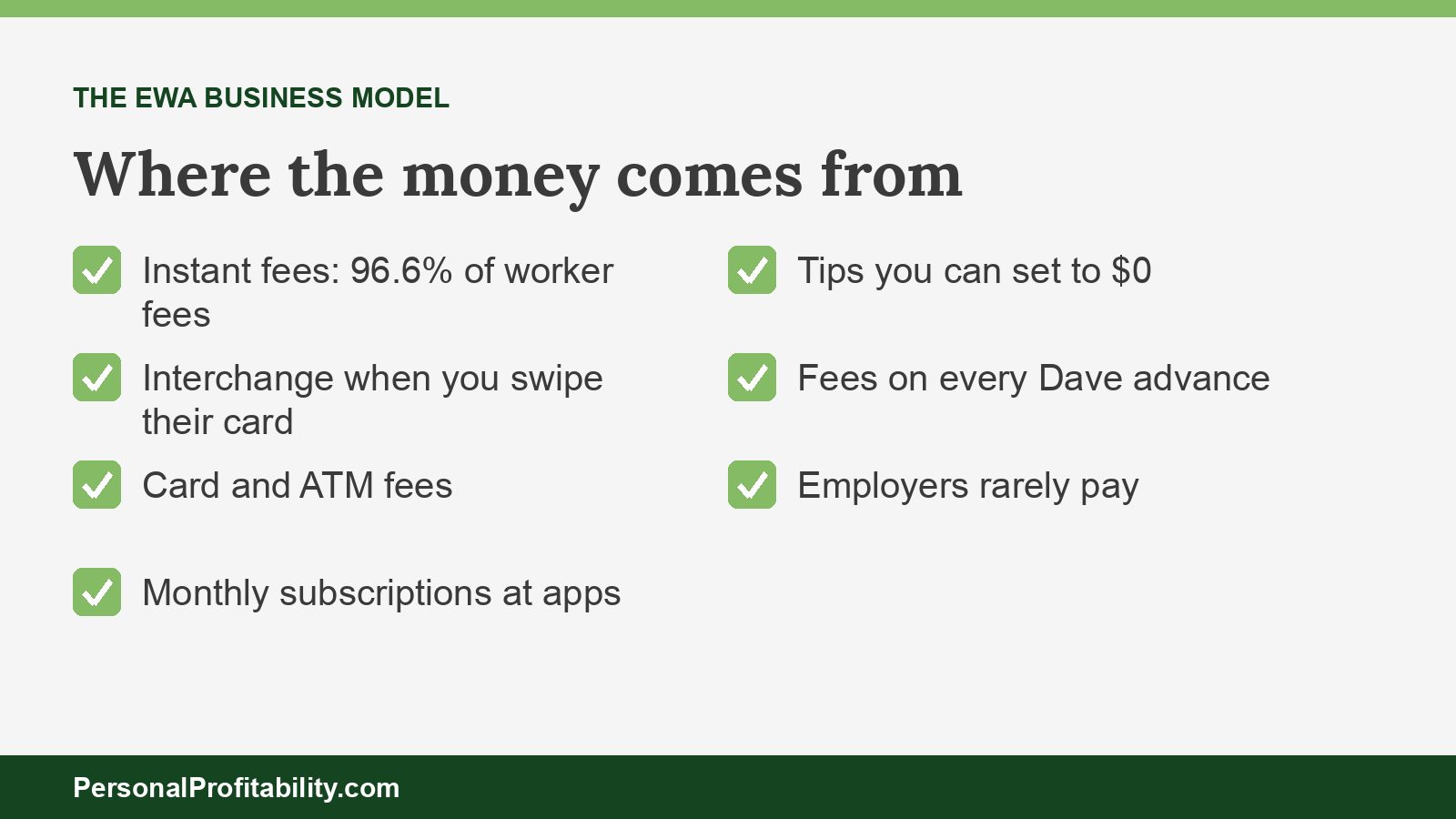
How do earned wage access companies make money? Mostly from instant transfer fees, which made up 96.6% of worker-paid fees in CFPB data, plus card interchange, subscriptions, tips, overdraft-style fees, and employer payments. Our earned wage access guide explains the product itself.
Eric Rosenberg, who founded Personal Profitability, wrote for Payactiv as a freelancer and later worked there as a marketing manager, until June 2026. Nobody at Payactiv reviewed this page. We held Payactiv to its own published fees and terms, the same standard we used for every other company here.
Personal Profitability may earn a commission from partner links on this page, at no cost to you. Partners don’t decide what we recommend or where it ranks. Fees and terms are each company’s as of 2026-10-31. Confirm them on the company’s site before you apply.
Last checked: October 31, 2026, against each company’s own fee and terms pages, SEC filings, and CFPB reports.
“Free” is the most common word on EWA marketing pages. Earned wage access (EWA), also sold as on-demand pay, lets employees reach earned wages before payday and repay from the next paycheck. Somebody still pays for the servers, the compliance staff, and the money that goes out early. We read the companies’ own pricing pages, the annual reports that Dave, Chime, and MoneyLion filed with the SEC, and the CFPB’s research to trace each revenue source. Once you know the business model, you know which button in the app costs you money.
The EWA business model in one table
EWA companies earn money from seven sources, and the worker pays for most of them through optional speed fees, card swipes, or monthly plans.
The CFPB laid out the menu in its December 2025 advisory opinion. The agency wrote that employer-partnered providers earn revenue from direct employer payments, a share of card interchange, worker fees for expedited delivery, and, “less frequently,” subscriptions. Direct-to-consumer apps use interchange, expedited fees, and subscriptions too, and “many” also solicit tips.
| Revenue source | Who pays | Companies that disclose the source | Free for you if |
|---|---|---|---|
| Instant transfer fees | Worker | Payactiv, DailyPay, Branch, ZayZoon, EarnIn, Klover, MoneyLion, Chime | You wait for the standard transfer |
| Card interchange | Merchant, when you swipe | Chime, Dave, MoneyLion. The CFPB says EWA firms “typically” share in card interchange | Always free to you at the register |
| Card and account fees | Worker | DailyPay Card, Branch card | You use in-network ATMs and keep the account active |
| Subscriptions | Worker | Dave, Brigit, Klover+, Tilt, Cleo, FloatMe, MoneyLion | You pick an app without a required plan |
| Tips | Worker | EarnIn, MoneyLion, and Dave (mostly before 2025) | You set the tip to $0 |
| Overdraft and advance service fees | Worker | Dave ExtraCash, EarnIn Cash Out Link | Never, at Dave |
| Employer and partner payments | Employer or platform | ZayZoon (employer may pay), Clair (platforms share revenue), ADP (marketplace commission) | Your employer covers the cost |
Fees and terms verified 2026-10-31. Sources for each row appear in the sections below. For a full fee table by provider, see our earned wage access fees page.
Spend less, earn more, and grow your wealth
Get my free 2026 Playbook with a checklist for your budget, credit, investing, and side income, plus the free 7-day Bootcamp.
Instant transfer fees pay most of the bills
Instant transfer fees are the core of the EWA business model: the CFPB found 96.6% of worker-paid fee revenue at employer-partnered providers came from expedited transfers.
The CFPB’s July 2024 data spotlight studied 2021 and 2022 data from several employer-partnered providers. Flat transaction fees made up 3.3% of fee revenue, and subscriptions made up 0.05%. About 90% of workers paid at least one fee. When a worker paid, the average fee was $3.18 on an average advance of $106.
That explains the design of every EWA app. The free option takes one to five business days, and the paid option arrives in minutes. Each provider prices speed a little differently:
- Payactiv charges a $2.49 load fee for a real-time transfer to its Visa card without a $200 qualifying direct deposit that pay period, $3.24 to Cash App in an early adopter program, and $3.49 to other debit cards, Venmo, PayPal, or Walmart cash pickup, according to its pricing page.
- DailyPay charges a flat $3.49 for instant access on its fees page and says “fees vary by employer.” Its June 2026 Program Terms list a range of $1.99 to $3.99.
- ZayZoon charges up to $5 for a near-instant transfer and $4 in Connecticut, per its terms.
- EarnIn charges $3.99 to $8.99 for Lightning Speed in most states, based on the amount.
- Klover charges up to $3.99 on a $25 advance and up to $37.49 on $750. Klover says it “earns revenue through express fees for expedited transfers and through Klover+ memberships.”
- MoneyLion charges 7.5% of an Instacash advance for Turbo delivery to its Spend account, capped at $14.99, and 9% to an outside account. Its 2024 annual report says MoneyLion earns Instacash revenue “from optional tips and instant transfer fees.”
Chime shows how big this line can get. Chime’s 2025 annual report says platform-related revenue, which includes MyPay, grew 73% to $686.2 million, and that MyPay’s full launch in July 2024 drove $212.5 million of that increase. Chime books the MyPay instant fee “net of fees paid to bank partners.” Chime charges 3% for an instant MyPay advance, with a $2 minimum and a $5 maximum.
Interchange: why apps push their own card
EWA companies that issue a debit or prepaid card earn a share of the interchange fee merchants pay each time you swipe, which is why many make instant transfers free to their own card.
The CFPB says EWA firms “typically earn a percentage of interchange fee revenue from these cards.” Payactiv waives its instant fee for transfers to the Payactiv Visa card when you have at least $200 of direct deposit per pay period, according to its pricing page. DailyPay waives fees on transfers to a DailyPay Card set up with direct deposit. Branch makes instant transfers to Branch Wallet free, and ZayZoon charges $0 to its Visa card. A banking partner issues each card: Central Bank of Kansas City for Payactiv, The Bancorp Bank for DailyPay, and Sutton Bank for Instant Financial.
For Chime, interchange is the biggest business. Chime reported $1.50 billion in payments revenue in 2025, which it describes as “the gross amount of the interchange fee,” out of $2.19 billion in total revenue. Dave reported $42.3 million in transaction-based revenue, and its annual report says Dave Checking revenue comes primarily from merchant interchange, Mastercard incentives, and interest on deposits paid by partner banks.
A free card transfer costs you nothing at the register. The card fees cost something, though. DailyPay’s card charges $2.50 at an out-of-network ATM, $1.99 per Allpoint+ cash load, 3% on foreign transactions, and $3.99 to send money out instantly. Branch’s card allows eight free in-network ATM withdrawals a month, then charges $2.00, and Branch charges up to $5.00 a month on accounts inactive for 12 months or more. Use the house card only if you’d use that card anyway.
Subscriptions and tips at direct-to-consumer apps
Apps that work without your employer lean on monthly subscriptions and, at some companies, tips, while the CFPB says it knows of no employer-partnered provider that asks for tips.
Subscriptions
- Dave charges a membership of up to $5 a month. Dave’s 2025 annual report says Dave raised the fee from $1 to $3 for new members in mid-2025, and subscription revenue grew 51% to $37.2 million.
- Brigit charges $8.99 to $15.99 a month, and Brigit’s terms put the Plus Express fee at $0.99 to $5.99, and Credit Builder requires the $15.99 plan, per Brigit’s homepage.
- Tilt charges $8 a month after a 14-day trial. FloatMe charges $6.99 a month but lets you request a Float without the membership. Klover+ costs $4.99 a month and is optional.
- Payactiv and ZayZoon charge no subscription, per Payactiv’s pricing page and ZayZoon’s terms. ZayZoon’s terms say it doesn’t charge “subscription fees, membership fees, enrollment fees.”
Tips
Tips are fees with better marketing, and consumers pay them on top of everything else. California’s financial regulator found that tip-based EWA companies collected a tip 73% of the time across 5.8 million tip-based transactions in 2021, at an average of $4.09, according to the DFPI’s data findings. The same report put the average APR at 334% at tip companies, tips included.
Dave’s numbers show what happens when a company drops tips. Dave earned $67.6 million in tips in 2024. In February 2025 Dave replaced its optional fee model with a mandatory 5% fee, and tip revenue fell 89% to $7.5 million in 2025. EarnIn removed tipping in Colorado and Wisconsin in July 2025, and Maryland banned EWA tips on October 1, 2026. The Colorado attorney general’s lawsuit says EarnIn collected more than $16 million in tips and Lightning Speed fees from Coloradans between January 2023 and July 2025. EarnIn disputes the suit.
Overdraft fees and credit products
Some of the largest companies in this market earn money from advances structured as overdrafts or loans, which charge a fee on every advance whether you choose speed or not.
Dave is the clearest case. Dave’s annual report says ExtraCash provides “short-term credit” as a discretionary overdraft through a bank partner, with an average term of about 11 days. In February 2025 Dave moved to “a mandatory 5% overdraft service fee, including a $5 minimum,” and Dave’s fee schedule lists a $15 maximum. Dave’s quarterly report says Dave removed that cap “for certain Member cohorts” in the second quarter of 2026. The results:
| Dave revenue line | 2024 | 2025 | Change |
|---|---|---|---|
| Processing and overdraft service fees | $218.8 million | $466.8 million | +113% |
| Tips | $67.6 million | $7.5 million | −89% |
| Subscriptions | $24.6 million | $37.2 million | +51% |
| Transaction-based revenue | $35.7 million | $42.3 million | +19% |
| Total revenue | $347.1 million | $554.2 million | +60% |
Processing and overdraft service fees made up 84% of Dave’s 2025 revenue. Dave says ExtraCash originations grew from about $5.1 billion in 2024 to about $7.6 billion in 2025, and the company set aside $91.0 million for credit losses. Our Dave review covers what that fee costs a member.
Other companies run similar structures. EarnIn’s Cash Out Link is a Lead Bank overdraft product with a $1.99 service fee on every approved overdraft, plus Lightning Speed if you want it fast. Chime calls MyPay “a line of credit.” Clair, which runs on-demand pay inside Gusto and QuickBooks, says Pathward, N.A. originates every advance. The CFPB’s charge-off data shows why a lender prices this way: 0.3% at employer-partnered providers versus 6.3% in its 2022 direct-to-consumer sample.
Employers, payroll platforms, and partners
Most employer EWA providers charge employers nothing. Employers covered less than 5% of total fees in the CFPB’s sample, so employees fund most of the model out of their own wages.
- No cost to the employer: Payactiv says employers can offer its EWA “at no cost,” on its earned wage access page. Tapcheck advertises “$0 Employer Cost,” Branch says EWA “comes at no cost to your business,” Immediate says it’s free for employers, and Dayforce includes on-demand pay with Dayforce Payroll.
- Employer pays for workers: ZayZoon’s terms waive or reduce the fee when “your employer has elected to pay” for the service. OnePay @Work makes instant delivery free when your employer configures the benefit.
- Platforms take a share: Clair says platforms that embed it earn a “share of every advance.” ADP lists EWA providers on its marketplace and receives a commission on listings.
- Partner commissions: ZayZoon says it “may get commissions” when you use its Boost gift cards. Tapcheck waives its fee on Prizeout gift cards that carry up to 20% extra value.
- Data: Klover’s privacy policy says “We sell and share your Personal Information, subject to your right to opt-out of these sales.” Klover’s homepage calls your data your “most valuable asset” and says it’s “always anonymized.”
Several states limit the employer side. Nevada and Wisconsin bar EWA providers from sharing fees or tips with employers, and the federal H.R. 9330, which cleared the House Financial Services Committee in June 2026 but isn’t law, would ban that sharing nationwide. Track the rules in our earned wage access laws by state page.
Float, funding, and money in motion
EWA providers front money before payday and collect repayment from the next paycheck. To fund advances, they borrow or sell receivables, and some hold your pay between payroll and payout.
DailyPay routes your full net pay through a DailyPay account after your first transfer, then sends the remainder on payday. DailyPay lists $960 million in total borrowing capacity on its about page. Rain says it “funds all transfers,” and your employer reimburses Rain after payroll. MoneyLion’s 2024 annual report describes a forward flow agreement, signed June 30, 2024, to finance Instacash originations. Payactiv, as a private company, doesn’t publish revenue, funding costs, or float income, and neither do DailyPay, EarnIn, Brigit, or Klover. So nobody outside these companies can say how much each one earns on money it holds.
Payactiv’s own history shows how the model shifted. In December 2020 the CFPB granted Payactiv a sandbox approval order covering a fee of up to $1 a day. The CFPB ended that order in June 2022 at Payactiv’s request, after Payactiv sought to change its fee model, and Payactiv’s about page lists “2022: Payactiv removes standard EWA fees.” Today Payactiv charges only for instant delivery outside its free paths. Compare the details in our Payactiv fees breakdown.
Is earned wage access free?
Earned wage access is free when you choose the standard transfer or the provider’s own card, and the company then earns from interchange, card fees, employers, or other users who pay for speed.
Every employer EWA provider we checked offers a $0 path, and EarnIn, Klover, MoneyLion, and Chime MyPay do too. Dave ExtraCash doesn’t. Use these five steps to keep your cost at $0.
- Request money a day or more before the bill. Speed is the product, so waiting is the discount.
- Use the house card only if it fits your life. The transfer is free, but ATM, reload, and inactivity fees aren’t.
- Set every tip to $0. A tip is a fee you volunteered to pay.
- Skip plans you won’t use. A $4.99 to $15.99 monthly fee costs money in months you never borrow.
- Ask your employer. Employer programs charge no tips or subscriptions, and some employers cover the instant fee.
If you pay for speed every pay period, the company’s best customer is you, and a starter emergency fund ends that relationship. Our guide to earned wage access without an employer covers the app options, and earned wage access vs cash advance shows where each product sits legally.
How EWA companies make money: FAQ
Conclusion: follow the fee, then skip the fee
Earned wage access companies make money when you pay for speed, swipe their card, keep a subscription, or leave a tip. The CFPB’s data puts instant fees at 96.6% of what workers pay, and Dave’s filings put ExtraCash processing and overdraft fees at 84% of revenue. Nearly every provider in our directory of earned wage access companies offers a $0 path, and Dave ExtraCash is the clear exception. Take the free transfer, set tips to $0, and compare apps in our best earned wage access apps roundup before you sign anything.
Free guide
Spend less, earn more, and grow your wealth
Get my free 2026 Playbook with a checklist for your budget, credit, investing, and side income, plus the free 7-day Bootcamp.
- Track your money with the tools that still work in 2026.
- The order to invest in, with the 2026 401(k) and IRA limits.
- Three ways to earn your first $100 on the side this month.
Bonus: The 7-day Personal Profitability Bootcamp, one short lesson in your inbox each day