
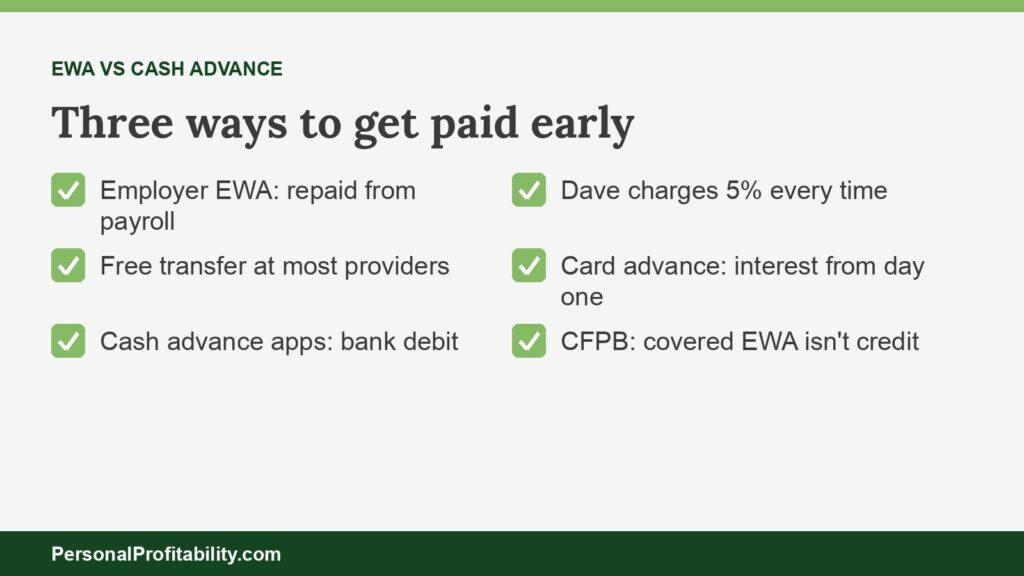
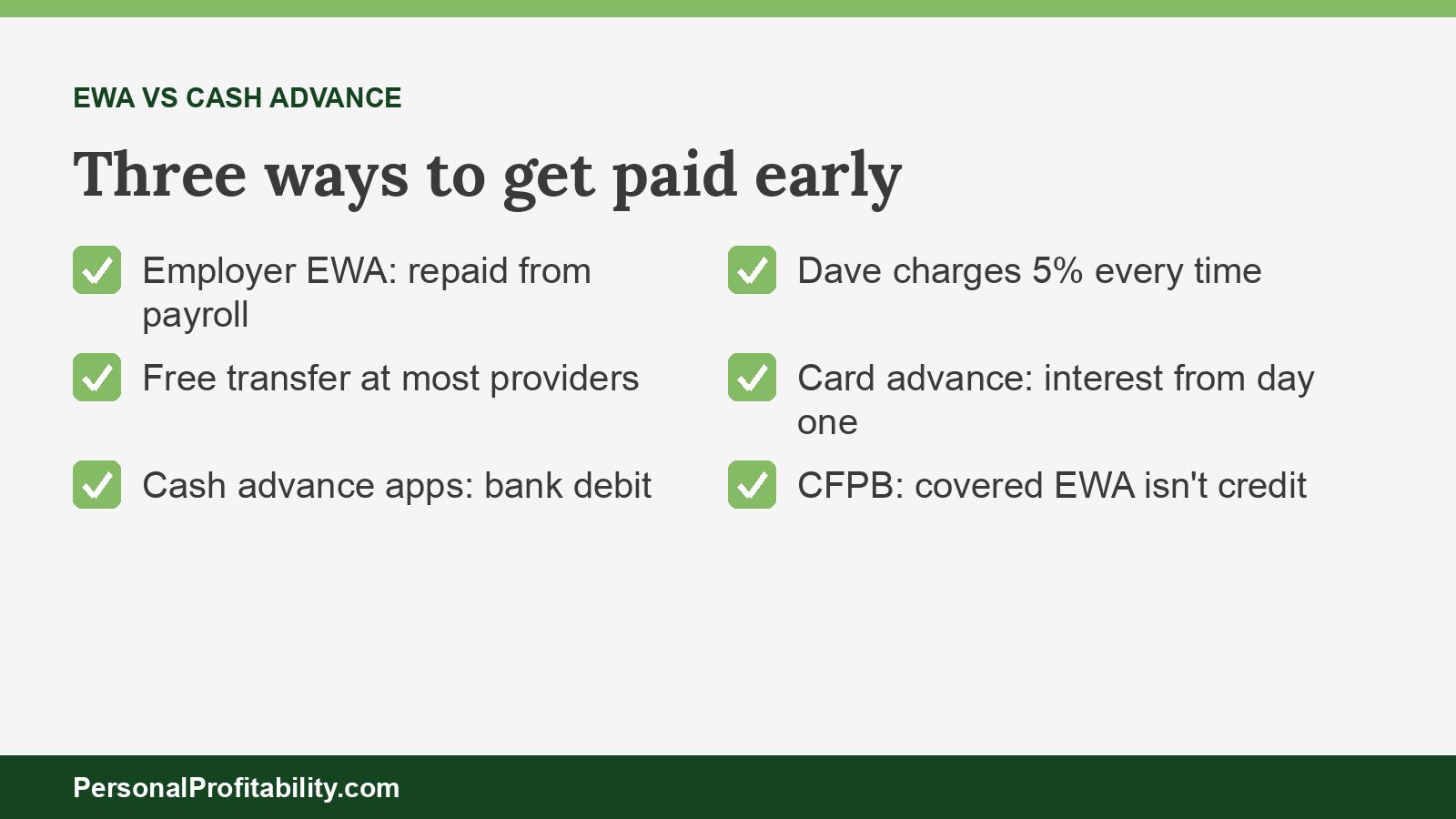
Earned wage access vs cash advance comes down to who repays and how: employer EWA like Payactiv takes repayment from your next paycheck, apps like Dave ExtraCash debit your bank, and a credit card cash advance charges interest from day one. Our earned wage access guide covers the basics.
Eric Rosenberg, who founded Personal Profitability, wrote for Payactiv as a freelancer and later worked there as a marketing manager, until June 2026. Nobody at Payactiv reviewed this page. We held Payactiv to its own published fees and terms, the same standard we used for every other company here.
Personal Profitability may earn a commission from partner links on this page, at no cost to you. Partners don’t decide what we recommend or where it ranks. Fees and terms are each company’s as of 2026-10-31. Confirm them on the company’s site before you apply.
Last checked: October 31, 2026, against each company’s own fee and terms pages.
People use “cash advance” for three different products. One is an earned wage access program that employers offer employees as a benefit. Another is a cash advance app such as Dave, Brigit, or Klover that you download on your own. The third is cash pulled from a credit card. All three put money in your hands early and smooth out cash flow before payday. They differ on cost, on what happens if you can’t pay, and on whether the law treats the money as a loan.
Earned wage access vs cash advance at a glance
Employer EWA is the cheapest and safest of the three, cash advance apps cost more and debit your bank, and a credit card cash advance is a loan with interest that starts the day you take the cash.
| Employer earned wage access | Cash advance app | Credit card cash advance | |
|---|---|---|---|
| Examples | Branch, DailyPay, Payactiv, Rain, and Tapcheck | Dave ExtraCash, Brigit Instant Cash, Klover, MoneyLion Instacash, and Chime MyPay | Any credit card with a cash advance line |
| Who offers the product | Your employer, through a provider | An app you join on your own | Your card issuer |
| How much | Part of wages you’ve already earned, set by your employer | $25–$1,000 caps, based on your bank deposits | Your card’s cash advance limit |
| How you repay | Payroll deduction from your next paycheck | A debit from your bank account on payday or a date you pick | Your card bill, with interest until paid |
| Free option | Yes, usually a 1–3 day transfer or the provider’s card | Most apps, if you wait. Dave has none | No |
| Credit check | No | No | Done when you opened the card |
| If you can’t repay | Most providers are non-recourse | Most apps block new advances, and some retry the debit | You owe the balance, interest, and late fees |
| Federal status | Not credit if it meets four CFPB conditions | Unsettled, and some apps call themselves credit | Credit |
Fees and terms verified 2026-10-31. Each row draws on the companies’ own pages, linked in the sections below. If you don’t have an employer program, our guide to earned wage access without an employer compares every app option.
Spend less, earn more, and grow your wealth
Get my free 2026 Playbook with a checklist for your budget, credit, investing, and side income, plus the free 7-day Bootcamp.
Where the CFPB’s 2025 opinion draws the line
The CFPB says earned wage access is not credit when the provider uses payroll data, collects by payroll deduction, gives up any claim against you, and skips credit checks, and most cash advance apps fail at least one of those four tests.
The Consumer Financial Protection Bureau published that position in an advisory opinion on December 23, 2025. The CFPB calls a product that meets all four conditions “covered EWA,” and the opinion says “Covered EWA is not credit.” That means federal Truth in Lending rules, the ones that require an APR on loans, don’t apply.
- Payroll data. Each advance stays within wages you’ve accrued, measured from payroll records.
- Payroll deduction. The provider collects at your next payroll, not from your bank account afterward.
- No recourse. The provider promises in advance that it won’t pursue you, sell the balance as debt, or report you to credit bureaus if the deduction falls short.
- No credit underwriting. The provider doesn’t pull credit reports or scores.
We lined up each product against those tests, using each company’s own description of its product.
| Product | The company’s own label | Fails which test |
|---|---|---|
| DailyPay, Payactiv, Rain, and ZayZoon | Earned wage access or on-demand pay, repaid through payroll | Designed to pass all four |
| EarnIn Cash Out | Earned wage access | Payroll deduction, since EarnIn debits your bank on payday |
| Current Paycheck Advance | “An earned wage access service and is not a loan or credit product” | Payroll deduction, since Current collects from your Current account |
| MoneyLion Instacash | “Our earned wage access product,” per its 2024 annual report | Payroll deduction |
| Dave ExtraCash | An overdraft from an ExtraCash account at Coastal Community Bank | Dave’s annual report says ExtraCash provides “short-term credit” |
| Chime MyPay | “A line of credit” | Chime sets limits on “risk-based criteria” |
| Clair (inside Gusto and QuickBooks) | Advances “originated by Pathward, N.A.” | Credit risk, since Clair says its Atlas engine approves advances |
| Credit card cash advance | A loan against your credit line | All four |
Failing a test doesn’t make an app illegal. The CFPB said it isn’t declaring non-covered products to be credit, and it left that question open. State attorneys general haven’t waited. The Colorado attorney general sued EarnIn in August 2026, Minnesota’s sued Brigit in June 2026, and New York’s sued MoneyLion and DailyPay in April 2025. Our explainer on whether earned wage access is a loan tracks each case.
What each option costs on a $100 gap
A $100 gap costs $0 through any free EWA transfer, $3.49 for instant employer EWA, $3 to $9.49 at a cash advance app, and about $11 or more on a credit card.
| Option for $100 | Fee | APR equivalent, 14 days | Source |
|---|---|---|---|
| Employer EWA, standard transfer | $0 | 0% | Payactiv and DailyPay fee pages |
| Payactiv instant to its card, no qualifying deposit | $2.49 | 64.9% | Payactiv pricing page |
| Payactiv or DailyPay instant | $3.49 | 91.0% | Payactiv and DailyPay fee pages |
| Chime MyPay instant | $3.00 | 78.2% | Chime MyPay page |
| Dave ExtraCash | $5.00 | 130.4% | Dave fee schedule |
| EarnIn Lightning Speed | $5.99 | 156.2% | EarnIn Cash Out page |
| MoneyLion Turbo to Spend | $7.50 | 195.5% | MoneyLion Instacash page |
| Klover express | Up to $9.49 | 247.4% | Klover pricing page |
| Credit card cash advance (example terms) | $11.15 | 290.7% | $10 fee plus 29.99% APR for 14 days |
| Payday loan | $15 | 391.1% | CFPB’s common $15 per $100 |
Payactiv charges $0 for a bank transfer in 1–3 business days, a $2.49 load fee for a real-time transfer to its Visa card without $200 in direct deposit that pay period, $3.24 to Cash App in its Early Adopter Program, and $3.49 to other debit cards, Venmo, PayPal, or Walmart cash pickup, according to its pricing page. Chime charges 3% for an instant MyPay advance, with a $2 minimum and a $5 maximum, per its MyPay page. Dave charges 5% of each ExtraCash advance, with a $5 minimum and a $15 maximum, according to its fee schedule.
The credit card row uses example terms, since every card differs. Say your card charges a $10 cash advance fee and a 29.99% cash advance APR. You’d pay the $10 up front plus about $1.15 in interest over 14 days. Chase says cash advance APRs “are almost always much higher” than purchase APRs, and the CFPB says you generally pay interest on a cash advance “as of the date of the transaction.” Check your card’s rates and fees table for your numbers.
The fee per use matters less than how often you pay the fee. The CFPB’s 2024 data spotlight found the average worker used EWA 27 times a year and paid $3.18 when a fee applied. That’s $85.86 a year. Our earned wage access fees page has the yearly math for every provider.
How repayment differs, and why it matters
Employer EWA comes out of your paycheck before you see the money, while cash advance apps pull from your bank account, which can overdraw you if the timing slips.
Employer earned wage access
Your employer’s payroll deducts what you took, and you get the rest on payday. Most providers also promise not to chase you if the deduction comes up short. DailyPay’s program terms call its service “non-recourse.” Rain’s agreement says you’re “not responsible for making a payment to Rain” in general. ZayZoon says it won’t pursue you personally except for fraud. That’s the main reason the CFPB measured a 0.3% charge-off rate at employer-partnered providers, versus about 6.3% at direct-to-consumer providers in 2022.
Cash advance apps
Apps collect from your bank account, and each one sets its own rules. EarnIn debits your linked account on payday. Brigit withdraws on the due date you chose and lets you push it back with extension credits. Cleo lets you pick a repayment date between 3 and 14 days away. MoneyLion says it “may deduct a partial repayment and make additional debit attempts,” and Dave says ExtraCash “is repayable on demand.” Klover and Current describe their advances as having no obligation to repay, but both stop new advances until you pay.
The GAO flagged the risk in its 2023 report: unexpected overdraft fees when an app’s debit hits an account without enough money. A single $35 overdraft costs more than ten $3 instant fees.
Credit card cash advances
A card cash advance becomes part of your balance. Interest keeps running until you pay it off, a missed payment brings a late fee, and the balance goes to collections if you stop paying. The advance also raises your credit utilization, which can lower your score. Read our guide to building credit before you lean on a card for cash.
EWA vs cash advance apps on credit checks and limits
Neither employer EWA nor the major cash advance apps check your credit, and both cap you well below what a credit card allows.
- Employer EWA limits come from your hours and earnings. DailyPay lets you transfer up to 100% of your available balance, capped at $1,000 a day. Branch caps you at 50% of projected earned wages and $1,000 a pay period. Rain says the limit is 50% of earned wages in most cases. Payactiv’s pricing page says you can reach “a portion” of what you’ve earned.
- App limits come from your deposits. Dave advertises $25 to $500 and says “few qualify for $500.” Brigit offers $25 to $500, Klover up to $750, and MoneyLion up to $500, or $1,000 with qualifying direct deposits into a MoneyLion Spend account.
- No credit pulls. Dave says it “does not require a credit check at any point.” MoneyLion says it doesn’t “do any sort of credit pull or credit check.” Brigit, Klover, EarnIn, and Chime say the same about their advances.
- No credit building either. EarnIn doesn’t report Cash Out to credit bureaus, and Chime doesn’t report MyPay payment history, so paying on time won’t help your score.
Lawsuits and settlements by product type
Federal and state regulators have aimed almost every action at cash advance apps that debit bank accounts, while only one major case targets an employer EWA provider.
| Company | Product type | Action | Status |
|---|---|---|---|
| Brigit | Cash advance app | FTC order, $18 million (2023). Minnesota AG suit (2026) | FTC order in effect, with a second refund round in May 2026. Minnesota case pending |
| Cleo | Cash advance app | FTC settlement, $17 million (2025) | Refunds started October 27, 2026 |
| Dave | Cash advance app | FTC and DOJ suit (2024). Baltimore suit (2025) | Pending. A court denied Dave’s motion to dismiss the federal case in September 2025 |
| EarnIn | Direct-to-consumer EWA | D.C. AG suit (2024). Colorado AG suit (2026) | D.C. mostly dismissed, per EarnIn’s counsel. Colorado pending |
| FloatMe | Cash advance app | FTC order, $3 million (2024) | Resolved |
| MoneyLion | Cash advance app | CFPB judgment, $1.75 million redress (2025). NY AG suit (2025) | CFPB judgment entered. NY case pending |
| DailyPay | Employer EWA | NY AG suit (2025) | Pending, no ruling found |
DailyPay disputes the New York case and sued first, asking a court to rule that its service is not a loan. Our DailyPay review covers the claims. For the apps, see our reviews of Dave, Brigit, and Klover.
Which one should you use?
Use your employer’s free EWA transfer first, a cash advance app’s free transfer second, and a credit card cash advance only to avoid a bigger fee, never as a habit.
- Free employer EWA. Ask HR whether your employer offers EWA, then wait a day for the $0 transfer, or use the provider’s own card if you’d use that card anyway.
- Paid employer EWA. A $3.49 instant fee beats a $35 overdraft. It doesn’t beat waiting a day.
- A free app transfer. EarnIn, Klover, MoneyLion, and Chime all offer a $0 standard option. Start with EarnIn or Klover if you have no employer program. Our roundups of apps like EarnIn and apps like Klover list the rest.
- A paid app transfer or a subscription app. Dave and Brigit fit people who’ll use the extra features in each paid plan. Compare them in Dave vs Brigit, or see apps like Dave and apps like Brigit.
- A credit card cash advance. Only if you can pay the full balance on your next statement.
- Never a payday loan. Our page on earned wage access vs payday loans shows why.
If you reach for any of these every pay period, the fix is a buffer. A starter emergency fund of a few hundred dollars beats every product on this page.
Earned wage access vs cash advance FAQ
Conclusion: pick the one that pulls from your paycheck
In the earned wage access vs cash advance choice, employer EWA wins when you have it: a free path, payroll repayment, and the CFPB’s clearest protection. Cash advance apps fill in when your job offers nothing, as long as you wait for the free transfer. A credit card cash advance is the costly fallback. To see where the fees go, read how earned wage access companies make money, or browse every provider in our earned wage access companies directory.

Free guide
Spend less, earn more, and grow your wealth
Get my free 2026 Playbook with a checklist for your budget, credit, investing, and side income, plus the free 7-day Bootcamp.
- Track your money with the tools that still work in 2026.
- The order to invest in, with the 2026 401(k) and IRA limits.
- Three ways to earn your first $100 on the side this month.
Bonus: The 7-day Personal Profitability Bootcamp, one short lesson in your inbox each day