
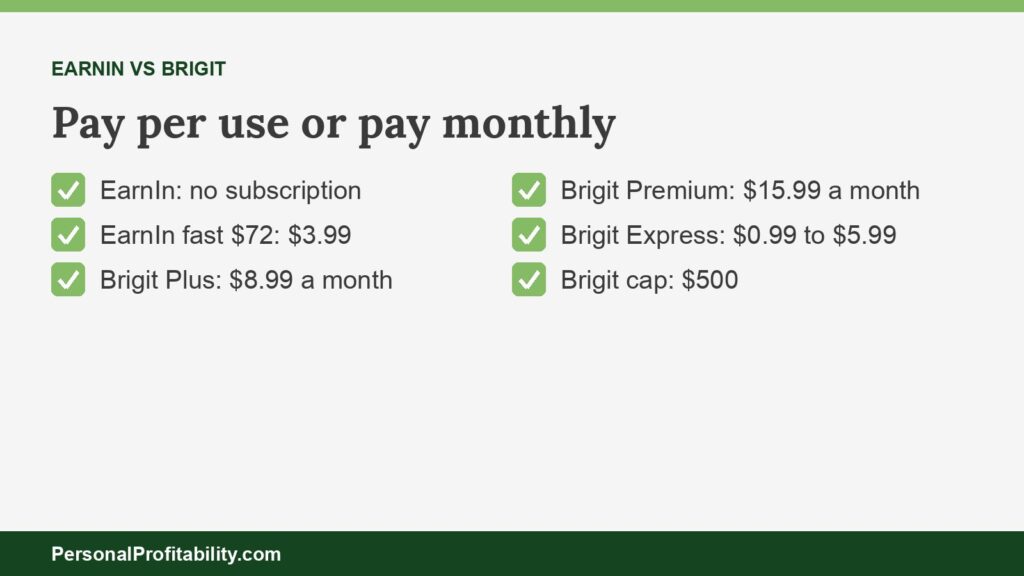
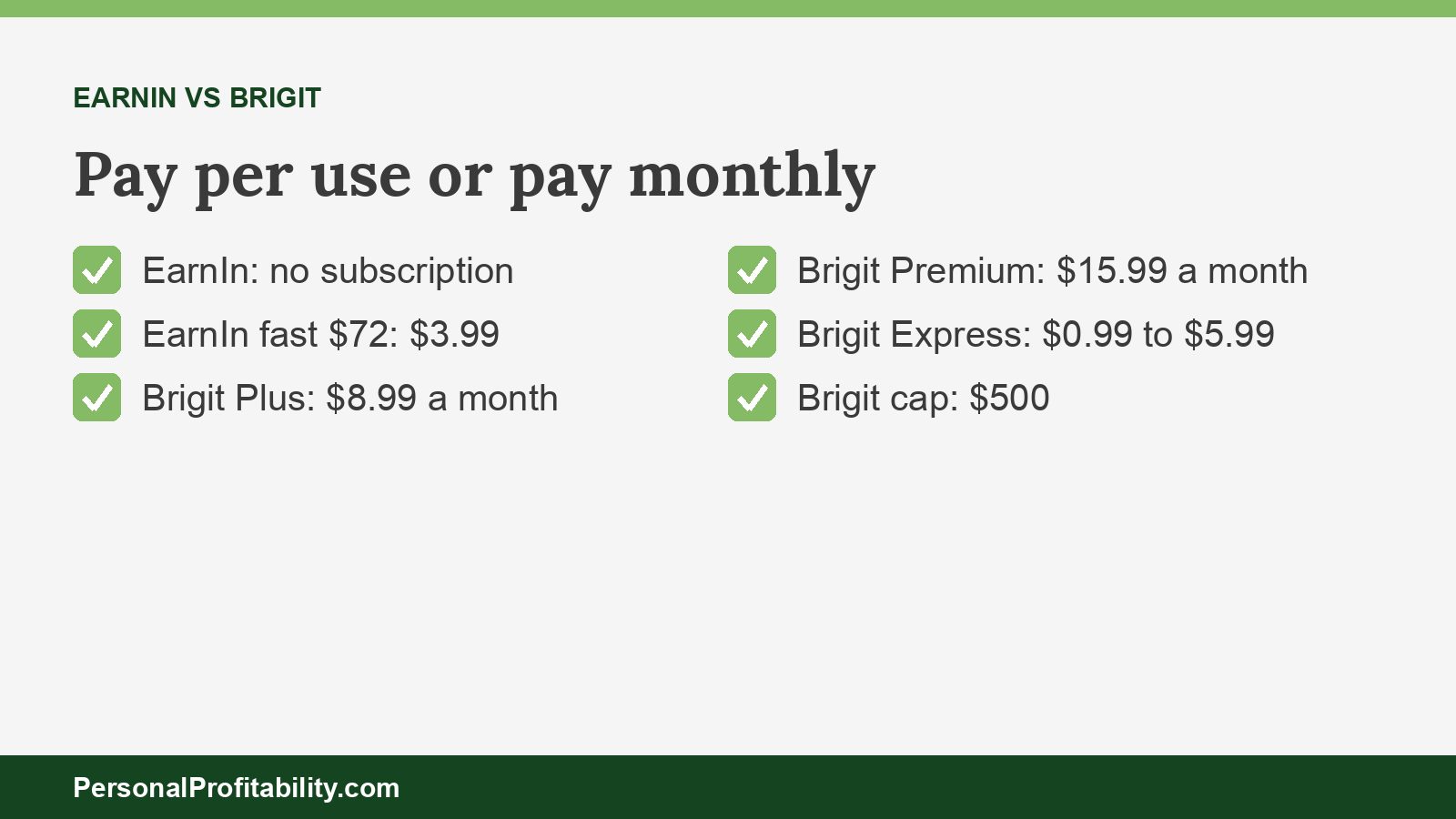
EarnIn vs Brigit is a choice between paying per advance and paying every month: EarnIn charges $0 for a standard transfer and $3.99 for a fast $72 advance, while Brigit charges $8.99 or $15.99 a month whether you borrow or not. For most people, EarnIn costs less over a year. Brigit pulls ahead for heavy users who want instant cash every payday, a due date they choose, or a credit builder. Our guide to earned wage access explains how both kinds of apps work.
Personal Profitability may earn a commission from partner links on this page, at no cost to you. Partners don’t decide what we recommend or where it ranks. Fees and terms are each company’s as of 2026-10-31. Confirm them on the company’s site before you apply.
Last checked: October 31, 2026, against each company’s own fee and terms pages.
EarnIn vs Brigit at a glance
EarnIn charges you only when you pay for speed, and Brigit charges you a subscription every month, then adds an Express fee on its cheaper plan. Every number below comes from each company’s own fee table, help center, or terms.
| Feature | EarnIn | Brigit |
|---|---|---|
| Pricing model | Pay per use. No subscription | Monthly subscription: Plus at $8.99, Premium at $15.99 |
| Free path | Standard transfer, $0, 1–2 business days in EarnIn’s FAQ, up to 3 on its Cash Out page | Standard delivery is free on paid plans, 1–3 days. An advance with no plan only if you email Brigit and ask |
| Fast delivery | Lightning Speed: $3.99 ($75 or less), $5.99 ($75.01–$150), $8.99 (over $150) | Express Delivery within 20 minutes. Plus: $0.99 to $5.99 under Brigit’s terms. Premium: free |
| Tips | Optional (none in Colorado and Wisconsin) | None |
| Advance size | Up to $200 a day and $1,000 a pay period ($100 a day in New York, $150 in Maryland) | $25–$500 ($25–$250 in Maine). Average advance $72 |
| Repayment | EarnIn debits your bank on payday | Brigit debits your bank on a due date you pick. Extension credits can move the date |
| Late fees | None listed | None |
| Credit check | None | None for Instant Cash |
| Credit building | Separate EarnIn Card reports to the bureaus | Credit Builder loan on Premium |
| Legal matters | Colorado AG suit (pending). D.C. AG suit (mostly dismissed, per EarnIn’s counsel) | Minnesota AG suit (pending). 2023 FTC order with $18 million in refunds (second refund round sent May 2026) |
| App Store rating | 4.79 (464,096 ratings) | 4.84 (579,326 ratings) |
Fees and terms verified 2026-10-31. App ratings as of October 2026. Sources: EarnIn’s fee table (last updated October 29, 2026) and Cash Out page, Brigit’s help article How much does Brigit cost? (updated October 27, 2026), its delivery article, and its Terms of Service (last revised March 31, 2026).
Spend less, earn more, and grow your wealth
Get my free 2026 Playbook with a checklist for your budget, credit, investing, and side income, plus the free 7-day Bootcamp.
Subscription vs pay-per-use: how each one charges you
Brigit’s cost starts the day you subscribe, and EarnIn’s cost starts only when you choose Lightning Speed.
Brigit charges $8.99 a month for Plus and $15.99 a month for Premium, according to its help center. Plus includes Instant Cash, credit monitoring, score simulators, and identity theft protection, so the membership buys financial tools along with the cash advance. Premium adds Credit Builder and free Express Delivery. Brigit’s homepage puts it this way: “$8.99–$15.99 monthly subscription may apply. Cancel anytime.”
Brigit’s help center calls the Plus Express fee “a small fee” and shows the amount in the app. Brigit’s own Terms of Service go further. Section 7.6.3 says the Express Fee “may range from $0.99 to $5.99” for non-Premium users, rising with the size of the advance. The same terms list Plus at “$5.99 to $9.99 per month,” with some members on promotional or legacy rates. We used the $8.99 price Brigit’s help center shows new members today.
EarnIn charges no subscription, no interest, and no mandatory fees. A standard Cash Out costs $0. EarnIn charges $3.99 for Lightning Speed on $75 or less, $5.99 on $75.01 to $150, and $8.99 above $150, according to its fee table. EarnIn also prompts for an optional tip in most states, and EarnIn ended tipping in Colorado and Wisconsin in July 2025. Tips are fees with better marketing, so set every one to $0.
Brigit has a free option too, though Brigit’s app doesn’t advertise the free plan. Brigit’s terms (section 7.7) say you can get an advance without a subscription. To ask, you email Brigit and say you want an advance without a membership plan. Brigit still decides whether you qualify.
What one $72 advance costs on each app
One $72 advance costs $0 to $3.99 on EarnIn and $8.99 to $14.98 on Brigit Plus, once you count the month of subscription.
We used Brigit’s own number for the test: an average advance of $72, per Brigit’s homepage (February 2018 to July 2026). Same assumptions on both sides: one $72 advance in a month, repaid in 14 days, EarnIn’s standard pricing, no tip, and one month of Brigit’s subscription. Brigit doesn’t publish the exact Express fee on $72, so we show its published range. The APR formula is the fee divided by the advance, times 365, divided by the days until you repay.
| Option | Cost for one $72 advance | APR equivalent (14 days) |
|---|---|---|
| EarnIn, standard transfer | $0 | 0% |
| EarnIn, Lightning Speed | $3.99 | 144% |
| Brigit free plan (by email, if approved) | $0 | 0% |
| Brigit Plus, standard delivery | $8.99 (subscription) | 326% |
| Brigit Plus, Express Delivery | $9.98 to $14.98 | 361% to 542% |
| Brigit Premium, Express included | $15.99 (subscription) | 579% |
The EarnIn row works out like this: $3.99 divided by $72 is 0.0554, times 365 is 20.2, divided by 14 is 1.44, or 144%. Brigit Plus at $8.99 lands at 326% before you pay for speed. Small advances make a flat monthly fee look terrible. On a $500 advance, the same $8.99 works out to 47%.
Yearly cost: when does a Brigit subscription beat EarnIn?
A Brigit subscription beats EarnIn only if you take a fast advance of more than $150 about every two weeks, and even then the cheaper move is to stop needing one.
Same assumptions on both sides: fast delivery every time, EarnIn’s standard Lightning Speed pricing, a $0 tip, and 12 months of Brigit’s subscription. Brigit Plus shows a range because Brigit’s Express fee runs $0.99 to $5.99.
| Your advance pattern | EarnIn, Lightning Speed | Brigit Plus ($107.88 a year) plus Express | Brigit Premium |
|---|---|---|---|
| $72, four times a year | $15.96 | $111.84 to $131.84 | $191.88 |
| $72, once a month | $47.88 | $119.76 to $179.76 | $191.88 |
| $72, every payday (26 times) | $103.74 | $133.62 to $263.62 | $191.88 |
| $200, every payday (26 times) | $233.74 | $133.62 to $263.62 | $191.88 |
For an occasional user, the gap runs about $100 a year in EarnIn’s favor. Take $72 four times a year and EarnIn costs $15.96, while Brigit Plus costs at least $111.84. Wait for EarnIn’s free transfer and the gap grows to the full subscription.
The bottom row flips the result. EarnIn’s fee climbs to $8.99 on anything above $150, and Brigit Premium includes free Express Delivery. Divide $191.88 by $8.99 and you get 21.3, so a person who takes 22 or more fast advances above $150 a year pays less on Premium. That reader also has a budget gap, not a timing gap. Spending $191.88 a year to reach your own pay early is a sign to build a starter emergency fund and look at cutting your monthly expenses.
For context, the CFPB’s July 2024 Data Spotlight found that employer-partnered users averaged 27 transfers a year. Run 27 paid advances through either app and the yearly cost lands in the triple digits. Our earned wage access fees guide covers the same math across the market.
Brigit vs EarnIn on limits and who qualifies
EarnIn lets you reach up to $1,000 a pay period, twice Brigit’s $500 ceiling, but EarnIn caps you at $200 a day and asks more about your job.
- EarnIn: Cash Out runs up to $200 a day and $1,000 a pay period, with lower daily caps of $100 in New York and $150 in Maryland. EarnIn sets your personal Max from your bank balance, paycheck history, on-time repayment, and how few other cash advance apps you use, per its Max article. EarnIn requires a consistent direct deposit schedule and a checking account. If you have a job, EarnIn asks for a work email or work location. EarnIn accepts Social Security, SSDI, SSI, and VA payments as income, but not unemployment.
- Brigit: advances range from $25 to $500, or $25 to $250 in Maine. Brigit needs a smartphone and a connected checking account, and Brigit reviews your transactions to compute a Brigit Score from 0 to 100. Brigit’s score weighs bank account health, spending behavior, and your earnings profile, per its score article.
New users rarely see the top number on either of these cash advance apps. Brigit’s average advance of $72 tells you where most people land. EarnIn says new members start lower and that your Max can change every pay period. EarnIn also stopped offering Cash Out to Connecticut residents at the end of 2023, so Connecticut readers should check our list of apps like EarnIn.
Repayment, due dates, and credit
Brigit gives you more control over when you repay, and EarnIn gives you less to manage because EarnIn collects on payday by default.
- Brigit withdraws the advance automatically on the due date you select when you request the money, according to its repayment article. You can push the date back with an extension credit, and Brigit says it charges “no late fees or penalties.” Brigit’s help center gives two deadlines for an extension, two business days before the due date in one article and three in another, so extend early.
- EarnIn debits your linked bank account on payday for the amount you transferred, plus any tips or fees. To move the debit, you contact EarnIn’s support team at least one business day ahead of the scheduled date.
Both cash advance apps collect from your bank, not from your paycheck. If your direct deposit lands late, your own bank can charge you an overdraft fee on either one. Our guide on getting overdraft fees refunded explains what to ask for if that happens.
Neither app runs a credit check for an advance, and neither one charges interest. Brigit says Instant Cash has no impact on your score, and EarnIn says Cash Out “won’t get reported to credit bureaus.” For credit-building, Brigit Premium includes a Credit Builder installment loan that reports your payments to the bureaus. EarnIn’s separate EarnIn Card also reports. A $15.99 subscription is a pricey way to build credit, though, and our guide on how to build credit from scratch covers cheaper routes, starting with a secured card.
Lawsuits and regulators
Both companies face state attorney general suits that call their advances illegal loans, and Brigit already paid an FTC settlement in 2023.
- Brigit, Minnesota: Attorney General Keith Ellison sued Brigit on June 10, 2026, calling it an unlicensed short-term lender with APRs “regularly” above 300% and some above 700%, against Minnesota’s 50% cap. Status: pending.
- Brigit, FTC: in November 2023 the FTC announced an order requiring $18 million for refunds over deceptive claims about advance amounts, fees, and cancellation. The FTC lists the refund rounds on its Brigit refunds page. Status: the order stands, and the FTC sent a second round of refunds in May 2026 and says money remains in the fund.
- EarnIn, Colorado: Attorney General Phil Weiser sued on August 27, 2026, saying EarnIn collected more than $16 million in tips and Lightning Speed fees from Coloradans and charged APRs “of several hundred percent.” Status: pending.
- EarnIn, D.C.: the D.C. attorney general sued on November 19, 2024. EarnIn’s counsel says a court dismissed most claims in May 2025. We found no official update on the rest.
None of the pending cases has a final ruling. The CFPB’s December 2025 advisory opinion says covered earned wage access isn’t credit under federal law, and state attorneys general keep suing under state lending laws anyway. Our explainer on whether earned wage access is a loan walks through both sides, and our earned wage access laws tracker covers your state.
EarnIn vs Brigit: which should you pick?
Pick EarnIn if you borrow now and then or can wait a day for free transfers, and pick Brigit if you’d pay for flexible due dates, a credit builder, or free instant delivery on larger, frequent advances.
Pros and cons of each
| EarnIn | Brigit | |
|---|---|---|
| Pros | No subscription. $0 standard transfer. Up to $1,000 a pay period. Accepts Social Security and VA income. | You pick the due date and can extend the date with credits. No late fees and no tips. Free Express on Premium. Credit Builder on Premium. |
| Cons | Lightning Speed up to $8.99, and tip prompts in most states. A $200 daily cap, plus work verification for people with jobs. Two AG suits. | You pay $8.99 or $15.99 every month, borrow or not. A $500 cap. The free plan works only by email. A pending Minnesota suit and a 2023 FTC order. |
Pick EarnIn if
- You take an advance a few times a year, not every pay period.
- You can wait one to two business days and pay $0.
- You’d rather not carry a monthly bill for months you don’t borrow.
- Your income includes Social Security, SSDI, SSI, or VA payments.
Pick Brigit if
- Your paydays shift, and you want to choose and extend your own due date.
- You’d use Premium’s Credit Builder anyway and want free Express Delivery in the same plan.
- You’ll email Brigit for the free plan and skip the subscription entirely.
Skip both if
- Your employer offers a pay-access program that repays through payroll, which keeps your bank account out of the loop. Read how EarnIn compares with an employer program first.
- You’d need an advance every pay period. That’s a budget gap, and our guide to budgeting with irregular income will help more than either app.
Dave is the other big subscription-style option, with a membership of up to $5 a month and a 5% fee on every advance, and our Dave vs Brigit comparison runs that math. Read more in our EarnIn review and Brigit review, or compare more apps like Brigit in our apps like Brigit guide. Other matchups: EarnIn vs Dave, EarnIn vs Klover, and Dave vs Brigit.
EarnIn vs Brigit FAQ
EarnIn vs Brigit: the bottom line
EarnIn wins the EarnIn vs Brigit matchup on price for anyone who borrows a few times a year. EarnIn charges nothing until you pay for speed, while Brigit charges $107.88 a year for Plus before your first advance. Brigit wins for a narrower reader: someone who wants a due date they control, would pay for Credit Builder anyway, or takes large instant advances every payday on Premium. Whichever you choose, take the free option first, tip $0, and treat a monthly advance habit as the signal to build a cash buffer.
No employer program? Our guide to earned wage access without an employer covers every option, and earned wage access vs cash advance explains where apps like these fit.

Free guide
Spend less, earn more, and grow your wealth
Get my free 2026 Playbook with a checklist for your budget, credit, investing, and side income, plus the free 7-day Bootcamp.
- Track your money with the tools that still work in 2026.
- The order to invest in, with the 2026 401(k) and IRA limits.
- Three ways to earn your first $100 on the side this month.
Bonus: The 7-day Personal Profitability Bootcamp, one short lesson in your inbox each day