
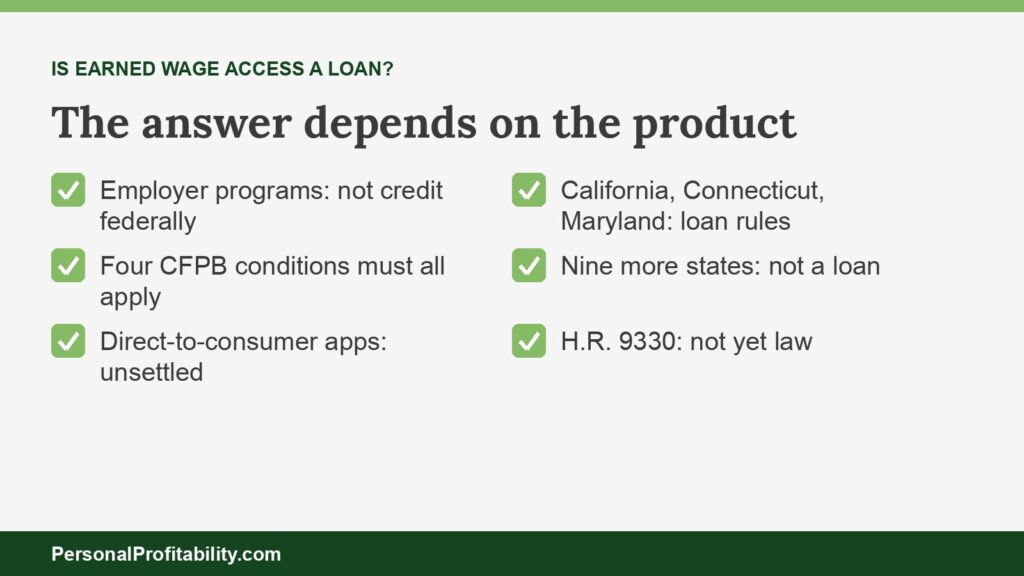
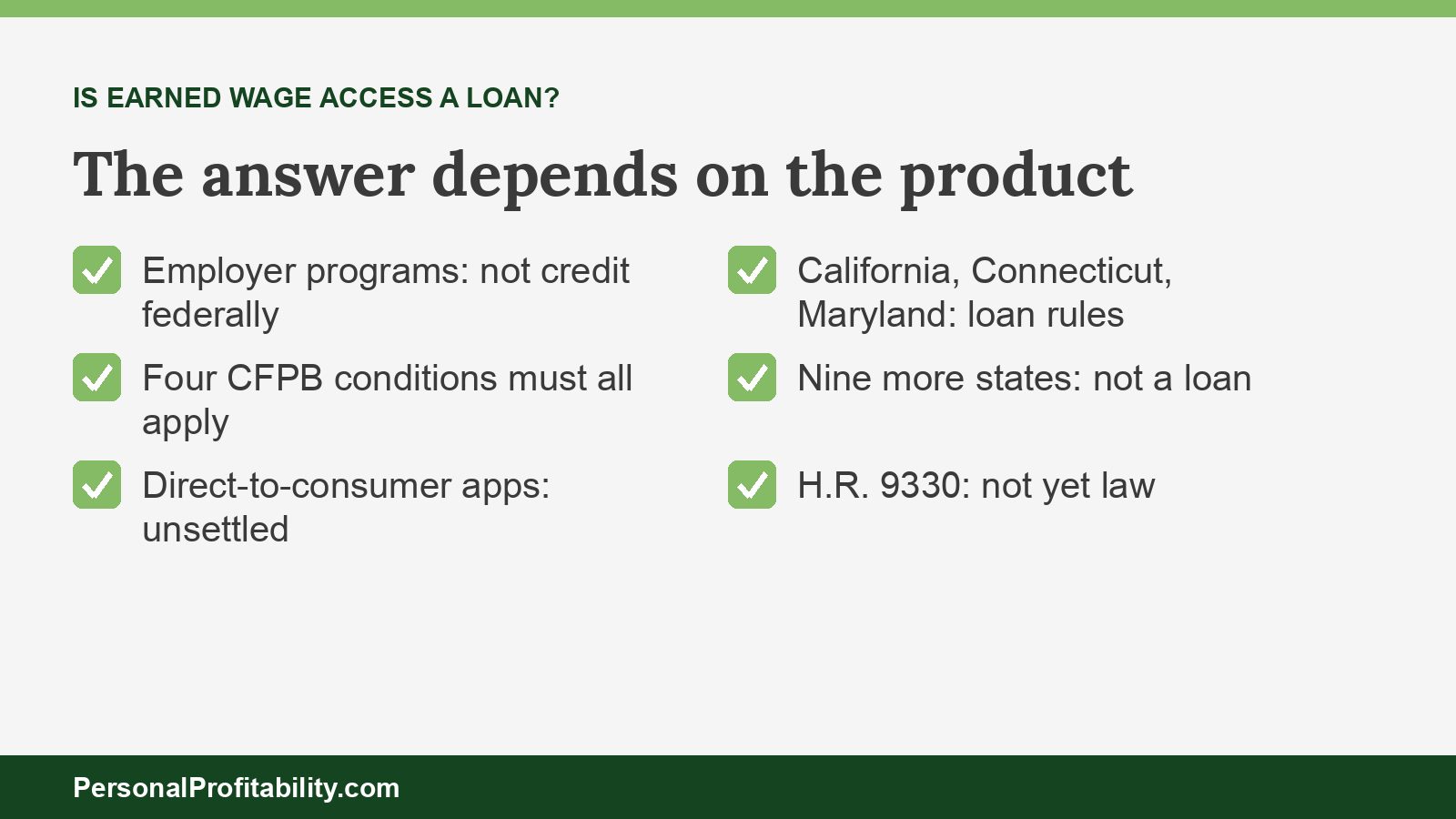
The question “is earned wage access a loan” has a three-part answer: under the CFPB’s December 2025 opinion, employer-integrated EWA meeting four conditions isn’t credit, direct-to-consumer apps remain unsettled, and California, Connecticut, and Maryland treat it as a loan. The rest of this page explains each part, the lawsuits testing it, and what it means for the fee you pay. For the basics first, start with our guide to how earned wage access works.
Laws, rules, and case statuses last checked October 24, 2026. This page explains the law in general terms. It isn’t legal advice for your situation.
Is earned wage access a loan under federal law?
No, not if it’s employer-integrated and meets four conditions the Consumer Financial Protection Bureau (CFPB) spelled out in an advisory opinion published December 23, 2025. The CFPB calls that product “covered EWA,” and its opinion says: “Covered EWA is not credit.” That means the Truth in Lending Act and Regulation Z, the federal rules that require APR disclosures on loans, don’t apply to it.
A provider has to meet all four conditions:
- Earned wages only. The provider caps each advance at the wages you’ve accrued, measured from payroll data, not from your own estimate.
- Payroll repayment. The provider collects repayment through a payroll deduction at your next payday, not by debiting your bank account afterward. It gets one retry for a technical error.
- No recourse. Before you take the money, the provider discloses and contractually promises that it has no claim against you if the deduction comes up short. That rules out debt collection, selling the balance as debt, and credit reporting.
- No credit check. The provider doesn’t pull your credit report or score to decide what you get.
Covered EWA can still carry fees. The CFPB says optional expedited-delivery fees and voluntary tips generally aren’t finance charges. The CFPB adds a warning, though: they could become finance charges if a provider makes the free option or the no-tip option too hard to pick.
The opinion leaves a gap. It doesn’t call non-covered EWA credit, and it doesn’t clear it either. Most direct-to-consumer apps, such as EarnIn, Brigit, and MoneyLion, estimate your pay from your direct deposit history and debit your bank account on payday. That fails condition two. For those apps, the CFPB took no position and said it may act later. The GAO still lists its 2023 recommendation, that the CFPB clarify whether those products are credit, as open.
Spend less, earn more and grow your wealth
Get my free 2026 Playbook with a checklist for your budget, credit, investing and side income, plus the free 7-day Bootcamp.
How earned wage access differs from a loan in practice
Earned wage access lets you access earned wages early, while a loan lets you borrow money you haven’t earned yet and charges interest for the wait. EWA can help with cash flow, the few days between a bill and payday. A loan covers a gap your next paycheck can’t fill. Employers typically offer EWA as on-demand pay before payday, and employees repay it from the paycheck they’ve already earned. That’s the line every regulator in this fight is trying to draw. In practice, the differences show up in five places:
- The limit. An employer program lets you request only a portion of pay you’ve already worked for, and caps vary. Rain, Branch, and Stream cap access at 50% of earnings, and Tapcheck allows up to 70% of net pay. A lender sets your limit by your credit and income.
- The price. EWA providers charge flat fees rather than interest rates. You can usually get the funds free in one to three business days if you don’t mind waiting, or instantly for a fee. A lender charges interest on the balance until you repay it.
- The credit check. Covered EWA can’t use one. Most loans start with one.
- Repayment. Your employer deducts the advance directly from your next paycheck. A loan has its own payment schedule, often for months.
- What happens if you can’t pay. A covered EWA provider has no claim against you. A lender can send the debt to collections and report it to the credit bureaus.
Direct-to-consumer apps blur those lines. They let you access EWA without your employer, which means they estimate your earnings from bank deposits, set the repayment date themselves, and debit your account. Chime even calls its MyPay product “a line of credit.” That’s why the legal fight centers on those apps rather than on employer programs.
When a personal loan makes more sense
EWA covers a gap of a few days, not a bill you need months to pay off. If you face a $1,500 car repair, accessing a few hundred dollars of your paycheck early just leaves the next paycheck short. A small personal loan from a credit union, with a disclosed APR and a fixed monthly payment, can cost less over time than drawing the same paycheck early, every pay period, for months. Daily, on-demand access to your pay feels like a benefit, but EWA only pays off for short gaps. Our guide to bridging a financial gap covers other options.
How the CFPB’s answer changed from 2020 to 2025
The CFPB reversed itself twice in five years, so older articles about EWA’s legal status are often out of date. Here’s the sequence, from the Federal Register and the CFPB’s own releases:
| Date | What happened |
|---|---|
| 2017 | The CFPB’s payday rule excludes employer wage advance programs that don’t exceed earned wages, charge only a participation fee, and have no recourse or credit reporting. |
| Nov. 30, 2020 | A CFPB advisory opinion says certain employer-integrated EWA with no fees to the worker isn’t credit. |
| July 18, 2024 | A proposed CFPB interpretive rule says many paycheck advance products, including EWA, are credit, and that expedite fees and many tips are finance charges. The CFPB never finalized it. |
| Jan. 15, 2025 | In Director Rohit Chopra’s final week, the CFPB rescinds the 2020 opinion. |
| May 12, 2025 | New CFPB leadership withdraws 67 guidance documents, including both the 2020 opinion and its January 2025 rescission. |
| Dec. 23, 2025 | The current advisory opinion takes effect, says covered EWA isn’t credit, and formally withdraws the 2024 proposal. |
The 2025 opinion goes further than the 2020 version in one way that matters to your wallet. The 2020 opinion covered only programs that charged workers nothing. The 2025 opinion lets covered EWA charge expedite fees and accept tips and still fall outside lending law. The CFPB hasn’t published another Federal Register document on earned wage access since.
What H.R. 9330 would change, and where it stands
H.R. 9330 would write the “not a loan” answer into federal law and override state laws that disagree, but it hasn’t passed the House. Rep. Bryan Steil introduced the Earned Wage Access Consumer Protection Act on June 18, 2026. The House Financial Services Committee approved it 29 to 22 on June 30, 2026, and reported it on September 1, 2026, when the House placed it on the Union Calendar. As of October 24, 2026, Congress.gov shows no floor vote, and we found no Senate companion bill.
The reported text says compliant EWA “may not be considered credit, a loan, debt,” and that its fees and tips aren’t finance charges. In exchange, providers would have to follow rules like these:
- Offer a free option for the same amount, sent within one business day.
- Set the default tip at $0 and keep tips voluntary.
- Charge no late fees, interest, or penalties, and refund overdraft fees their mistimed debits cause.
- Never report to credit bureaus, sue, use debt collectors, or sell the balance.
- Share no fees or tips with your employer.
Two things the bill leaves out: a dollar cap on fees, and room for states to call compliant EWA a loan. It would preempt state laws that do, which would undo the loan treatment in California, Connecticut, and Maryland for compliant products. More than 225 groups urged the committee to reject it, according to the Center for Responsible Lending.
Which states treat earned wage access as a loan?
California, Connecticut, and Maryland treat earned wage access as a loan or credit, with carve-outs, while nine other states with EWA laws say compliant products aren’t loans. That’s 12 states in all, by the Urban Institute’s count. Our earned wage access laws by state tracker has the citations and dates for each one.
| Treatment | States | What it means for you |
|---|---|---|
| Loan or credit, with carve-outs | California, Connecticut, Maryland | Providers need a lender license or registration, and Connecticut and Maryland cap fees |
| Not a loan, but providers must register or get a license | Indiana, Kansas, Missouri, Nevada, South Carolina, Utah, Wisconsin | Providers register or apply for a license, then follow product rules, often including a free option. Wisconsin caps fees at $5 and $7.50 |
| Not a loan, product rules only | Arkansas, Louisiana | No license, but the law requires a no-cost option and voluntary tips |
The loan states draw the line in different places. California’s financial regulator, the DFPI, calls income-based advances loans under its lending law but exempts registered providers from lender licensing and its rate caps. Connecticut requires a small loan license and, for advances under $750, caps charges at $4 per advance and $30 a month. Maryland put EWA under its Consumer Loan Law in 2025, capped delivery fees at $5 for advances of $75 or less and $7.50 above that, and banned tips starting October 1, 2026.
Two more states, Arizona and Montana, have attorney general opinions saying non-recourse EWA isn’t a consumer loan. New York has no EWA statute, which is why its attorney general went to court instead.
What the lawsuits against EWA apps claim
State attorneys general in New York, Colorado, Minnesota, and Washington, D.C., have sued EWA companies on the theory that their products are illegal loans, and none of those cases has reached a final ruling on that question. Almost every case targets a direct-to-consumer company and its EWA services. DailyPay is the employer-integrated exception.
| Case | Filed | What the state alleges | Status as of Oct. 24, 2026 |
|---|---|---|---|
| New York AG v. DailyPay | April 14, 2025 | Usury violations plus wage assignment violations. The AG says DailyPay’s most common advance, $20 for seven days with a $2.99 fee, works out to over 750% APR. | Back in state court after a federal judge remanded it. DailyPay moved to dismiss in January 2026. We found no ruling. |
| New York AG v. MoneyLion | April 14, 2025 | Usury claims, plus fraud claims. The AG says more than half of MoneyLion’s advances carried APRs above 500%. | Remanded to state court. Motion to dismiss filed January 2026. We found no ruling. |
| D.C. AG v. EarnIn | Nov. 19, 2024 | Unlicensed lending, with average APRs on instant Cash Outs over 300%, against D.C.’s 24% cap. | Unsettled. EarnIn’s lawyers say the court dismissed most claims in May 2025. A consumer-group tracker lists the case as still active. |
| Minnesota AG v. Brigit | June 10, 2026 | Unlicensed short-term lending, with APRs regularly over 300% and some over 700%, against Minnesota’s 50% cap. | Pending |
| Colorado AG v. EarnIn | Aug. 27, 2026 | High-cost lending, plus deceptive tip prompts. The AG counts 3.1 million-plus Colorado advances and $16 million-plus in tips and fees from January 2023 to July 2025. | Pending |
DailyPay went to court first. DailyPay sued the New York attorney general on April 7, 2025, a week before the state filed its own case. The company asked a judge to declare that its service “is not a loan and therefore not subject to usury laws.” Private plaintiffs have pushed too. In early 2026, Judge Lewis Liman in Manhattan federal court let a case against Brigit proceed, finding its Instant Cash “substantially similar” to payday loans, according to the New Economy Project. Brigit has appealed. Several other federal judges have let similar claims against direct-to-consumer apps go forward. If you use EarnIn, our EarnIn review covers what these suits mean for its customers, and our DailyPay review covers the New York case.
What the loan question means for your wallet
The legal label decides whether a provider has to show you an APR, but it doesn’t change what you pay, so do the math yourself. Under lending law, a lender has to disclose the annual percentage rate. Covered EWA providers don’t, so a $3 fee looks like pocket change. If you’re living paycheck to paycheck, nearly every dollar you spend on accessing your money early is a dollar the next paycheck won’t cover.
Price it like a loan anyway. The CFPB’s 2024 data showed an average transfer of $106 and an average fee of $3.18 when workers paid one, repaid in about 10 days. That’s an illustrative APR of 109.5%. Shrink the advance or the wait and the rate climbs past 500%. The average worker in the CFPB’s sample made 27 transfers a year, which at $3.18 each comes to $85.86 a year in fees on your own pay. Our earned wage access fees guide runs the numbers for each provider.
Why tips sit at the center of the fight
Tips decide much of the legal case, because a tip that isn’t voluntary works like interest. California’s DFPI found that workers tipped 73% of the time on tip-based apps in 2021, and it put the average APR for those companies at 334% with tips included. Colorado’s suit accuses EarnIn of dark patterns that steer people toward tipping. Maryland banned tips outright. The CFPB’s 2025 opinion treats tips as voluntary only if skipping them is easy. Our advice is simpler: tip $0 every time, and take the free transfer.
Earned wage access vs. payday loan
Employer-integrated earned wage access costs less and carries less risk than a payday loan, even when both charge a fee. The GAO compared them in 2023 and found that getting $100 cost $0 to $10.08 across four EWA products, against $10 to $30 for a typical payday loan.
| Feature | Covered EWA | Payday loan |
|---|---|---|
| Cost to get $100 (GAO) | $0 to $10.08 | $10 to $30 |
| Limited to pay you’ve earned | Yes | No |
| Repayment | Payroll deduction | Lump sum from your bank account |
| Collections if you can’t repay | None, by the provider’s own contract | Yes |
| Federal lending law applies | No | Yes |
We’ve never recommended a payday loan, and our take on why payday lenders are like the mafia hasn’t softened. For the full side-by-side, read earned wage access vs. payday loans. Colorado readers can also see how the state already limits payday lenders in our post on Colorado payday loan legislation.
Is earned wage access a loan? FAQ
Loan or not, price it like one
Federal regulators say employer-integrated EWA isn’t a loan, three states say it is, and courts are still sorting out the direct-to-consumer apps. None of that changes the math on your phone. A $3 fee on a $100 advance repaid in a week costs more, in APR terms, than most credit cards. Use the free transfer, tip nothing, and if you need EWA every pay period, put your next spare $25 toward an emergency fund instead. Our roundup of the best earned wage access apps shows which ones give you a $0 path.
Free guide
Spend less, earn more and grow your wealth
Get my free 2026 Playbook with a checklist for your budget, credit, investing and side income, plus the free 7-day Bootcamp.
- Track your money with the tools that still work in 2026
- The order to invest in, with the 2026 401(k) and IRA limits
- Three ways to earn your first $100 on the side this month
Bonus: The 7-day Personal Profitability Bootcamp, one short lesson in your inbox each day