
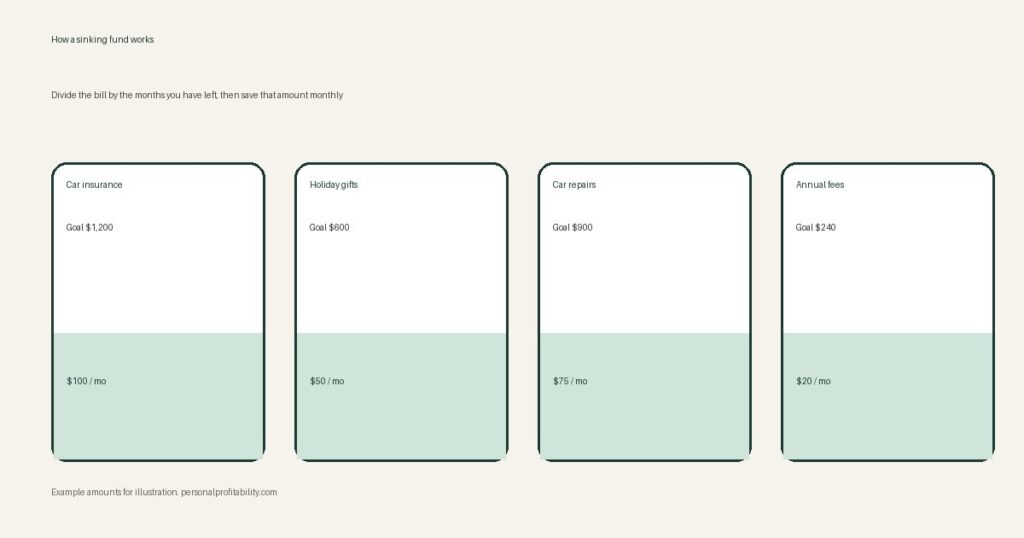
If you’re wondering how to start a sinking fund, pick one bill you know is coming, divide its cost by the months you have left, and move that amount into a separate savings account every month. A sinking fund is money you set aside in small pieces for a planned expense, so a $1,200 car insurance bill never lands on your credit card. If you already have an emergency fund, this is its quieter cousin, the money you set aside for the bills you can see coming.
Budgets usually break in one spot. Monthly bills are fine, but the annual and twice-a-year ones show up as surprises, even though they have the same due date every year. With a sinking fund, you turn each of those into a small, boring monthly habit. Boring is the point.
What a sinking fund is (and how it differs from an emergency fund)
Think of a sinking fund as a savings bucket with a name, a target amount, and a date. You know what the money is for before you save a dollar of it. You save an emergency fund for the things you can’t predict, like a layoff or an ER visit. You save a sinking fund for the things you can predict but don’t pay every month.
The Consumer Financial Protection Bureau’s savings plan worksheet makes the same split. The CFPB asks about money for “expenses that come one to four times per year,” such as car insurance, renter’s insurance, back-to-school costs, birthdays, and holidays, as a separate question from money for emergencies like a flat tire or a job loss. Keep the two in separate buckets. Mix them, and you’ll spend the cushion on the first predictable bill and have nothing left for the surprise.
| Sinking fund | Emergency fund | |
|---|---|---|
| What it covers | Expected costs with a known or likely date | Surprises you can’t schedule |
| Target amount | The cost of the bill, split across months | Usually several months of essential expenses |
| When you spend it | On the due date | Only when something goes wrong |
| How many you have | Several, one per goal | One |
| What happens at zero | You refill it for next year | You rebuild it as fast as you can |
Build a budget you'll keep this month
Get my free 2026 guide to picking categories, setting limits, automating your savings and choosing a budgeting tool.
Which expenses deserve a sinking fund
Candidates include any bill that arrives less often than monthly and costs enough to hurt. Start with the ones that already caught you off guard. Try this test: if you’ve ever put a bill on a credit card because you weren’t ready for it, give that bill a fund.
- Insurance premiums you pay once or twice a year, including auto, renters, and life.
- Car maintenance and repairs. A car is a certain future expense even when the date is unknown.
- Holidays and gifts, including birthdays, which come on the same day every year.
- Annual fees and subscriptions, like a credit card fee, a software license, or a warehouse club membership.
- Property taxes and HOA dues when you pay them outside your mortgage escrow.
- Out-of-pocket health costs, such as deductibles, dental work, and glasses.
- Travel, if you take a trip every year.
- Estimated taxes on freelance income. If you freelance, you may need to make quarterly payments, and you can find the dates in our guide to quarterly estimated taxes.
Skip the 25-fund spreadsheet on day one. Three to five is plenty, and fewer is better if you have never done this before.
How to start a sinking fund in five steps
- List the bills that surprised you in the last 12 months. Check your bank and card statements. Anything that was over about $100 and not monthly goes on the list.
- Put a cost and a date next to each one. Use last year’s amount, and round up a little if prices have been rising. If you don’t know the date, pick a realistic one.
- Divide the cost by the months remaining. A $1,200 insurance premium due in 12 months takes $100 a month. Due in 6 months, the same premium takes $200 a month.
- Add up all the monthly amounts and check it against your income. If the total is too high, stretch the deadline on the least urgent goal or drop it from the list for now. You’ll give up on a plan you can’t afford by March.
- Automate the transfers. Set up a recurring transfer for the day after payday so the money moves before you can spend it.
Most people make or break the plan on step five. Automating is the pay-yourself-first idea applied to bills, and you never have to decide to do it. If you want more on setting that up, see our guide on how to automate your finances.
A worked example: four sinking funds for $245 a month
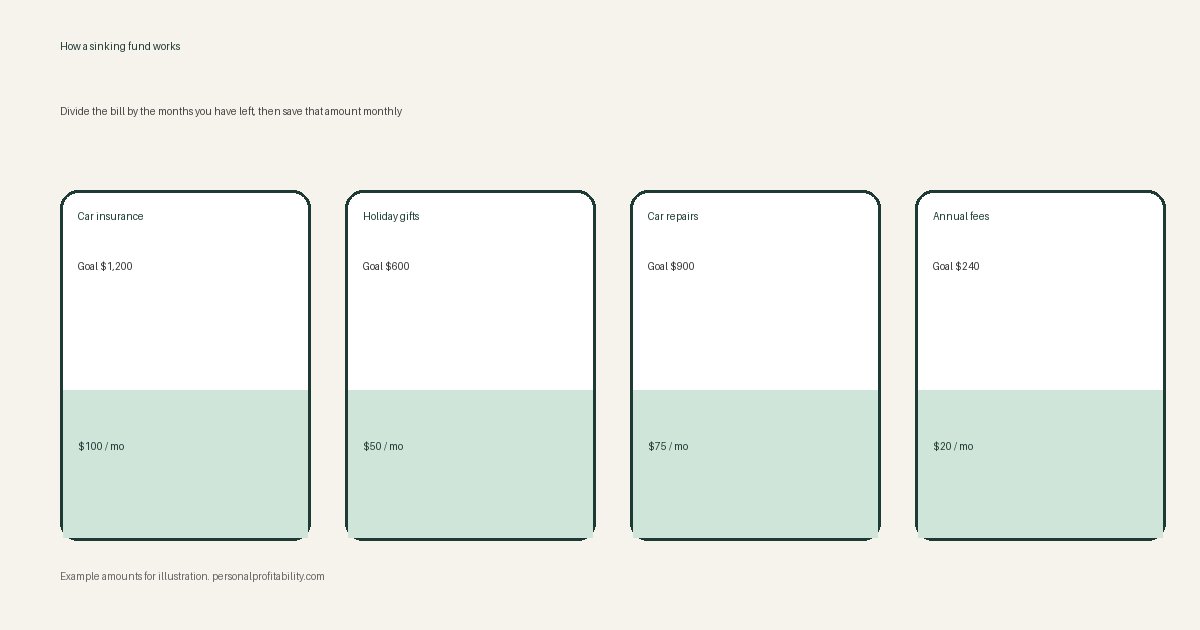
The four funds below use made-up but realistic amounts so you can see how the math stacks up. Your numbers will differ, so swap in your own bills.
| Sinking fund | Target | Months to save | Monthly transfer |
|---|---|---|---|
| Car insurance premium | $1,200 | 12 | $100 |
| Holiday gifts | $600 | 12 | $50 |
| Car repairs and maintenance | $900 | 12 | $75 |
| Annual fees and subscriptions | $240 | 12 | $20 |
| Total | $2,940 | $245 |
$2,940 in annual expenses sounds heavy until you see it as $245 a month. Some goals don’t reset to zero. Keep a repair fund as a running balance, so you can put the money you don’t spend this year toward a bigger repair next year.
If your income swings from month to month, treat the transfers like a bill and fund them first in good months. Our post on how to budget with irregular income walks you through that without a rigid spreadsheet.
Where to keep the money
You can park the money in an FDIC-insured savings account that pays interest and doesn’t charge you to hold it. The FDIC insures deposits up to $250,000 per depositor, per insured bank, for each account ownership category, so a few thousand dollars in sinking funds sits well inside that limit. A high-yield savings account is the usual choice, and our explainer on how a high-yield savings account works lists what to compare.
You have two practical setups:
- One account with a running total. You track each fund in a notes app or spreadsheet. It’s simple, but you have to keep the tally yourself.
- Separate accounts or sub-accounts. Many online banks let you create named buckets inside one savings account. Each goal has its own balance, and you can see at a glance if the car fund is short. Check with your bank, because the feature and any fees vary.
Leave investing out of it. Every sinking fund has a due date, sometimes only a few months away, so if the market dips at the wrong time, you could come up short. Park it where it can’t lose value, and invest your long-term money instead.
Mistakes that sink the plan
- Raiding the fund for something else. Spend the insurance money on a weekend trip, and you’re back to a credit card in the fall. If you borrow from one fund, set a date to pay it back.
- Making too many funds. More than five or six and you stop checking them. Group small goals together under one name like “annual stuff.”
- Skipping the emergency fund. If you have nothing saved at all, build a small starter cushion first, then add sinking funds.
- Setting a target and never revisiting it. Insurance and car costs rise. Review each target once a year, ideally when the bill arrives.
- Saving for debt you could pay off instead. If you carry a credit card balance, your first job is paying it down. You’ll usually pay more in card interest than a savings account earns. Keep a small sinking fund for the biggest predictable bills so they stay off the card, and put the rest toward the debt avalanche.
When even a short list doesn’t fit, your budget has a gap. Fixing that with more income is often easier than cutting further, and our list of passive income ideas that actually work is a place to start.
Should you use a sinking fund or a budget category?
Use both. Treat a sinking fund as a budget category with its own savings balance behind it. If you keep a loose budget, you can get by with a spreadsheet column. If you spend most of your paycheck before the month ends, you’ll do better with a separate account, because it’s harder to spend money you can’t see in your checking balance.
You can pair it with conscious spending: decide what matters, fund it first, and spend the rest without guilt. You can also fit it into the 50/30/20 budget rule. Count each transfer as a need, a want, or savings, depending on what the money buys.
Sinking fund FAQ
Start with one bill this month
To start a sinking fund, name the bill, set the amount, divide by the months left, and automate the transfer. Begin with the one expense that surprised you most, and add the next one once the first transfer runs without you thinking about it.
For more on building the habit, read our guides on emergency funds, how to create your first budget, and more budgeting posts, or head back to the Personal Profitability homepage.
Free guide
Build a budget you'll keep this month
Get my free 2026 guide to picking categories, setting limits, automating your savings and choosing a budgeting tool.
- Set category limits from what you spend now
- Try envelope, zero-based and one-line budgets
- Compare free and paid budgeting tools for 2026
Bonus: The 30-Day Money Reset, a one-task-a-day plan to put your budget to work