
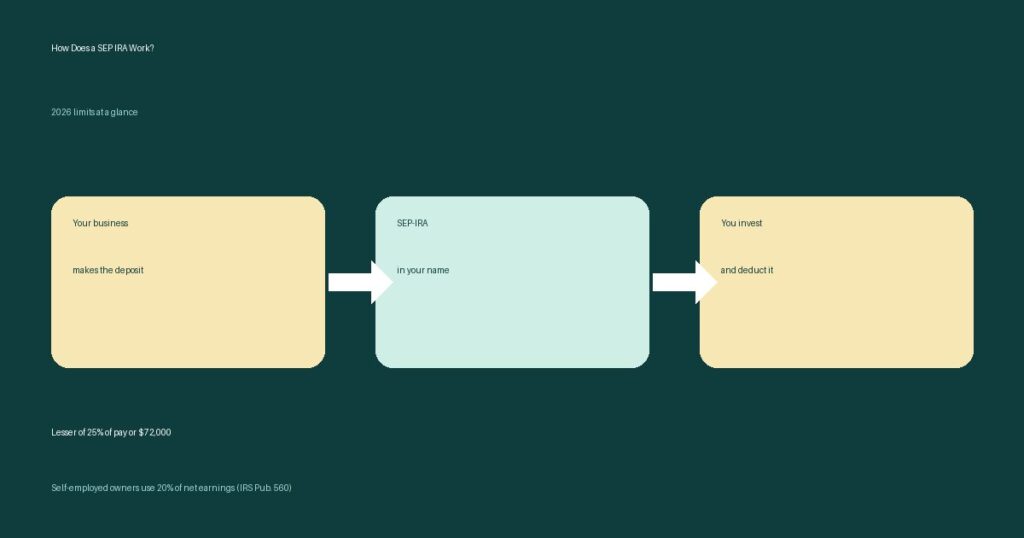
How does a SEP IRA work? Your business opens a traditional IRA-style account and makes the contributions, up to the lesser of 25% of compensation or $72,000 for 2026. You can’t put in money as an employee, so every dollar comes from the business, even when you are the business. If you freelance or run a one-person shop, you can open one in an afternoon and still fund it after the year ends. Below you’ll find the 2026 limits, the self-employed math, the setup steps, and the catches.
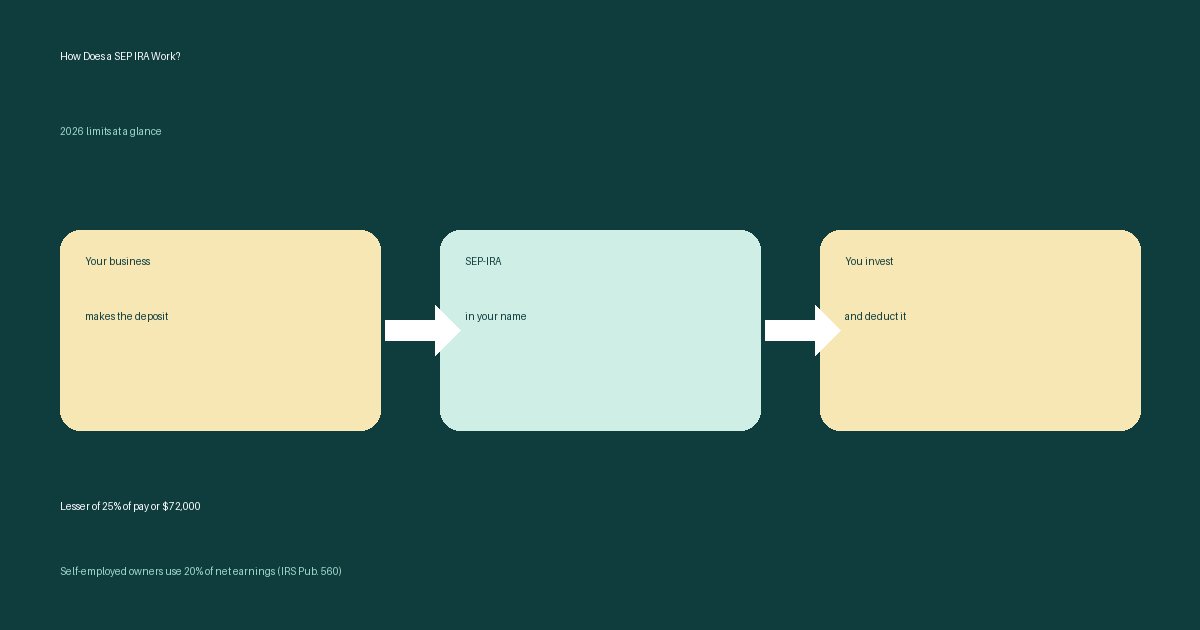
How does a SEP IRA work? The basics
SEP stands for Simplified Employee Pension. The IRS describes it as a plan where only the employer contributes, and any business can set one up, even a self-employed person with no staff. Contributions land in a traditional IRA (a SEP-IRA) in each eligible person’s name, so you own the account and pick the investments.
Paperwork stays minimal. Form 5305-SEP is the IRS model document, and you adopt the form and keep a copy in your records, with no IRS filing. Larger 401(k) plans carry annual filings, but a SEP doesn’t, and employees own every contribution from day one.
Money flows one way here. Employees can’t defer pay and nobody gets catch-up contributions, so someone age 50 or older gets no extra room the way they would in a 401(k).
Learn how the stock market works, then start
Get my free 2026 guide to stocks, trades, account types, and index funds, plus a step-by-step plan for your first investment.
How much you can contribute to a SEP IRA in 2026
For 2026, the IRS limits what an employer contributes to the lesser of 25% of the employee’s compensation or $72,000. That’s up from $70,000 for 2025. The IRS counts compensation only up to $360,000, and 25% of $288,000 already equals $72,000, so an employee paid $288,000 or more hits the dollar cap.
| Item | 2026 figure | Source |
|---|---|---|
| Contribution cap per person | Lesser of 25% of compensation or $72,000 | IRS, SEP contribution limits |
| Compensation counted in the 25% | Up to $360,000 | IRS Publication 560 |
| Minimum pay to be eligible | $800 in the year | IRS Publication 560 |
| Owner’s own rate (Schedule C) | 20% of net self-employment earnings | IRS Publication 560 |
| Employee deferrals or catch-up | Not allowed | IRS |
The IRS sets your personal IRA allowance at $7,500 for 2026, and a SEP contribution leaves it untouched. So you can fund a SEP IRA and a Roth IRA in the same year. Income limits still apply to the Roth.
How to figure your own contribution as a self-employed owner
If you file Schedule C, you use 20% of your net self-employment earnings, not 25%. The IRS sets the lower rate in Publication 560 because your contribution is itself a deduction that lowers your earnings. Before you apply the rate, subtract the deductible half of your self-employment tax.
Here’s a rough example. Say your Schedule C shows $100,000 of net profit. Self-employment tax is 15.3% of 92.35% of that profit, or about $14,130, and half of it (about $7,065) is deductible. That leaves roughly $92,935. Twenty percent of $92,935 is about $18,587. So the most you could put in is about $18,600, and the dollar cap doesn’t come into play.
For the exact number, use the Rate Table and the Deduction Worksheet in Publication 560, or hand the job to a tax preparer. You can see where that 15.3% comes from in our guide to self-employment tax.
What you owe your employees if you have any
Solo owners get the most from a SEP, and you pay more for it once you hire. Federal rules require you to cover every employee who is at least 21, has worked for you in at least 3 of the last 5 years, and earned at least the minimum pay for the year. You can set looser eligibility rules than these, but never stricter rules.
Everyone gets the same percentage. Put in 15% of your pay and you owe 15% of each eligible employee’s pay. That’s why a SEP is cheap to run for a freelancer and expensive for a shop with five full-time workers. You may exclude employees under a union agreement and nonresident aliens who have no U.S. income from your business.
How to open a SEP IRA, step by step
- Pick a provider. Most brokerages and many banks offer SEP IRAs. Compare account fees, investment choices, and whether they handle the Form 5305-SEP paperwork.
- Adopt the plan. Fill out Form 5305-SEP (or the provider’s own SEP document) and keep it with your business records. You don’t file it with the IRS.
- Open the account. Set up a SEP-IRA in your name, plus one for each eligible employee if you have any.
- Figure your contribution. Use 25% of pay for employees and the Publication 560 worksheet for yourself.
- Fund it by the deadline. Deposit the money by your tax-return due date, including extensions, for the year you want to count.
- Invest the money. Choose a low-cost S&P 500 index fund or a target-date fund, and set it to buy automatically.
You can wait until you know your profit for the year, since the deadline runs through your filing date. A big client payment in March can still count toward the prior year’s contribution.
Taxes, deadlines, and withdrawals
Your business deducts the contributions. Sole proprietors claim theirs as an adjustment to income on Schedule 1, so it lowers your income tax but not your self-employment tax. Inside the account, the money grows tax-deferred.
Withdrawals follow traditional IRA rules. Ordinary income tax applies to what you take out, and the IRS generally adds a 10% additional tax on distributions before age 59½. Rollovers work the same way they do for other IRAs, and you can keep a SEP alongside another retirement plan. Unless the other plan is also a SEP, you can’t use Form 5305-SEP, so you’d adopt a prototype SEP document from a provider instead.
Self-employed workers who owe quarterly taxes can use a SEP to cut the bill, but you only see the savings when you file. To plan around that timing, read our guide on how to pay quarterly estimated taxes.
When a SEP IRA fits, and when it doesn’t
Freelancers and owners with no employees get the simplest setup, and they can fund it after year-end. Irregular income also works, since a skipped year costs nothing.
It fits poorly if you have staff, because the same-percentage rule applies to everyone. It also fits poorly if your income is modest and you want to save a large dollar amount, because with a Solo 401(k) you contribute as both employee and employer. We run both side by side in our SEP IRA vs Solo 401k comparison, and you can read how a Solo 401(k) works for the other option.
Set a percentage you can live with, open the account, and automate the deposits.
SEP IRA pros and cons
Speed and flexibility are the upside. You can open the account in a day, skip contributions in a slow year, and fund the prior year after you see your profit. You also choose your own investments.
Owners who earn less get limited room. Because you contribute only as the employer, your 20% rate on net earnings sets the ceiling, so a freelancer with $40,000 of profit tops out near $7,400. Add the missing catch-up contributions and the same-percentage rule for staff, and many small teams do better with another plan.
- Pros: minimal paperwork, no annual filing, flexible yearly contributions, 100% immediate vesting, a high dollar cap, and a deadline that runs through your filing date.
- Cons: no employee deferrals, no catch-up contributions, and a same-percentage rule for every eligible employee.
SEP IRA vs other self-employed retirement accounts
Each account trades simplicity against contribution room, and this table compares them for 2026.
| Feature | SEP IRA | Solo 401(k) | Traditional or Roth IRA |
|---|---|---|---|
| Who contributes | Employer only | Employee and employer | You |
| 2026 contribution cap | Lesser of 25% of pay or $72,000 | $72,000 total, with $24,500 in employee deferrals | $7,500 |
| Catch-up contributions | None | Yes, at age 50 or older | Yes, at age 50 or older |
| Setup | Form 5305-SEP, no filing | Plan document, plus an annual form once assets grow large | Open the account |
| Best for | Simple setup, high income | Modest income, bigger savings | Extra savings on top |
The $24,500 deferral figure and the catch-up rule come from the IRS retirement plan limits for 2026. For a full comparison with numbers, read the SEP IRA vs Solo 401k post.
Frequently asked questions about SEP IRAs
Conclusion
A SEP IRA gives a self-employed owner a tax-deductible place to put up to $72,000 a year for 2026, with almost no paperwork. Compare it against a Solo 401(k), check the self-employed retirement saving options, and use the Roth IRA guide for the account you fund yourself. For more, browse the retirement category. Check current limits on IRS.gov before you contribute, and ask a tax professional about your own numbers.

Free guide
Learn how the stock market works, then start
Get my free 2026 guide to stocks, trades, account types, and index funds, plus a step-by-step plan for your first investment.
- How a trade works, from order types to T+1 settlement.
- Why I start with low-cost index funds instead of stock picks.
- The margin rules and my own trading mistakes, so you can avoid the same errors.
Bonus: The First-Investment Checklist, the order to handle your match, debt, and savings