
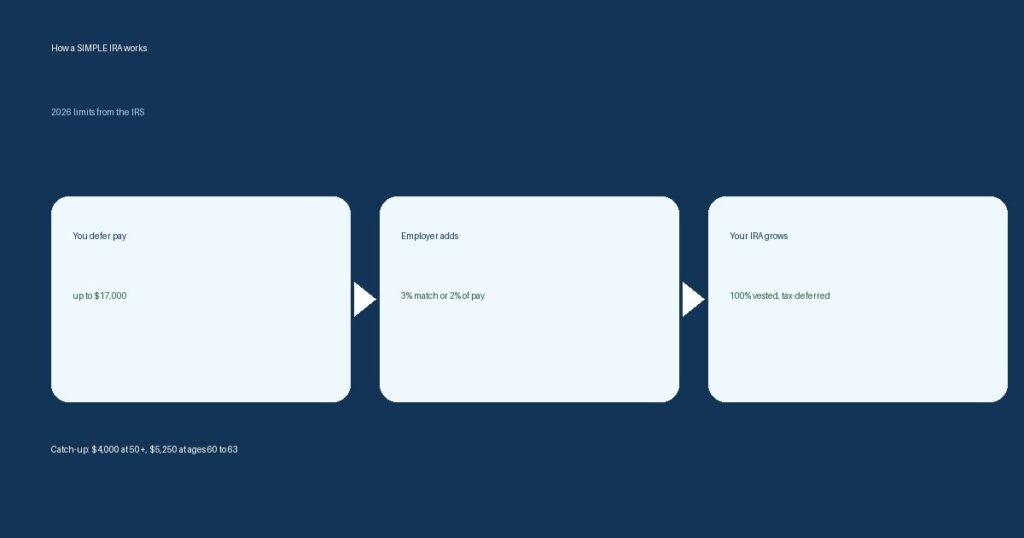
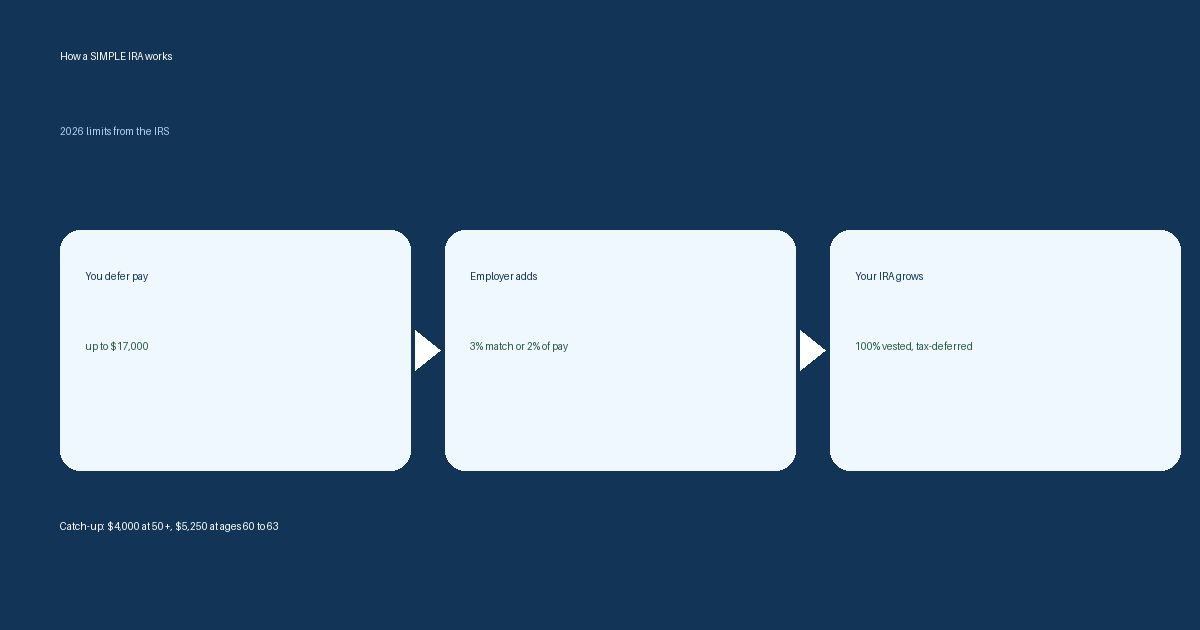
How does a SIMPLE IRA work? You and your employer both put money into an IRA that you own. You choose how much pay to defer, up to $17,000 for 2026, and the business adds either a match of up to 3% of your pay or a flat 2% contribution for every eligible employee. The plan suits businesses with 100 or fewer employees, and it also works for one-person shops. Below you’ll find the 2026 limits, the employer rules, the withdrawal penalties, and how it compares with a SEP IRA and a Solo 401(k).
How does a SIMPLE IRA work? The basics
SIMPLE stands for Savings Incentive Match Plan for Employees. Each worker owns an individual retirement account under the plan and picks the investments inside the account. The IRS describes it as a plan for small businesses, generally those with 100 or fewer employees, and the employer can’t have any other retirement plan running at the same time.
Think of it as a 401(k) with the paperwork stripped out. The business signs a short plan agreement (the IRS offers Forms 5304-SIMPLE and 5305-SIMPLE for this), keeps the form, and does not file it with the IRS. The business also generally has no annual Form 5500 to file. You get a retirement account, and the owner skips most of the compliance work that makes a 401(k) expensive for a small shop.
Employees are always 100% vested. Every dollar you defer and every dollar the employer adds belongs to you immediately, even if you quit next month.
Learn how the stock market works, then start
Get my free 2026 guide to stocks, trades, account types, and index funds, plus a step-by-step plan for your first investment.
What are the SIMPLE IRA contribution limits for 2026?
The 2026 employee deferral limit is $17,000, according to the IRS SIMPLE IRA contribution limits page. If the plan allows a catch-up, workers 50 or older can add one, and a bigger catch-up applies at ages 60 through 63. Here are the figures side by side.
| Contribution | 2026 limit | Who qualifies |
|---|---|---|
| Employee deferral | $17,000 | Every participant |
| Age 50+ catch-up | $4,000 | Participants 50+ in plans with a catch-up |
| Age 60 to 63 catch-up | $5,250 | Participants who turn 60, 61, 62, or 63 this year, in place of the $4,000 |
| Compensation counted for the 2% contribution | $360,000 | Employers using the 2% method |
Recheck these each January, because the IRS adjusts them for cost of living. If you also defer pay into another employer plan, such as a 401(k) at a second job, the IRS caps your combined deferrals across all plans at $24,500 for 2026. Under SECURE 2.0, Congress also set a higher deferral limit and a different age 50 catch-up for some SIMPLE plans, and employers may now add an extra contribution for everyone. Ask your plan provider which rules your plan follows.
Eric’s standing advice on retirement accounts is to take every dollar of free money first. A SIMPLE IRA match counts as free money. If your employer offers the 3% match, defer at least enough to collect all of it before you put a dollar anywhere else.
The employer contribution: match or 2%
Every year the employer picks one of two methods, and the choice has to reach employees before the election period starts.
| Method | What the employer pays | Do employees need to defer? |
|---|---|---|
| Match | Dollar for dollar up to 3% of pay, reducible to 1% in no more than 2 of any 5 years | Yes, you get the match only on what you defer |
| Nonelective | 2% of pay for every eligible employee | No, you get it even if you defer nothing |
Here is what that looks like in dollars. Say you earn $60,000 and your employer uses the 3% match. If you defer $1,800 or more, the employer adds $1,800. You defer $6,000 and the employer still adds $1,800, because the match stops at 3% of your pay. Under the 2% method, the employer would put in $1,200 whether you defer anything or not.
Employee deferrals must reach the plan within 30 days after the end of the month the pay would have been in your hands. The employer’s own contribution is due by the business tax return due date, including extensions, according to the IRS SIMPLE IRA plan page.
Eligibility, including the self-employed
The plan must admit any employee who earned at least $5,000 in compensation in any two prior years and expects at least $5,000 this year. An employer may choose looser rules, such as letting a new hire join on day one, but not stricter ones.
Self-employed people can use one too. If you run a sole proprietorship with no other retirement plan, you play both roles. You defer a slice of your earnings as the employee and then make the match or the 2% contribution as the employer. Freelancers who plan to hire help sometimes choose this plan for that reason, since it already covers employees without a new setup.
Setting up a SIMPLE IRA in six steps
- Confirm you qualify. You need 100 or fewer employees and no other retirement plan at the business.
- Pick a provider. Banks, brokerages, and mutual fund companies all offer SIMPLE IRAs. Compare annual fees and the investment menu.
- Sign the plan document. Use IRS Form 5304-SIMPLE or 5305-SIMPLE, or a provider’s prototype plan. Keep it. Do not send it to the IRS.
- Choose the employer method. Decide on the 3% match or the 2% contribution, and tell employees before the election period.
- Open an IRA for each employee. Each worker owns the account and picks their investments.
- Start deferrals. Send each worker’s chosen amount from payroll to the IRA on time.
Timing matters. A business that has never had a SIMPLE IRA can make the plan effective on any date from January 1 through October 1. A business that ran one before can only start a new plan effective January 1. Employees must receive a notice before the annual election period, which generally runs November 2 to December 31.
Withdrawal rules and penalties
Pull money out before age 59½ and you generally owe regular income tax plus a 10% additional tax. If the withdrawal happens in your first two years of participating in the plan, the additional tax jumps to 25%. That two-year window is the sharpest edge in the plan, so don’t treat a new SIMPLE IRA as emergency money.
The same two-year clock controls rollovers. You can roll a SIMPLE IRA into a traditional IRA, a 401(k), or another eligible plan tax-free only after two years of participation. Before then, you can move it only to another SIMPLE IRA. Keep a separate emergency fund so you never need to touch the account early.
SIMPLE IRA vs SEP IRA vs Solo 401(k)
The right plan depends on whether you work alone, how much you want to save, and whether you have employees.
| Plan | Who contributes | Best fit |
|---|---|---|
| SIMPLE IRA | Employee defers pay, employer adds a match or 2% | Small teams, owners with a few workers, and anyone who wants low paperwork |
| SEP IRA | Employer only | High earners with few or no employees who want a big employer-funded contribution |
| Solo 401(k) | Employee and employer | One-person businesses that want the highest total |
A one-person business that wants to save the most usually does better with a Solo 401(k), which our guide on SEP IRA vs Solo 401(k) covers in detail. Pick a SIMPLE IRA when you have even a couple of employees and want a plan they can use without a Form 5500 or a third-party administrator.
Pros and cons of a SIMPLE IRA
You give up some flexibility to get simplicity. Here is what you get and what you give up.
- Low cost and low paperwork (pro). You skip the annual Form 5500 and the testing that bigger plans need.
- Employee deferrals (pro). Only the employer contributes to a SEP IRA, so a SIMPLE IRA suits a team where workers want to save too.
- Full vesting on day one (pro). Employer money belongs to you from the first dollar.
- A lower ceiling (con). The $17,000 deferral limit sits below the $24,500 limit the IRS set for 401(k) deferrals in 2026.
- A yearly employer commitment (con). The business commits to a match or a 2% contribution, with limited room to skip.
- The two-year penalty (con). A withdrawal in the first two years costs 25%, and rollovers to other plan types wait until the two years pass.
Who should pick a SIMPLE IRA
Ask three questions. Do you have employees, or plan to hire soon? Do you want a plan that costs little to run? Are you comfortable owing a contribution every year, even in a slow one? If you answered yes three times, look hard at a SIMPLE IRA. A solo freelancer who wants to shelter the most income usually does better with a Solo 401(k), and a self-employed person with fluctuating income may prefer the flexibility of a SEP IRA.
You invest the money in these accounts, so the usual rules apply. Eric’s default is a low-cost S&P 500 index fund or a target-date fund, and avoiding market timing. Whatever your provider offers, compare the fund fees before you pick.
Tax treatment is another point. Deferrals reduce your taxable pay now, and you pay income tax when you withdraw in retirement. If you also want tax-free withdrawals later, open a Roth IRA outside the plan. Our Roth IRA for beginners guide explains how.
Frequently asked questions about the SIMPLE IRA
Conclusion
You can run a SIMPLE IRA with little effort as a small business and still give workers a tax-advantaged account with an employer match. Know the 2026 limit of $17,000, pick the 3% match or the 2% contribution each year, and remember the two-year window before the 25% penalty and the rollover limits fall away. If you want to compare other small-business options, start with how a SEP IRA works and how a Solo 401(k) works, or browse more in our retirement category. For tax questions specific to your business, talk with a CPA, and see the Personal Profitability homepage for more guides.

Free guide
Learn how the stock market works, then start
Get my free 2026 guide to stocks, trades, account types, and index funds, plus a step-by-step plan for your first investment.
- How a trade works, from order types to T+1 settlement.
- Why I start with low-cost index funds instead of stock picks.
- The margin rules and my own trading mistakes, so you can avoid the same errors.
Bonus: The First-Investment Checklist, the order to handle your match, debt, and savings