
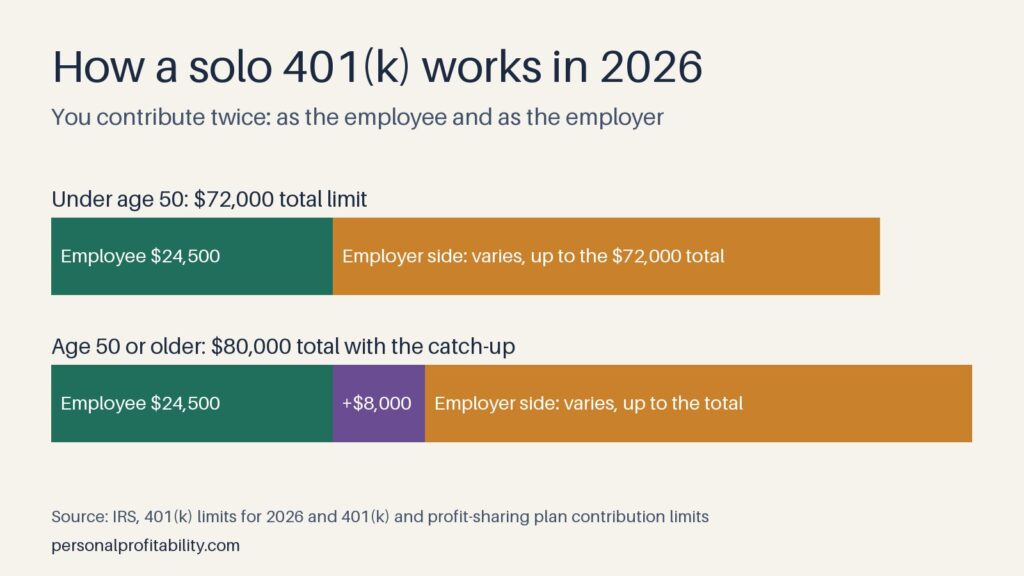
How does a solo 401k work? A solo 401k is a regular 401(k) built for a business owner with no employees, and you save as both the employee and the employer, so a freelancer or side hustler can put away far more than a typical IRA allows. The IRS calls it a traditional 401(k) plan covering a business owner with no employees, or that owner and a spouse. If you earn money on your own, this is one of the strongest retirement accounts on the menu. You can find the rest of the self-employed money picture in our personal finance guides for hustlers.
How does a solo 401k work? The short version
You get two paychecks to save from with a solo 401k. As the employee, you defer part of your own earnings. As the employer (your business), you add a contribution on top. You can stack the two sides, up to a combined yearly cap.
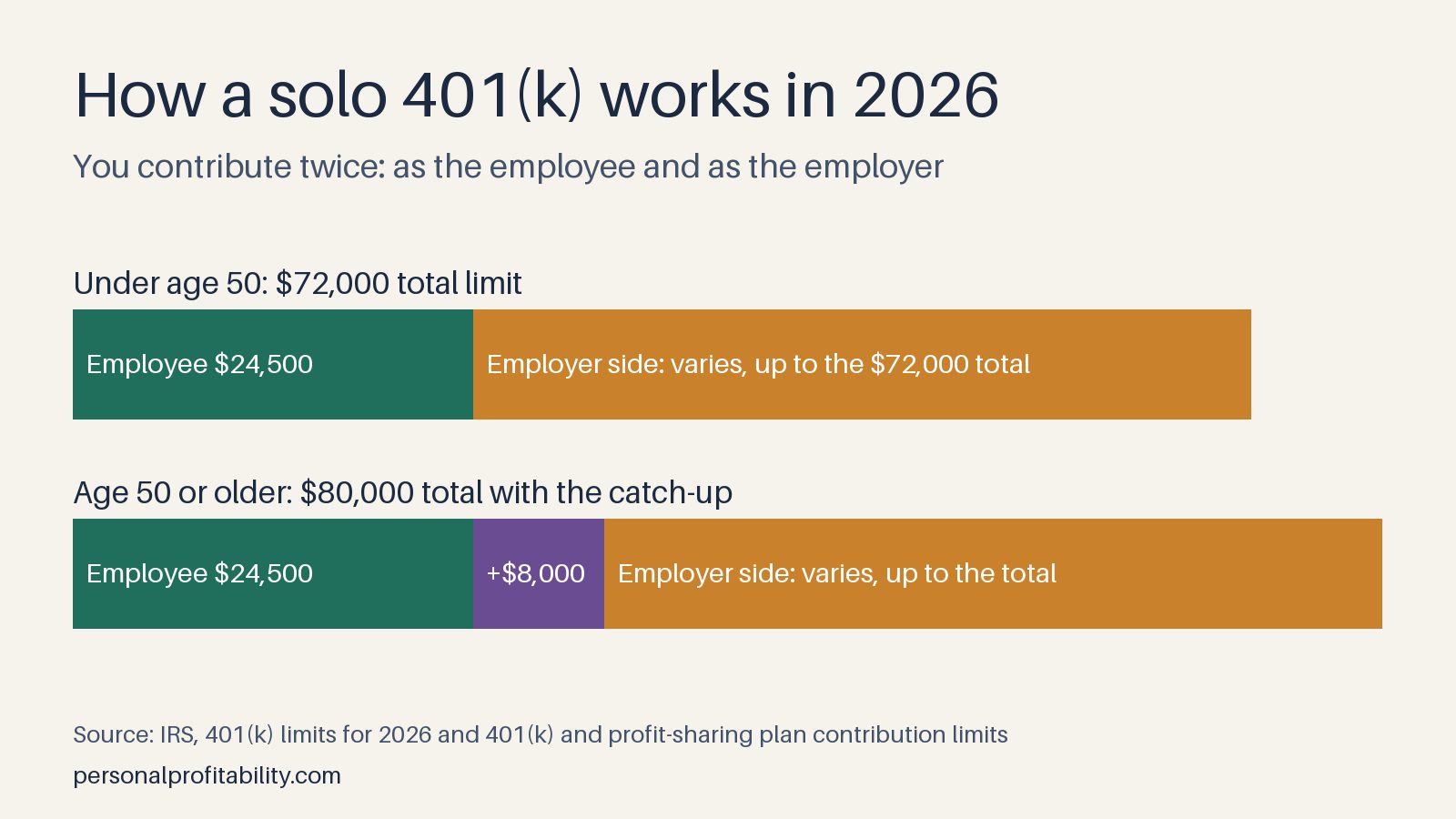
- Employee side: you elect to defer up to 100% of your compensation, capped at $24,500 for 2026.
- Employer side: your business contributes a percentage of your compensation, which the IRS caps at 25% of compensation under the plan.
- Combined cap: the two sides together cannot exceed $72,000 for 2026, not counting catch-up contributions.
Those figures come from the IRS one-participant 401(k) page and its IRS announcement of the 2026 limits. Money you add goes into investments you choose, and it grows tax-deferred until you withdraw it in retirement. Traditional deferrals go in pre-tax. Your plan may also offer Roth contributions on the employee side. You pay tax on Roth money now and can withdraw it tax-free later under the qualified distribution rules. Ask the provider before you open the account.
Learn how the stock market works, then start
Get my free 2026 guide to stocks, trades, account types and index funds, plus a step-by-step plan for your first investment.
Who qualifies for a solo 401k
You qualify when you have self-employment income and no employees, other than a spouse who works in the business. That covers freelancers, consultants, rideshare and delivery drivers, online sellers, and anyone filing a Schedule C. A side hustle counts, even when you also hold a full-time job. Start with our guide to self-employment tax if you are still sorting out how the IRS taxes that income.
Hiring changes things. The IRS says that if you hire employees who meet the plan’s eligibility rules, you must include them in the plan, and then it’s no longer a solo plan. Read your plan document before you hire anyone.
Solo 401k contribution limits for 2026
The 2026 employee deferral limit is $24,500, up from $23,500 in 2025, according to the IRS. The overall limit on employee and employer money together is $72,000 for 2026, per the IRS retirement topics page on 401(k) contribution limits.
| Contribution type | 2026 limit | Who it applies to |
|---|---|---|
| Employee deferral | $24,500 | Everyone |
| Catch-up contribution | $8,000 extra | Age 50 and older |
| Higher catch-up | $11,250 instead of $8,000 | Ages 60 through 63 |
| Combined employee and employer limit | $72,000 (before catch-up) | Everyone |
| Combined limit with catch-up | $80,000, or $83,250 for ages 60 to 63 | Age 50 and older |
You can’t contribute more than you earn. The IRS limits deferrals to 100% of your compensation, and for the self-employed that means earned income, which is your net self-employment earnings after certain deductions. A freelancer who nets $30,000 cannot defer $24,500 and then also add a large employer share.
How the employer contribution works for the self-employed
The employer contribution is the confusing part, so it helps to see the number. The IRS says the employer can contribute up to 25% of compensation as the plan defines it, but a sole proprietor does not have a paycheck to measure. Instead, you use the rate table or worksheet in IRS Publication 560, Chapter 5, which starts from your net earnings after you subtract the deductible half of your self-employment tax. In practice that works out to roughly 20% of that net figure.
Here is an illustration with round numbers. Say your business nets $100,000 for the year. The self-employment tax is 15.3% of 92.35% of your net, which comes to about $14,130, and half of that, about $7,065, is deductible. Your net earnings for the plan are then about $92,935, and 20% of that is roughly $18,600 for the employer side. Add the $24,500 employee deferral and you can save about $43,100 for the year, well under the $72,000 cap. Your worksheet result will differ, so treat this as a sketch and not a quote.
If you have not yet planned for the tax bill on that income, read our guide to paying quarterly estimated taxes helps. You lower your taxable income when you contribute, but you still owe estimated payments.
What a solo 401k looks like at different income levels
Your profit changes what the same account can do. Take a freelancer who nets $40,000. The self-employment tax comes to about $5,650, half of it, about $2,825, is deductible, and the net earnings for the plan are about $37,175. The employer side at roughly 20% is about $7,435. That freelancer can defer up to $24,500 on top, for a possible $31,900. Most people at that income save less, and an emergency fund comes first.
Now the $100,000 example from above. The employer share is bigger, but the $24,500 deferral is still the larger piece. You get a flat dollar amount on the employee side, which helps lower earners most. The employer side grows with profit, which helps higher earners most. Neither number is a target. Save what your cash flow and your emergency fund can support.
Withdrawals, distributions, and other rules to know
Providers also call this account an individual 401(k) or a self-employed 401(k), and the rules are the same. Your employee money counts as elective deferrals, and the IRS calls the employer side nonelective contributions. Both go into the same retirement plan, and you invest them in whatever funds the provider offers.
Distributions follow the usual 401(k) rules. Taking money out before retirement age can trigger income tax plus an additional tax, and required minimum distributions start later in life. Business owners should confirm the current ages and exceptions on the IRS site, since Congress has changed them more than once. Some providers also allow plan loans, and others do not, so check that detail if you might need cash access.
Pros and cons of a solo 401k
The first three items below are strengths and the last three are costs. Weigh both before you open one.
- High limits: you can save up to $72,000 in 2026, far above the IRA limit.
- Two ways to contribute: the employee deferral works even when your profit is modest.
- Low cost: many providers charge no account fee for a solo plan.
- Paperwork: you adopt a plan, track contributions, and file Form 5500-EZ at $250,000 in assets.
- Staying solo: hiring an employee generally means switching plans.
- Locked-up money: early withdrawals can mean taxes and penalties.
How to open a solo 401k, step by step
- Confirm you qualify. You need self-employment income and no employees besides a spouse.
- Pick a provider. Compare fees first. Many large brokerages offer a solo 401k with no account fee and a menu of low-cost index funds, which is where most people belong. Our default pick is an S&P 500 index fund or a target-date fund.
- Get an EIN if you want one. You can use your Social Security number as a sole proprietor, but many providers prefer an Employer Identification Number from the IRS.
- Adopt the plan. You sign the provider’s plan document. Under Publication 560, a sole proprietor with no employees can adopt a 401(k) after the year ends, as long as it’s by the tax filing deadline without extensions. Confirm the exact date with your provider.
- Make the contributions. Move your employee deferral and employer contribution into the account, and invest them. Employer contributions can go in up to your tax return due date, including extensions, per Publication 560.
- Keep records. Save your plan statements and contribution totals so your tax return matches. File Form 5500-EZ if the plan reaches $250,000 or more in assets at year end.
Solo 401k vs SEP IRA and Solo Roth options
A solo 401k wins when your income is modest, because the $24,500 employee deferral lets you save a big dollar amount before the employer percentage even matters. A SEP IRA only has the employer side, so you need a high profit to reach the same total. You’ll find a SEP easier to open, and it never needs a Form 5500-EZ. Our full SEP IRA vs solo 401k comparison runs the numbers side by side.
For young earners we lean Roth over traditional, and a Roth IRA sits beside the solo 401k and has its own limit, covered in our Roth IRA guide for beginners. If you max out both and still have cash to save, the mega backdoor Roth strategy lets you save more, but only if your plan accepts after-tax contributions.
Mistakes to avoid with a solo 401k
- Contributing before you know your profit. Employer contributions depend on your net earnings, so wait until you can calculate them or leave room for a late-year top-up.
- Paying high fund fees. Choose broad index funds with low expense ratios. A fee-only fiduciary can review your plan, and a commission-based salesperson should not.
- Forgetting the 401(k) limit is per person. Your deferrals at a day job and at your own plan share one $24,500 cap.
- Skipping the Form 5500-EZ. The IRS requires it once the plan reaches $250,000 in assets at the end of the year, so mark your calendar when you get close.
- Skipping an emergency fund. Treat a 401(k) as retirement money, since early withdrawals can trigger taxes and penalties. Build cash savings first.
Solo 401k FAQ
Conclusion
A solo 401k lets a self-employed person save as employee and employer, up to $24,500 in deferrals and $72,000 combined for 2026. Start by checking your net profit, pick a low-fee provider, and open the plan before your filing deadline. If you are deciding how to pay yourself from the business first, read how to pay yourself as a business owner. For more on building your nest egg, browse our retirement guides. This article explains how the account works and does not give individual tax advice, so run your final numbers by a tax professional.

Free guide
Learn how the stock market works, then start
Get my free 2026 guide to stocks, trades, account types and index funds, plus a step-by-step plan for your first investment.
- How a trade works, from order types to T+1 settlement
- Why I start with low-cost index funds instead of stock picks
- The margin rules and my own trading mistakes, so you skip them
Bonus: The First-Investment Checklist, the order to handle your match, debt and savings