

A mega backdoor Roth is a way to push up to $72,000 into your 401(k) in 2026, far past the regular $24,500 employee deferral limit, by making after-tax contributions and converting them to Roth. It’s not a loophole and it’s not a secret handshake. It’s a written-into-the-tax-code option that most people never use because their plan either doesn’t offer it or they’ve never heard the term. If you’ve already maxed a Roth IRA and still have money left to save, this is the next lever worth checking.
Mega backdoor Roth, defined
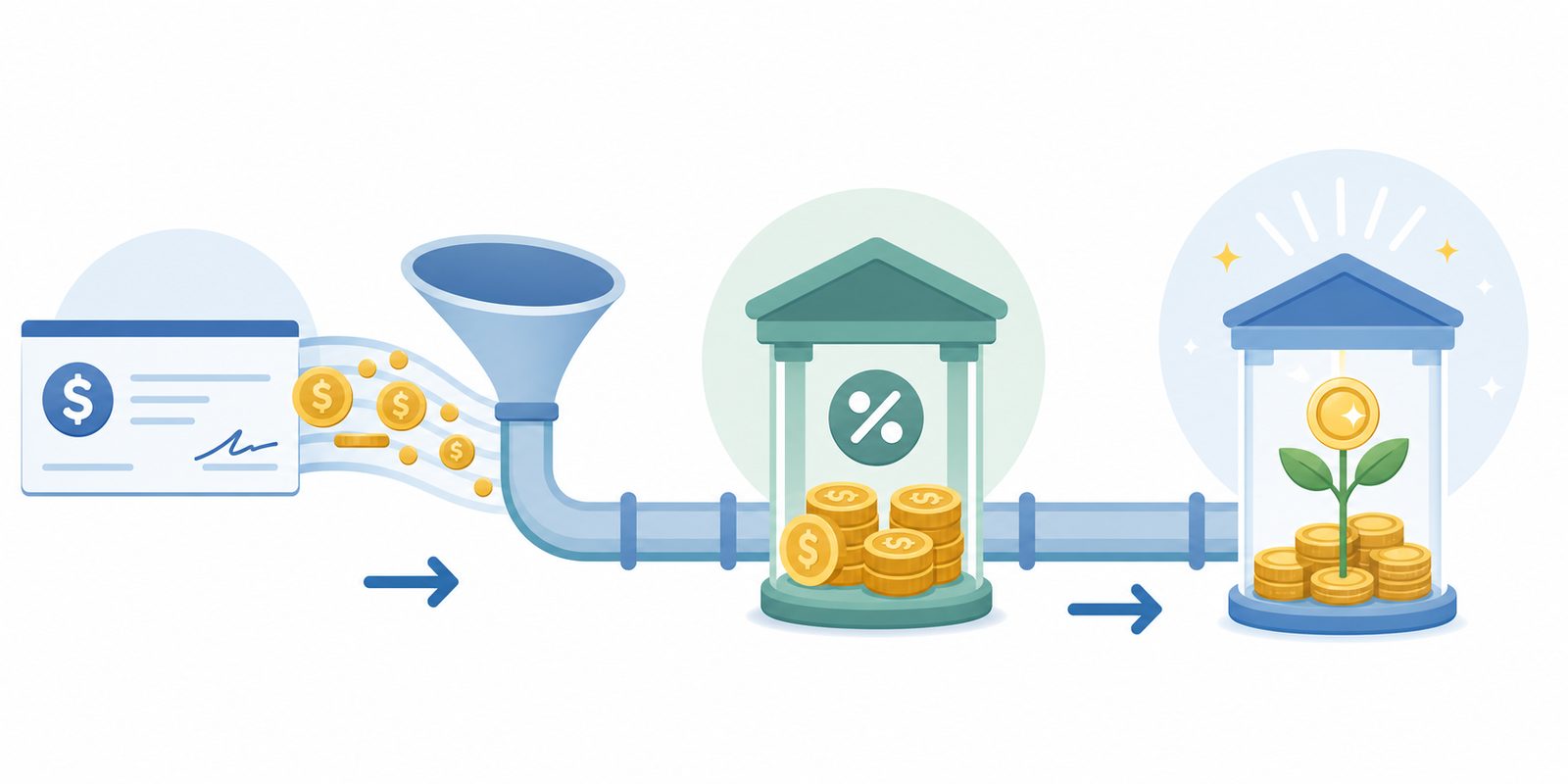
A mega backdoor Roth is a two-step move inside a 401(k) plan. First you contribute after-tax dollars to your 401(k), on top of your regular pretax or Roth deferrals. Then you convert that after-tax money into a Roth account, either a Roth 401(k) inside the same plan or a Roth IRA, so it grows and comes out tax-free in retirement. You already pay tax on the dollars going in, so you won’t pay taxes again when you pull them out later. The “mega” is the size of it. A regular backdoor Roth IRA moves a few thousand dollars a year. This version can move tens of thousands, because it rides on the much bigger overall 401(k) contribution limit instead of the small IRA limit. For a high-income saver, it’s one of the bigger tax breaks still available under current law.
Three separate buckets live inside one 401(k): your regular pre-tax or Roth deferral, your employer’s match or profit-sharing contribution, and this third bucket of after-tax (non-Roth) contributions. That third bucket is what makes this whole strategy possible, and it’s the bucket most plans skip entirely.
How the mega backdoor Roth works, step by step
Here’s how the mechanics actually work, step by step, assuming your plan supports it (more on that below).
- Max your regular elective deferral first. Put in the full $24,500 for 2026 (or more if you qualify for a catch-up contribution) before you touch after-tax dollars. Never skip a full employer match to fund this instead. The match is free money and it comes first.
- Confirm your plan allows after-tax, non-Roth contributions. This is a distinct feature from a Roth 401(k) option. Check your plan’s summary plan description or ask HR directly, because the account statement often lumps everything together and won’t show it clearly.
- Confirm your plan allows in-plan Roth conversions or in-service withdrawals. Contributing after-tax money does nothing for you on its own. Your plan also has to let you move that money to Roth, either through an in-plan conversion or a withdrawal you roll into a Roth IRA.
- Contribute after-tax dollars up to the overall plan limit. Keep contributing after-tax dollars until you hit the total 415(c) limit for the year (see the table below), minus what you and your employer already put in.
- Convert quickly, ideally right away. Any investment growth on the after-tax money between the contribution and the conversion is taxable. Some plans convert automatically and immediately, which keeps the taxable gain close to zero. If yours doesn’t, ask how often conversions run and convert as soon as you can.
- Invest the converted money the same way you’d invest anywhere else. A low-cost S&P 500 index fund or a target-date fund inside the plan, not a stock pick. The tax treatment changes, the investing strategy shouldn’t.
The 2026 contribution limits
The IRS adjusts these contribution limits every year for inflation. Here are the 2026 limits, from IRS Notice 2025-67.
| Limit | 2026 amount |
|---|---|
| Employee elective deferral (section 402(g)) | $24,500 |
| Catch-up, age 50 and older (section 414(v)) | $8,000 |
| Catch-up, ages 60 to 63 (SECURE 2.0 “super” catch-up) | $11,250 |
| Overall plan limit, all sources combined (section 415(c)) | $72,000 |
| Overall limit plus age 50+ catch-up | $80,000 |
| Overall limit plus age 60–63 catch-up | $83,250 |
The $72,000 figure above is the one that matters here. It covers your own employee contributions, your employer’s match and profit sharing, and your after-tax contributions, all added together. Subtract what you and your employer already put in from $72,000 (or $80,000 or $83,250 with a catch-up), and whatever’s left is your after-tax contribution room. One more thing worth knowing: starting in 2026, if you earned more than $150,000 in FICA wages the prior year, any age-based catch-up contribution has to go in as Roth, not pre-tax. That doesn’t block this strategy, it just changes which bucket your catch-up lands in.
Here’s what that looks like with real numbers. Say you defer the full $24,500 in 2026 and your employer kicks in a $6,000 match. Add those together and you’re at $30,500 of the $72,000 overall limit, leaving $41,500 of room for after-tax contributions. Convert that $41,500 to Roth quickly and you’ve moved almost double your regular deferral limit into tax-free growth, on top of whatever you already put into a Roth IRA. That’s the entire point of this move: it turns unused space in the $72,000 bucket into new tax-free savings instead of leaving it empty.
Does your plan actually allow it?
Most workplace 401(k) plans don’t offer this, which is the real reason it stays obscure. Two separate features have to both be true: the plan has to accept after-tax (non-Roth) contributions, and it has to allow in-plan conversions or in-service withdrawals of that money. Large plans at big employers, especially in tech and finance, are the most likely to have both. A lot of smaller-company 401(k) plans have neither, because adding them costs the employer money in plan administration and testing.
If you’re self-employed, you have more control than a W-2 employee stuck with whatever their employer picked. When you set up your own Solo 401(k), you choose the plan document, and some Solo 401(k) providers will let you write in after-tax contributions and in-plan Roth conversions from day one. Not all of them do this by default, so ask specifically about “after-tax, non-Roth contributions” and “in-plan Roth conversion” before you open the account, not after. A generic, free Solo 401(k) template often skips both features. A provider built for self-employed people who want this option will advertise it directly.
Why this matters more for high earners
A Roth IRA has income limits. Once your earnings pass a certain threshold, the IRS blocks you from contributing directly, which is exactly why the regular backdoor Roth IRA exists in the first place. A 401(k) has no such income limit, so high earners locked out of a direct Roth IRA contribution can still build tax-free income through this route. That’s the real case for high-income earners: it’s one of the few paths left to meaningful tax-free retirement savings once your income rules out the easier options.
Some plan statements call this bucket an “after-tax, non-Roth” contribution rather than a mega backdoor Roth, so knowing the real name helps when you call your plan administrator. It sits apart from your regular pretax or Roth deferral and any Roth contributions you’re already making elsewhere.
A few considerations before you start. You have to still be working for the employer that sponsors the plan, or be self-employed with your own plan, for any of this to apply. Your plan has to support both after-tax contributions and conversions. And if your situation involves multiple old 401(k)s, several traditional IRAs, or other complicated retirement planning, loop in a financial planner or tax professional before you move a large amount. Done right, this is one of the more powerful ways to add flexibility and tax-free income to a retirement plan that already includes a traditional 401(k), one or more IRAs, and your regular catch-up contributions.
The tax mechanics and the mistakes that cost people money
This version is cleaner than the regular backdoor Roth IRA in one specific way: there’s no pro-rata rule to worry about. With a backdoor Roth IRA, the IRS treats all your traditional IRAs as one pool, so old rollover IRAs can make part of your conversion taxable. The 401(k) version doesn’t have that problem, because it lives inside a single plan with its own separate after-tax bucket.
Rollovers add one more wrinkle worth knowing. If you’ve ever rolled an old 401(k) into a traditional IRA, that pretax money sits apart from your new after-tax contributions and doesn’t get pulled into this pro-rata calculation the way it would for a regular backdoor Roth IRA. The IRS caps the overall 415(c) limit each year, and that annual number tends to increase most years with cost-of-living adjustments, so check the current figure before you plan around last year’s cap. You’re not required to convert the very same day, but the sooner you do, the less taxable growth you end up reporting.
The actual risk is timing. Any earnings on your after-tax contributions before you convert them are taxable as ordinary income in the year you convert, even though you already paid tax on the original amount. The maximum tax-free benefit comes from converting fast, before earnings pile up. Leave the money sitting for a year before converting and you’ll owe tax on whatever it grew. Convert within days, and there’s barely anything to tax. That’s why the plans that automate the conversion (sometimes weekly or even same-day) are worth more than the ones that make you request it manually.
Watch for one more detail: some plans only allow in-service withdrawals, not in-plan conversions, and some restrict how often you can take one. Read your plan document or ask your plan administrator directly what your specific plan allows before you contribute a dollar of after-tax money, because contributing it and then discovering you can’t move it to Roth just leaves it stuck as ordinary after-tax savings with no real tax advantage.
Who should actually do this
This is a high-income, high-savings-rate move, not a starter step. It makes sense once you’ve already taken the full employer match, maxed your regular 401(k) deferral, maxed a Roth IRA (directly or through the regular backdoor route if your income is too high to contribute directly), and you still have cash left over that you want to invest for the long term. Not every saver is able to reach the full $72,000 cap, and that’s fine. If any of those earlier steps aren’t done yet, do those first. There’s no point stacking an advanced move on top of an unfunded match, and the mega backdoor Roth strategy works best for high earners who’ve already covered the basics.
It’s also a long-term bet on tax-free growth. Once the money is in Roth, it never gets taxed again, no matter how much it grows over the next 20 or 30 years. For a high earner who expects to be in a similar or higher tax bracket in retirement, that trade is usually worth making. If your income and savings rate don’t leave extra room after the earlier steps, skip this one for now. It’s a “yes, and” for people already doing everything else right, not a shortcut around the basics.
Conclusion: a real move, not a gimmick, once the basics are covered
The mega backdoor Roth is one of the few legal ways to get a genuinely large amount of money into a Roth account in a single year. It’s not for everyone, and it’s not a step one move. Get the match, max the regular deferral, fill up a Roth IRA, and only then go looking for the after-tax bucket. If you’re weighing where the extra dollars go next, compare this against topping off an HSA as a retirement account, another tax-advantaged spot worth filling before a plain taxable brokerage account. And if you’re running your own business and building the retirement side of your setup from scratch, start with the fundamentals in our guide to SEP IRA vs Solo 401(k) before you go looking for this feature on top of it. For more on the full range of retirement accounts and how they fit together, visit our Retirement category or head back to the Personal Profitability homepage.