
How does a money market account work? It’s a savings-style deposit account at a bank or credit union. You earn interest, move money in and out when you need it, and often get a debit card or checks. The federal government insures it up to $250,000 per depositor. Think of it as a middle ground between a plain savings account and a checking account. If you’re still sorting out the basics, start with our banking 101 guide.
Key Takeaways
- Money market accounts are insured deposit accounts. You earn interest and can usually spend or transfer the money.
- The FDIC or NCUA covers up to $250,000 per depositor, per institution, per ownership category.
- A money market fund at a brokerage is a different product, and the FDIC doesn’t cover it.
- Your bank can change the interest rate, set minimum balance requirements, and charge fees, so read the terms.
- Interest is taxable income.
Build a budget you'll keep this month
Get my free 2026 guide to picking categories, setting limits, automating your savings and choosing a budgeting tool.
How Does a Money Market Account Work?
You keep cash in a money market account (MMA), earn interest on it, and get easier access than most savings accounts allow. The bank takes your deposit, lends or invests it in short-term, low-risk ways, and pays you a share of the earnings as interest. You don’t pick any investments. You just deposit and earn.
Most MMAs share a few traits:
- Interest that compounds. The bank pays interest on your balance, usually credited monthly.
- A variable rate. The bank can raise or lower your interest rate at any time, so the rate you see today isn’t locked in.
- Easy access. Many accounts come with a debit card, paper checks, or both, plus online transfers.
- Possible minimums. Some financial institutions require a minimum opening deposit or a minimum balance to earn the top rate or avoid a fee. Each bank sets its own, so read the fee schedule.
- Federal insurance. The FDIC covers money market deposit accounts at banks, and the NCUA covers money market share accounts at credit unions.
With that mix, you can keep money safe and still reach it. Use one for an emergency fund, a house down payment, or a big bill you know is coming.
Is a Money Market Account Safe? How the Insurance Works
Yes, as long as the account sits at an insured bank or credit union. The FDIC says deposits are automatically insured to at least $250,000 at each FDIC-insured bank, and it lists money market deposit accounts among the covered products. The NCUA gives the same $250,000 standard amount at federally insured credit unions, and its share insurance covers money market accounts too.
Deposit insurance applies per depositor, per institution, per ownership category. The FDIC counts a single account and a joint account at the same bank separately, so a couple can protect more than $250,000 at one bank. If you hold more than that, spread it across banks and credit unions or check your coverage with the FDIC’s online estimator.
The FDIC doesn’t cover mutual funds, stocks, bonds, annuities, or crypto assets, even when you buy them through a bank. People trip over that gap more than anything else with this product.
Money Market Account vs. Money Market Fund
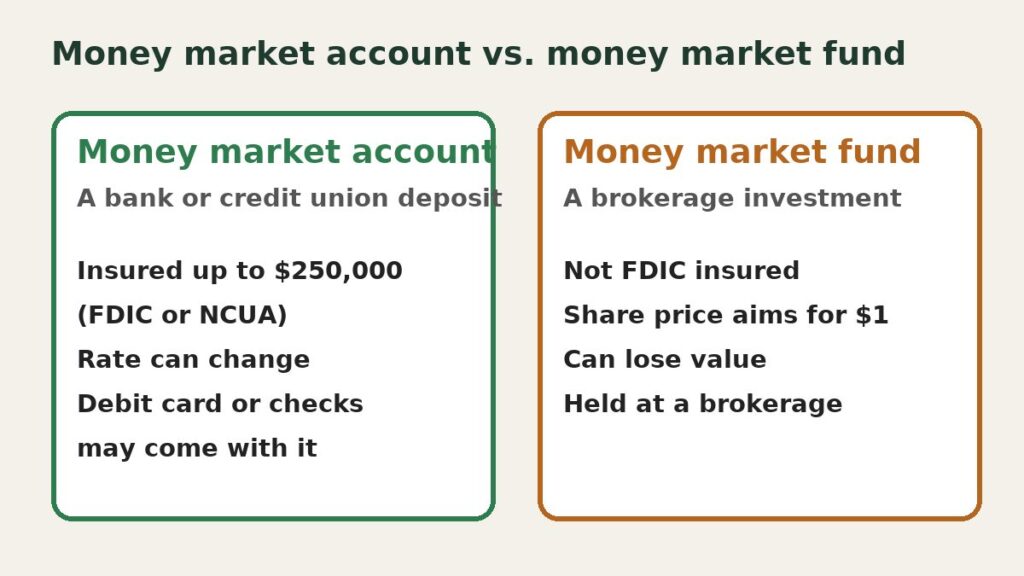
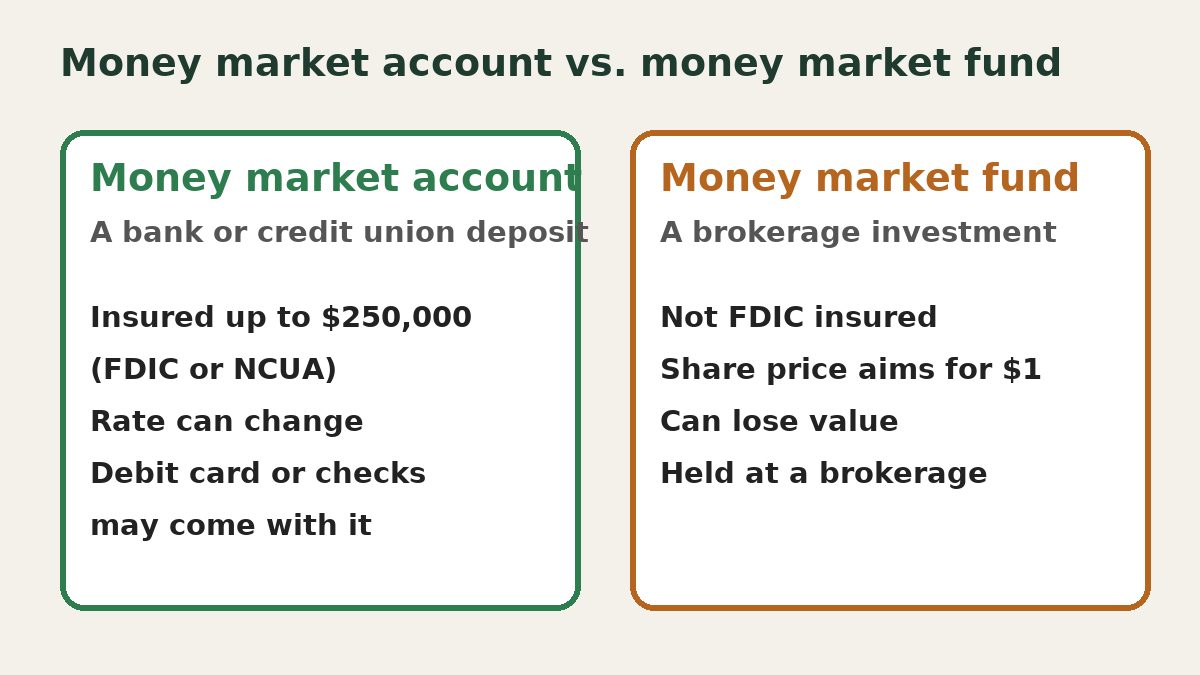
A money market account is a bank deposit. A money market fund is an investment you buy at a brokerage. The names sound alike, but the difference in risk matters.
| Feature | Money market account | Money market fund |
|---|---|---|
| Where you get it | Bank or credit union | Brokerage or fund company |
| What it is | A deposit account | A mutual fund that holds short-term debt |
| Federal insurance | FDIC or NCUA, up to $250,000 | None. The FDIC doesn’t cover mutual funds |
| Can you lose money? | Not from market moves, within insurance limits | Yes. The fund aims to hold a $1 share price but doesn’t guarantee it |
| Debit card or checks | Often | Sometimes, depending on the brokerage |
Check the label before you open anything. Money market funds carry the word “fund” or a ticker symbol, and they’re investments. A product with “Member FDIC” or “NCUA insured” on the institution’s site is a deposit. Brokerages also sell cash accounts with their own names, so ask whether the specific product carries FDIC insurance before you assume it does.
Money Market Account vs. Savings, Checking, and CDs
You can give each deposit account a different job, and many people use two or three of them together. Compare the four side by side.
| Account | Best for | Access | Rate |
|---|---|---|---|
| Checking | Paying bills day to day | Debit card, checks, and bill pay | Little to none |
| Savings | Cash you rarely touch | Online transfers | Low to moderate |
| Money market account | Larger cash reserves you may need soon | Transfers and often a debit card | Often higher than traditional savings accounts |
| Certificate of deposit | Money you won’t need for a set term | Locked until maturity | Fixed for the term |
You’ll want a money market account when your cushion outgrows what checking accounts should hold. Say you keep $15,000 for emergencies. In checking, you’d earn almost nothing on it. In a money market account, you earn interest on all of it and can still pull cash out on a bad day.
On a CD, banks often pay more for a fixed term, but you pay a penalty to withdraw early. You need to reach an emergency fund fast, so keep it in an MMA or savings account and save the CD for money with a firm end date.
What Rate Does a Money Market Account Pay?
It varies by bank, and it moves with interest rates. For a benchmark, the FDIC’s national rate data as of October 19, 2026 shows an average of 0.63% for money market accounts and 0.38% for savings accounts. Those are national averages across all banks, and online banks often post yields well above them. Check current offers on each bank’s own rate page.
We cover the closest alternative in our guide to a high-yield savings account. The two products often carry similar interest rates, so the right pick comes down to whether a debit card or checks matter to you. For a locked rate, see how a certificate of deposit works.
You’ll earn more if you shop around. On $10,000, the gap between a 0.63% average and a rate a full point higher is about $100 a year. Move your cash if your bank sits at the bottom of the pack. Your bank can cut the rate at any time, and you owe it no loyalty.
How Do I Choose the Best Money Market Account?
Start with the yield, then check the conditions that decide what you keep. A high APY means little if you hand it back in monthly fees. Compare these items across at least three banks:
- APY. The annual percentage yield is the yearly return after compounding. You only earn the higher APY if you meet the balance requirements.
- Minimum balance requirements. Some banks pay a top rate only on balances above a certain tier, and they charge a fee if you don’t maintain it.
- Monthly fees. Pick an account with no monthly maintenance fee, or a fee you can waive easily.
- Transactions and limits. Find out how many withdrawals the bank allows and what it charges past that.
- Access. Confirm whether you get a debit card, checks, and an app that suits you.
Big banks tend to pay the least on traditional savings accounts. Online banks often pay more on high-yield savings accounts than branch banks pay on either savings or money market accounts, so price them side by side. Pick the account that wins on yield and fees for your balance, not the one with the flashiest ad.
Can You Withdraw From a Money Market Account Any Time?
Usually yes, though your bank sets the rules. For decades, federal Regulation D capped savings-type transfers at six per month, and that cap covered money market accounts. On April 24, 2020, the Federal Reserve Board removed the six-per-month limit from the rule, and its savings deposits FAQ says it has no plans to bring the limit back.
Today banks can drop the limit, but they don’t have to. The Fed’s FAQ says banks can suspend enforcement, and your bank sets any fee for extra withdrawals in your account agreement. Your bank may have kept its own cap, so check your account terms for a monthly transaction limit and any excess-withdrawal fee.
Money Market Account Pros and Cons
You’ll find a money market account fits some goals well and others poorly. Weigh both columns.
| Pros | Cons |
|---|---|
| Federally insured up to $250,000 | Variable rate that the bank can cut |
| Usually a higher rate than a standard savings account | May require a minimum deposit or balance |
| Debit card or checks often included | Some banks still cap withdrawals or charge fees |
| No market risk on your principal | Rate often trails a top online savings account |
| Easy to open online | Interest counts as taxable income |
On that last point, the IRS taxes interest income from a money market account as ordinary income, and your bank sends Form 1099-INT if you earn $10 or more in a year. You still report smaller amounts.
Who Should Open a Money Market Account?
Open a money market account when you want your cash safe, earning something, and available without much hassle. Three uses fit best:
- Your emergency fund. You want the money insured and reachable fast. See our guide to emergency funds for how much to hold.
- A near-term goal. Keep a down payment or a tax bill due within a few years out of the stock market.
- Cash you move often. If you pay bills or write the occasional check from a savings pot, you can skip a transfer step with an MMA that has a debit card.
Skip it for money you won’t touch for five years or more. Over that stretch, investors in stock index funds have historically earned more than cash savers, though with ups and downs. Keep your emergency fund in cash, and put long-term money to work in the market.
How to Open a Money Market Account
You can open one online in about 15 minutes. Follow these steps:
- Shop rates and fees. Write down the APY, the minimum deposit, the monthly fee, and any withdrawal limit.
- Confirm the insurance. Find the FDIC or NCUA coverage notice on the institution’s site. The FDIC has a BankFind tool to check.
- Gather your information. You’ll need your Social Security number, a government ID, and your contact details.
- Fund the account. Link your checking account and transfer the opening deposit.
- Set up automatic transfers. Pay yourself first by moving a fixed amount each payday.
Credit unions sometimes pay better rates than big banks, so include a credit union in your comparison.
Money Market Account FAQ
Conclusion
With a money market account, you get insured cash that earns interest, plus a debit card or checks. Before you open one, compare rates, confirm the FDIC or NCUA coverage, and read the fee schedule. Then browse our banking category for more, or head to the Personal Profitability homepage for ways to earn and keep more of your money.
Free guide
Build a budget you'll keep this month
Get my free 2026 guide to picking categories, setting limits, automating your savings and choosing a budgeting tool.
- Set category limits from what you spend now
- Try envelope, zero-based and one-line budgets
- Compare free and paid budgeting tools for 2026
Bonus: The 30-Day Money Reset, a one-task-a-day plan to put your budget to work