
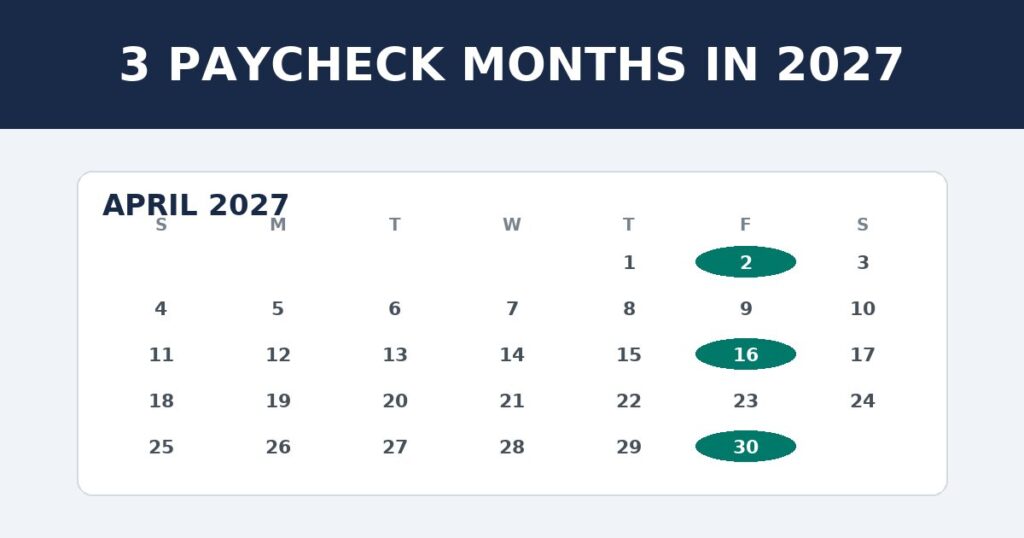
Your 3 paycheck months 2027 depend on the weekday your employer pays you and the week your first check arrives. Biweekly workers get three paychecks in two months a year, and the table below lists them for all ten possible schedules. Find your first 2027 payday, read across, and mark both months on your budget. For a primer on building a spending plan around steady income, start with how to create your first budget.
What a 3 Paycheck Month Means
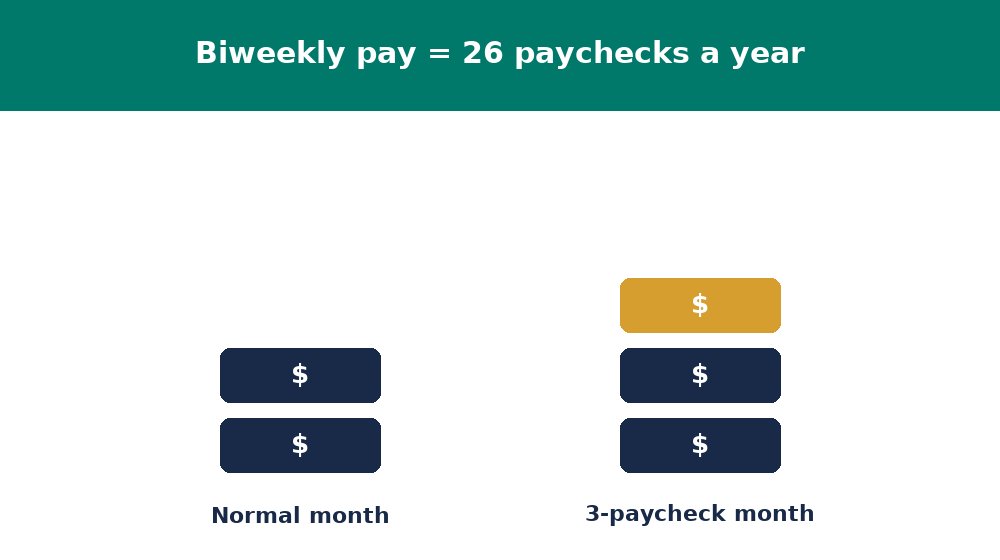
On a biweekly schedule you get 26 paychecks a year, not 24, because 52 weeks divided by 2 is 26. Each check covers a 14-day pay period. Most months hold two of those checks. Two months a year hold three, and that’s what people mean by a three-paycheck month or a third paycheck month. Your annual pay doesn’t change. Your employer just splits the same salary into more, smaller pieces.
Biweekly is the most common pay schedule among U.S. employers. As of February 2023, 43.0% of U.S. private establishments paid employees biweekly, according to the Bureau of Labor Statistics. Weekly pay came in second at 27.0%, with semimonthly at 19.8% and monthly at 10.3%. States set their own payday rules, and the Department of Labor lists each state’s payday requirements.
Build a budget you'll keep this month
Get my free 2026 guide to picking categories, setting limits, automating your savings and choosing a budgeting tool.
3 Paycheck Months 2027 for Every Biweekly Schedule
Pick your payday weekday, then pick the row with your first 2027 payday. Your first payday falls in one of two weeks in early January, so every weekday has two patterns. We built each row by counting forward 14 days at a time from the first payday, then checked every date against a 2027 calendar.
| Biweekly payday | First 2027 payday | Paychecks in 2027 | 3 paycheck months | Exact dates in those months |
|---|---|---|---|---|
| Monday | Jan 4 | 26 | March and August | March: Mar 1, Mar 15, Mar 29 August: Aug 2, Aug 16, Aug 30 |
| Monday | Jan 11 | 26 | May and November | May: May 3, May 17, May 31 November: Nov 1, Nov 15, Nov 29 |
| Tuesday | Jan 5 | 26 | March and August | March: Mar 2, Mar 16, Mar 30 August: Aug 3, Aug 17, Aug 31 |
| Tuesday | Jan 12 | 26 | June and November | June: Jun 1, Jun 15, Jun 29 November: Nov 2, Nov 16, Nov 30 |
| Wednesday | Jan 6 | 26 | March and September | March: Mar 3, Mar 17, Mar 31 September: Sep 1, Sep 15, Sep 29 |
| Wednesday | Jan 13 | 26 | June and December | June: Jun 2, Jun 16, Jun 30 December: Dec 1, Dec 15, Dec 29 |
| Thursday | Jan 7 | 26 | April and September | April: Apr 1, Apr 15, Apr 29 September: Sep 2, Sep 16, Sep 30 |
| Thursday | Jan 14 | 26 | July and December | July: Jul 1, Jul 15, Jul 29 December: Dec 2, Dec 16, Dec 30 |
| Friday | Jan 1 | 27 | January, July and December | January: Jan 1, Jan 15, Jan 29 July: Jul 2, Jul 16, Jul 30 December: Dec 3, Dec 17, Dec 31 |
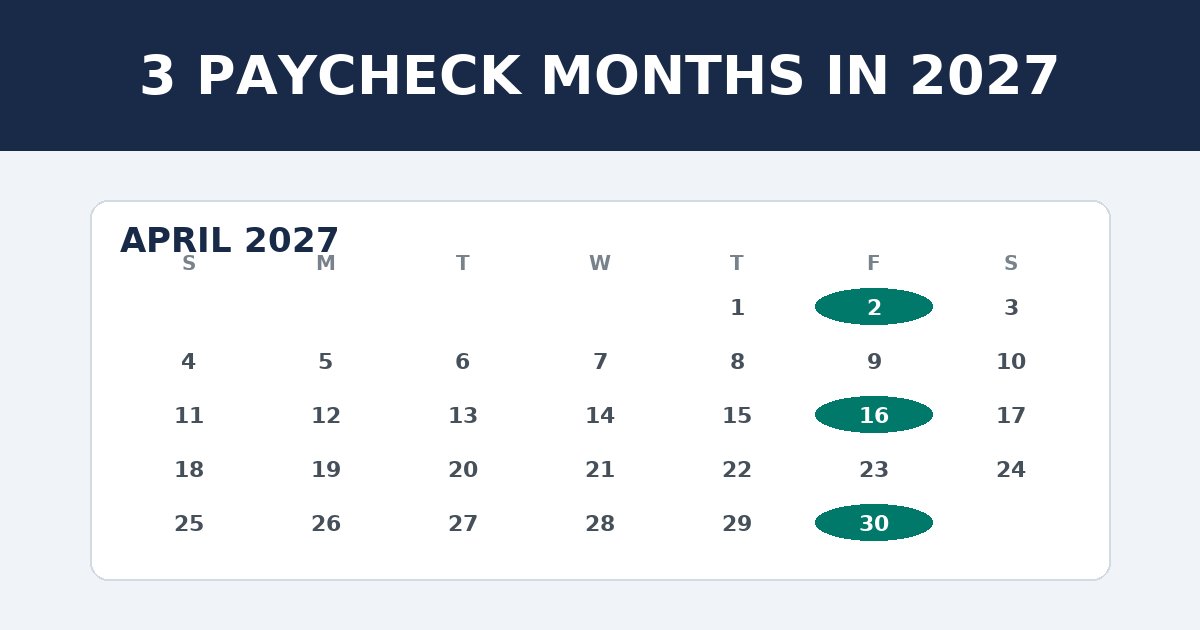
| Friday | Jan 8 | 26 | April and October | April: Apr 2, Apr 16, Apr 30 October: Oct 1, Oct 15, Oct 29 |
Friday paydays hold the one oddity. January 1, 2027 is a Friday and so is December 31. If your first check lands January 1, you get 27 paychecks this year and three paycheck months in January, July and December. Every other schedule gets the normal 26 checks and two three-check months. New Year’s Day is a federal holiday and banks close, so many employers move that check. If yours pays on Thursday, December 31, 2026, that check counts toward 2026, and your 2027 drops to 26 checks with three-check months in July and December. If it moves to Monday, January 4, you still get 27. Ask your payroll team which one applies.
Not sure which row is yours? Pull up a recent pay stub from a week without holidays, find any past payday, and add 14 days until you reach early January 2027. That date is your first payday. Check your employer’s payroll calendar for the final dates, since employers usually move a payday that falls on a weekend or bank holiday to the nearest business day.
How to Find Your Own Dates in Four Steps
- Find your next payday. Check a pay stub or your HR portal for the date.
- Count forward in 14-day jumps. Add 14 days, then 14 more, until you reach the end of 2027.
- Circle any month with three dates. Most months hold two. The two months that hold three are your 3 paycheck months.
- Write both months on your budget now. Plan for the extra check before the year starts.
You can do the counting in seconds with a spreadsheet or a free online pay period calculator. Either way, double-check the result against a calendar.
How to Budget Around a 3 Paycheck Month
Start with your bills. Most rent, loan and insurance payments come due once a month, so a third check doesn’t raise them. List every bill that hits in a 3 paycheck month and cover it from your first two checks, the way you do in every other month. Then assign the third check a job before the month begins. Write the amount and the account it goes to on your budget, so the cash has a destination when it arrives.
Some people prefer to spread the benefit across the year. You can do that by moving the third check into savings and setting up a small automatic transfer to checking in the leaner months. Either approach works, as long as you pick one on purpose. Check your pay stub in each 3 paycheck month, too. Some employers take benefits premiums out of only 24 checks and skip them on the third, while others take them from all 26. Your payroll team can tell you which way yours works.
Paid Weekly? You Get 5 Paycheck Months Instead
Weekly pay follows the same logic. A month with five of your weekday gets five checks instead of four. If your employer pays you on Fridays, you collect 53 checks in 2027 because the year opens and closes on a Friday. Every other weekday collects 52 checks and four five-check months.
| Weekly payday | Paychecks in 2027 | 5 paycheck months |
|---|---|---|
| Monday | 52 | March, May, August and November |
| Tuesday | 52 | March, June, August and November |
| Wednesday | 52 | March, June, September and December |
| Thursday | 52 | April, July, September and December |
| Friday | 53 | January, April, July, October and December |
Semi-Monthly and Monthly Pay Never Get a 3 Paycheck Month
Semi-monthly employers pay twice a month on two fixed dates, commonly the 15th and the last day of the month. You get 24 paychecks a year and exactly two in every month. Monthly pay means 12 checks and one per month. Neither schedule drifts, so 2027 holds no 3 paycheck month for you. Dates like the 15th and 30th every month on your stub tell you that you’re on a semi-monthly cycle.
What to Do With Your Extra Paycheck in 2027
Decide where the extra check goes before it lands. These moves beat a bigger grocery bill:
- Top off your emergency fund first. If you hold less than 3 to 6 months of expenses, start here. See Emergency Funds 101 for how much to target and where to keep it.
- Pay down your highest-interest debt. Once your emergency fund is solid, you save the most interest by sending extra money to the highest rate. Compare the two approaches in debt snowball vs avalanche.
- Add it to a Roth IRA. You can put the extra check toward retirement without touching your regular budget. New to this? Roth IRA for Beginners walks you through it.
- Automate it. Set a rule in your bank app to move the extra direct deposit to savings or debt the day it arrives. Automate Your Finances shows you how.
You have no single right answer here. If you’re debt-free with a full emergency fund, spending it on a trip, a course or a down payment fund is a fine choice. The mistake is skipping the decision.
Common Mistakes in Three-Paycheck Months
The biggest mistake is building your monthly budget around your biggest month. Budget off your normal two-check months and treat the extra checks as a bonus layer. Flip that order and you’ll run short the other ten months.
The second mistake is treating the extra check as new money. Your salary stays the same whether your employer splits it into 24, 26 or 27 checks. Call it a windfall and it vanishes without moving a single goal forward.
Frequently Asked Questions
Conclusion
Your 3 paycheck months 2027 come down to your payday weekday and your first payday of the year. Find your row, circle the two months with three checks and decide ahead of time where that money goes. Pair it with an emergency fund, a debt payoff plan or a Roth IRA contribution, and the extra check moves a goal forward. For more ways to make your pay schedule work harder, browse the Budgeting archive on Personal Profitability.

Free guide
Build a budget you'll keep this month
Get my free 2026 guide to picking categories, setting limits, automating your savings and choosing a budgeting tool.
- Set category limits from what you spend now
- Try envelope, zero-based and one-line budgets
- Compare free and paid budgeting tools for 2026
Bonus: The 30-Day Money Reset, a one-task-a-day plan to put your budget to work