
Is buy now pay later a good idea? Sometimes, yes. But only for something you could already afford today, and only if you never run more than one plan at a time. BNPL apps like Affirm, Afterpay, Klarna, PayPal, and Zip split a purchase into a handful of payments, often four, with a soft credit check or none at all. That ease makes the plans simple to overuse, and late fees stack up fast. Saving the cash first usually beats financing a purchase you can’t quite cover yet, and you’ll get more out of building an emergency fund than out of another bill to track. This guide covers how BNPL works, the risks in the data, and when a credit card beats it.
What Happens When You Click “Pay in 4”
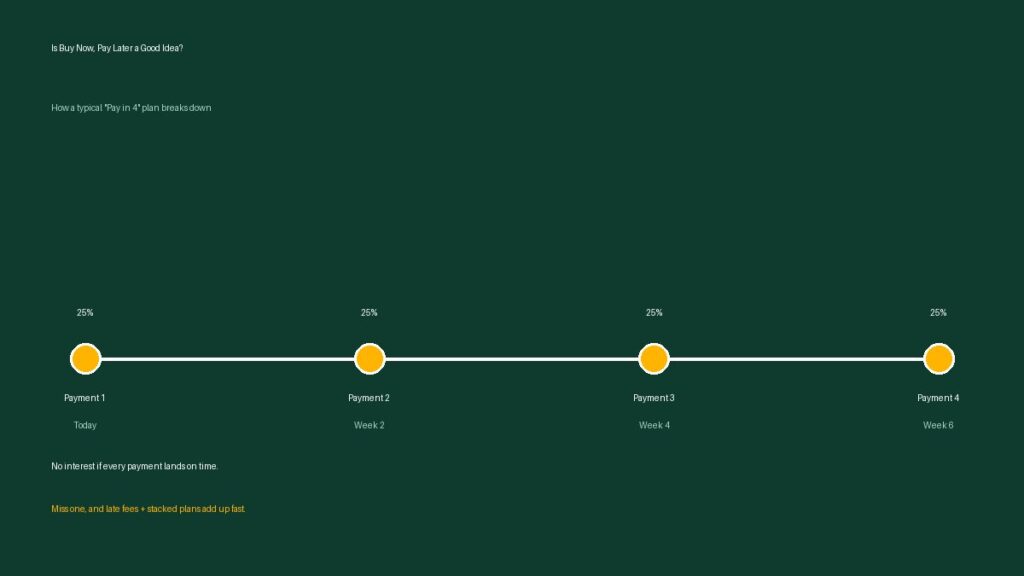
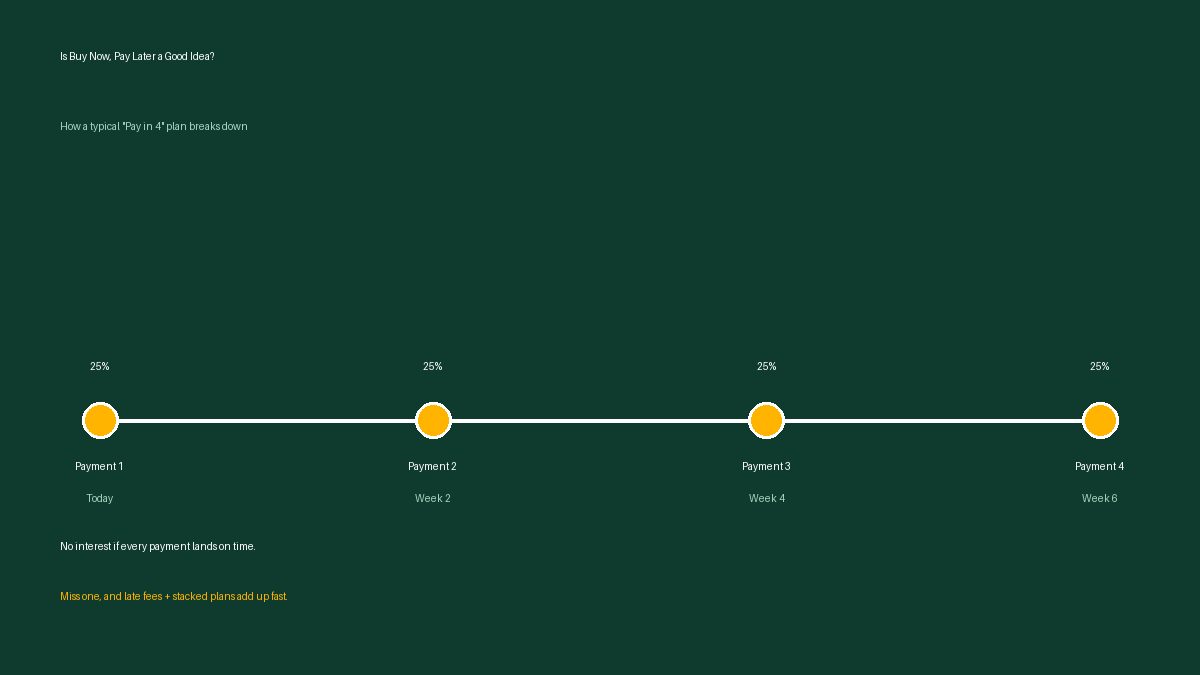
Buy now, pay later splits one purchase into several smaller payments on a fixed repayment schedule. The provider pulls each payment automatically from your card or bank account, often with the first due at checkout, and approval usually takes seconds. “Pay in 4,” the most common structure, breaks the purchase into four installments, 25% of the price every two weeks. No interest applies if every payment lands on time. Some BNPL plans stretch to 6 or 12 months instead, and those do carry interest, closer to a store financing offer. Read the schedule before you confirm. Six BNPL services handle about 94% of all BNPL lending in the US, per a 2026 Federal Reserve Bank of Richmond brief. Providers usually approve you on a soft credit check, not the hard inquiry a loan application triggers. That soft check is part of why checkout feels so frictionless.
Build an excellent credit score without paying interest
Get my free 2026 guide to how credit scores work, what moves them and how to fix mistakes on your credit report.
Who Uses These Plans
BNPL has grown from a checkout novelty into a sizable slice of consumer spending. The Richmond Fed brief estimates BNPL purchases reached about $70 billion in 2025, or about 1.1% of total credit card spending, and says volume has grown roughly 20% per year since 2021. On usage, the Federal Reserve’s report on household economic well-being in 2025 found that 16% of adults used BNPL in the prior 12 months. Women used it more than men (19% versus 14%), and younger adults used it most (22% of 18 to 29 year olds, against 9% of those 60 and older). The same groups were also the most likely to fall behind on a payment.
Late Fees and Stacking Plans Are the Biggest Risk
One $25 payment rarely sinks anyone. Opening several plans at once does. The Fed’s survey found that slightly more than one-fourth of BNPL users were late on a payment, and 17% of users said the provider charged them extra for it. FICO names the pattern that makes BNPL different: people can open a large number of these loans within a short period of time. Each provider sees only its own loan, so you can lose track of what you owe across all of them.
Late fees and finance charges add up fast when you juggle several plans. Avoid that by never opening a second plan while one is still active. A $40 Afterpay payment feels harmless until it’s one of five due the same week across five apps, none of which show up on a single statement. If you can’t list every open plan and its next due date from memory, stop opening new ones until you can.
How BNPL Shows Up on Your Credit Score
For plenty of plans, BNPL still doesn’t touch your credit score either way. Most providers don’t report short “Pay in 4” plans to the three credit bureaus. Paying on time doesn’t build your score, and a missed payment usually doesn’t hit your report directly, though an unpaid balance can still go to collections. That’s starting to change.
In June 2025, FICO announced two new models, FICO Score 10 BNPL and FICO Score 10 T BNPL, that factor BNPL data in alongside regular credit reports. Affirm started reporting its Pay in 4 loans to Experian in April 2025 and to TransUnion in May 2025. Klarna and Afterpay have been more cautious about reporting so far. Don’t assume a BNPL plan stays invisible to your credit file forever. A soft check at checkout doesn’t mean a missed payment has no consequences. An unpaid balance that reaches collections can cost you far more than the original purchase.
Where a Credit Card Still Beats BNPL
A credit card and a BNPL plan both let you buy something before it’s fully paid off, but the legal protections differ. Unlike a credit card, a BNPL plan isn’t a revolving line of credit. Credit cards come with dispute rights built in under the Truth in Lending Act. If an order arrives broken or never shows up, you can dispute the charge while the bank investigates. BNPL loans don’t automatically carry that guarantee, so the outcome depends on the provider you used.
In 2024 the Consumer Financial Protection Bureau issued an interpretive rule on BNPL. The CFPB’s own page says it withdrew that rule on May 12, 2025, along with several other guidance documents. Check each provider’s dispute policy before you buy, because a BNPL plan does not come with the card protections by default.
| What matters | Credit card | Buy now, pay later |
|---|---|---|
| Credit check | Hard inquiry | Usually soft or none |
| Cost if paid on time | Free if paid in full | Free on most “Pay in 4” plans |
| Dispute rights | Built in under federal law | Depends on the provider |
| Shows on your credit report | Yes, standard | Varies by provider |
| Tracking your balance | One statement, one balance | One balance per app, no combined view |
Rewards Cards and Personal Loans Offer More
With a rewards credit card, you earn cash back, points or miles on every purchase. A BNPL installment plan pays you nothing back. For a larger purchase, compare a personal loan too. You repay it in fixed monthly payments with a set APR and loan term, often 2 to 5 years, instead of BNPL’s typical six-week schedule.
BNPL’s edge is speed: quick approval at checkout and no interest if you pay on time. Rewards cards and personal loans win on cash back and longer terms for a bigger cost, though both need decent credit for the best rates. The best choice depends on the purchase amount, your cushion, and how fast you can pay it off. Weigh the pros and cons before you check out: BNPL’s biggest pro is no interest on a short plan paid on time, and its biggest con is no rewards plus a pile of due dates if you stack more than one.
Before You Click “Pay in 4”: Is Buy Now Pay Later a Good Idea?
Ask one question before your next purchase: could you pay for this today without the plan? Say yes, and a true 0% “Pay in 4” plan on something you already planned to buy works fine, especially around a big expense like the holidays. Say no, and BNPL isn’t making the purchase more affordable. Your bill moves a few weeks out, with a second payment schedule added to track. Using BNPL once rarely causes trouble. Stacking it on a credit card balance does. So does running two or three plans at once, because each one looks small by itself.
- Check you could pay cash today. If you couldn’t cover the full price right now, you’re borrowing against a future paycheck, and the plan doesn’t change that.
- Confirm the plan is 0% interest. Some longer BNPL plans charge interest like a store card. Read the schedule before you confirm.
- Check your other open plans first. Already have a BNPL payment due this month? That’s your answer: wait on this one.
- Put every due date in one place. Use one calendar or budgeting app, not five separate app notifications, so you catch each payment before it’s late.
Save the Cash Before You Need It
Build the cash for a big purchase before you need it, not after. Set aside money in a dedicated account for one future expense, a small sinking fund, over a few months. You get the same result as BNPL with no stacking risk, no dispute-rights gap and no fees. If holiday spending has you eyeing a payment plan, start a holiday budget a few months out and you’ll reach the same purchase with cash in hand. If debt from past BNPL or credit card use is piling up, compare the debt snowball and debt avalanche methods to find the one you’ll stick with.
Final Word on Pay in 4 Plans
Buy now, pay later earns its keep only when it replaces cash you already have, not when it replaces a plan to save it. Used rarely, on a single interest-free plan, for something you’d have bought anyway, BNPL is a convenience. Used to stretch a budget that doesn’t balance, it’s an easy way to end up owing several apps at once. Financing one planned purchase is fine. Financing your whole month isn’t. Keep your credit utilization low, save ahead for purchases you can see coming, and browse the Debt Management archive for more ways to handle debt and manage your money.

Free guide
Build an excellent credit score without paying interest
Get my free 2026 guide to how credit scores work, what moves them and how to fix mistakes on your credit report.
- The five factors FICO uses and how much each one counts
- How long late payments, collections and medical bills can stay
- A step-by-step plan to raise your score and dispute errors
Bonus: The Debt Payoff Plan, a worksheet to list your balances and pick a payoff order