
How do I bonds work? An I bond is a U.S. savings bond that pays a fixed rate plus an inflation rate, so your money keeps pace with rising prices. You buy it from the Treasury, the principal can’t shrink, and you can’t touch the cash for a year. That makes it a solid home for savings beyond your emergency fund. Below are the current rate, the rules, the tax treatment and the cases where an I bond is the wrong call.
What is an I bond?
An I bond, short for Series I savings bond, is a savings bond issued by the U.S. Treasury. It earns interest from two parts. One is a fixed rate that stays the same for the life of the bond. The other is an inflation rate that resets every six months, based on changes in the Consumer Price Index for all Urban Consumers (CPI-U). The Treasury combines the two into one number called the composite rate.
Think of it as a savings account with an inflation adjustment built in. The Treasury backs it, so the risk of losing your principal is about as low as it gets. The tradeoff is access. You can’t touch the money for the first 12 months, and there’s a cap on how much you can buy.
Build a budget you'll keep this month
Get my free 2026 guide to picking categories, setting limits, automating your savings and choosing a budgeting tool.
How do I bonds work? The interest rate explained
The composite rate is the fixed rate plus twice the semiannual inflation rate, plus a small cross term. TreasuryDirect publishes the formula as: fixed rate + (2 x semiannual inflation rate) + (fixed rate x semiannual inflation rate).
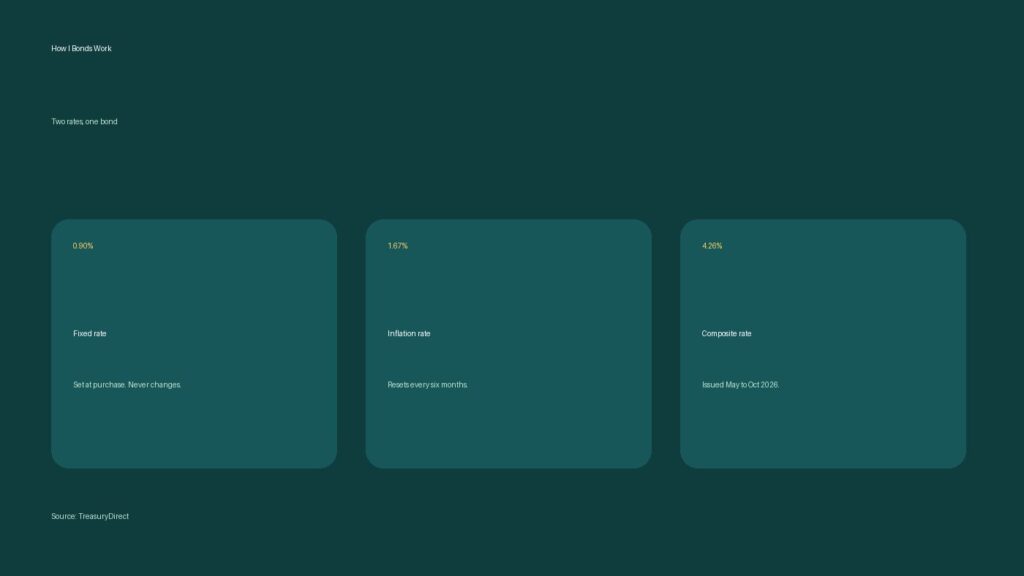
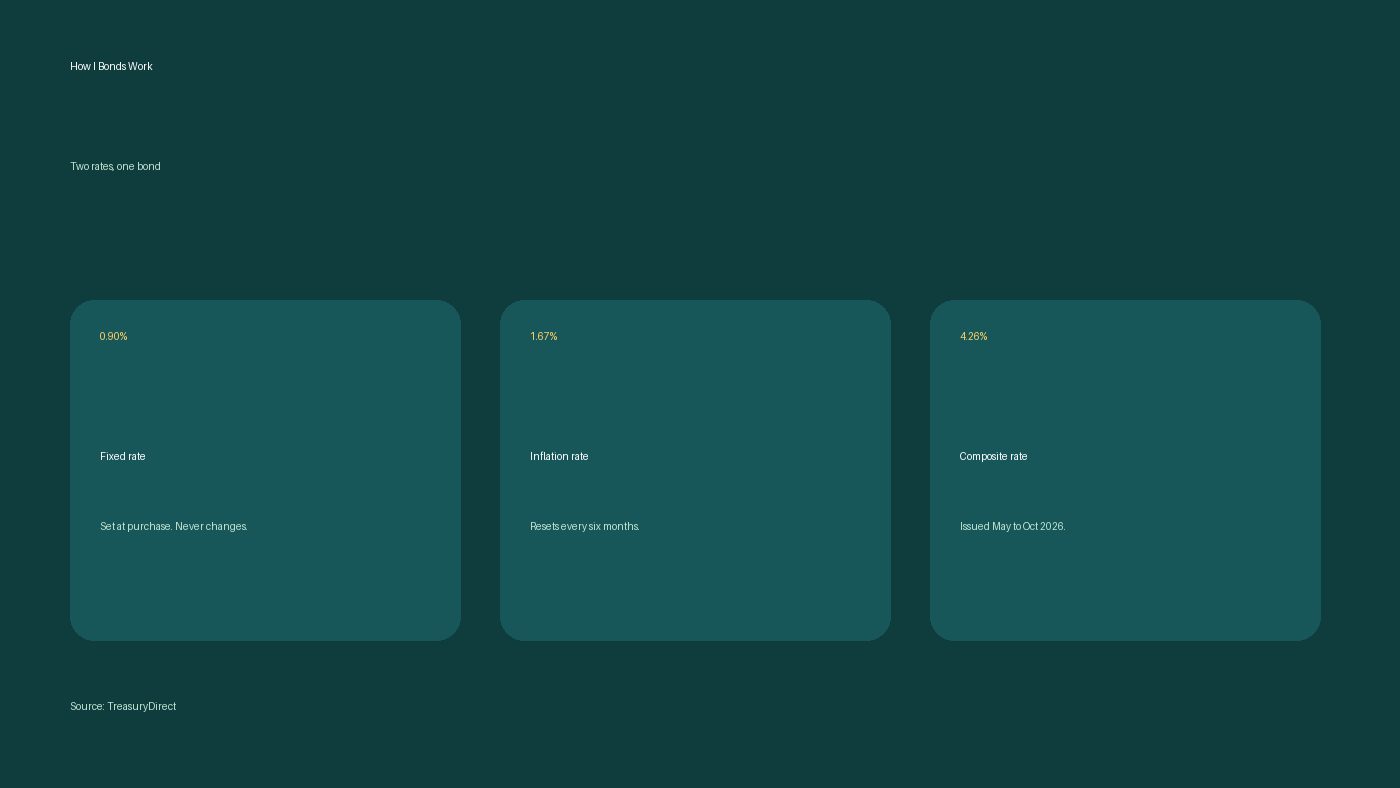
TreasuryDirect’s own example for bonds issued May 1, 2026 to October 31, 2026 uses a 0.90% fixed rate and a 1.67% semiannual inflation rate. That produces a 4.26% composite rate.
| Piece of the rate | May 2026 issue | How it behaves |
|---|---|---|
| Fixed rate | 0.90% | Set when you buy. Never changes. |
| Semiannual inflation rate | 1.67% | Resets every six months. |
| Composite rate | 4.26% | Fixed plus inflation pieces, per the formula. |
The Treasury announces the fixed rate and the inflation rate every May 1 and November 1. Each bond follows its own six-month schedule from the month you bought it. So a bond bought in March gets a new rate in September, no matter what the calendar says for newer buyers. The next announcement is November 1, 2026, and bonds bought after that date start at the new rates.
The composite rate can’t fall below zero. TreasuryDirect says that if falling prices would push it under zero, it stops at zero. Rates change, so check the TreasuryDirect I bond page for the current numbers before you buy.
Interest accrues monthly and compounds semiannually. That means earned interest gets added to your principal, and the bigger balance earns interest too.
The rules: limits, holding period, and penalty
Six rules separate an I bond from a regular savings account.
- Purchase limit: up to $10,000 in electronic I bonds per calendar year for each Social Security number or Employer Identification Number.
- Minimum purchase: $25. You can buy any amount above that, down to the penny.
- Lockup: you can’t cash in for the first 12 months.
- Early-withdrawal penalty: if you cash in before 5 years, you give up the last 3 months of interest.
- Maturity: 30 years, unless you cash it in earlier.
- Electronic only: since January 1, 2025, I bonds are sold only electronically through a TreasuryDirect account.
The penalty is smaller than it sounds. TreasuryDirect’s example: cash in at 18 months and you get the first 15 months of interest. You lose three months of interest, not any of your original money.
How to buy I bonds
You buy I bonds straight from the Treasury. There’s no broker and no fee at purchase. The steps are short.
- Open a TreasuryDirect account. You’ll need your Social Security number, a bank account, and ID details.
- Link your bank account. This is where the purchase money comes from and where redemptions go.
- Pick Series I and enter an amount. Anything from $25 up to your annual limit.
- Confirm the purchase. The bond issues in the month you buy it, and that month sets its six-month rate schedule.
- Set a reminder for month 12. That’s the first date you can cash in.
Because you can only buy through TreasuryDirect, protect the login. Use a strong password and keep your recovery details current.
How I bonds are taxed
I bond interest is subject to federal income tax but exempt from state and local income tax, according to TreasuryDirect. The state exemption saves the most in a state with a high income tax.
You also get a choice on timing. You can report the interest each year, or defer it until you cash in the bond, give up ownership, or it stops earning interest at 30 years. Deferring pushes the tax bill to the year you cash out. Cash the bonds in the same year you pay qualified higher education costs and some or all of the interest may be excludable, subject to income limits. IRS Form 8815 and Publication 550 have the rules, and a tax pro can tell you whether you qualify.
A simple example
Say you buy $1,000 of I bonds in May 2026 at the 4.26% composite rate. Over the first six months that’s roughly $21 of interest, before compounding. When the rate resets, your next six months could earn more or less. The fixed 0.90% piece stays, and only the inflation piece moves. This is simple arithmetic, not a forecast.
Common I bond mistakes to avoid
- Using it as emergency money. The 12-month lockup makes that a bad fit.
- Forgetting the account login. TreasuryDirect is the only place to manage the bond, so store your details safely.
- Cashing out at month 13 by default. Before five years, you give up three months of interest, so compare that cost with your other options.
- Ignoring the fixed rate. It never changes, so a higher fixed rate is worth more over a long hold.
- Buying more than the cap. The $10,000 yearly limit applies per Social Security number or EIN.
I bonds vs a high-yield savings account
I bonds protect against inflation, and a high-yield savings account gives you instant access. They solve different problems. A high-yield savings account pays a variable rate and lets you pull money out any time. An I bond ties up your cash for a year but adjusts with inflation.
| Feature | I bond | High-yield savings |
|---|---|---|
| Access | Locked for 12 months | Available any time |
| Rate | Fixed plus inflation, resets every six months | Variable, set by the bank |
| Yearly limit | $10,000 per person | None |
| State income tax | Exempt | Taxable |
| Where you buy | TreasuryDirect only | Banks and credit unions |
Build a cash cushion first. Money you might need this year doesn’t belong in an I bond. Once that’s covered, an I bond is a decent place for savings you won’t need for several years.
When an I bond makes sense, and when it doesn’t
An I bond fits money you can leave alone for at least a year, and ideally five. It also fits someone who wants a hedge against inflation without taking stock market risk. The long-term growth engine for most people is still low-cost index funds. I bonds are the safe slice of that plan.
It’s a poor fit for your emergency fund, for money you’ll need within a year, or for anyone who’d rather chase higher returns elsewhere. The $10,000 yearly cap also keeps it small. It won’t replace your retirement accounts.
If you’re not sure how inflation eats into savings, our post on what inflation is and how it affects you walks through it. And if you hold an older paper bond, see how to deal with U.S. savings bonds.
Frequently asked questions
Conclusion
So how do I bonds work? You get a fixed rate plus an inflation rate, you lock the money up for a year, and you can buy up to $10,000 a year through TreasuryDirect. Keep the emergency fund in cash, and treat I bonds as a safe, inflation-aware place for money you won’t need soon. Browse more in the Saving category or the Investing category.
Sources: TreasuryDirect I bonds and I bond interest rates, plus IRS Publication 550.
Free guide
Build a budget you'll keep this month
Get my free 2026 guide to picking categories, setting limits, automating your savings and choosing a budgeting tool.
- Set category limits from what you spend now
- Try envelope, zero-based and one-line budgets
- Compare free and paid budgeting tools for 2026
Bonus: The 30-Day Money Reset, a one-task-a-day plan to put your budget to work