
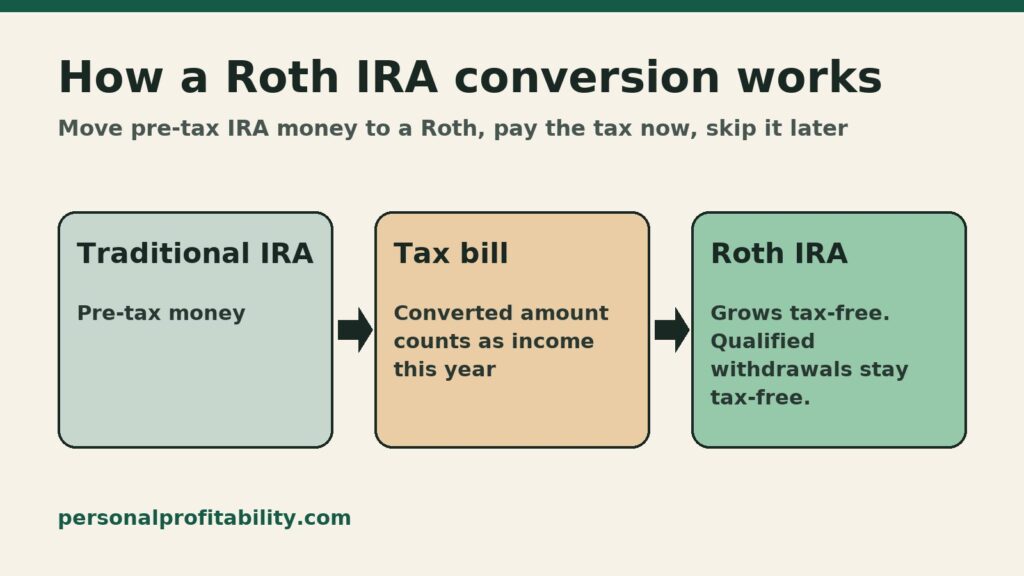
How does a Roth IRA conversion work? You move money from a traditional IRA into a Roth IRA, you add the pre-tax part of what you moved to this year’s taxable income, and from then on you can take qualified withdrawals tax-free. You pay the tax bill now so you can skip it later. If you’re building income as a freelancer or side hustler, you can time a conversion for a slow year and pay less tax on the move.
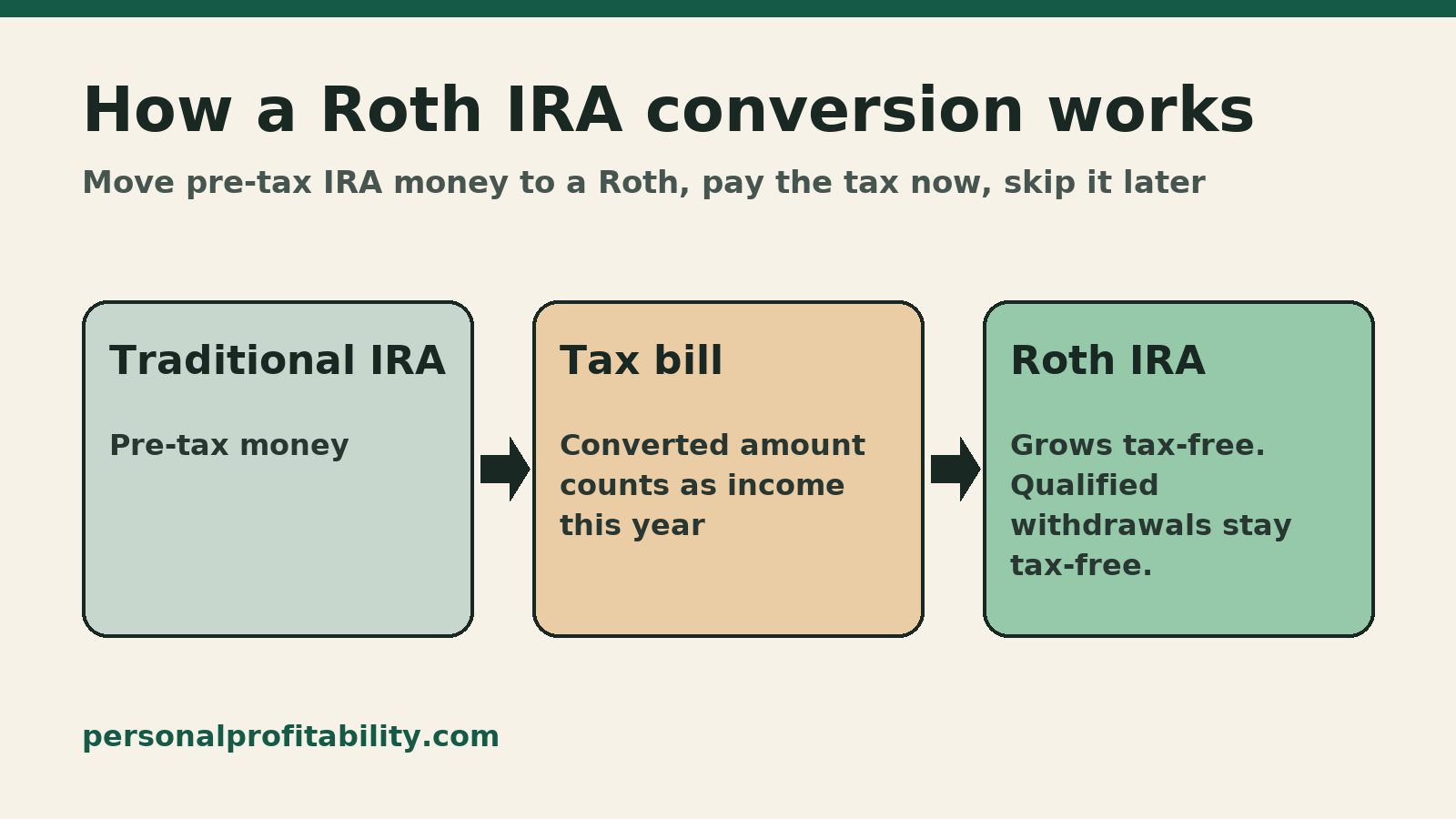
How does a Roth IRA conversion work, step by step?
You do a conversion by rolling money from a traditional IRA into a Roth IRA, and the IRS lists conversions among the rollovers on its rollover page. You can convert all of your balance or only a slice. You need a Roth IRA to receive the money, so open one before you start.
- Open a Roth IRA at the same brokerage that holds your traditional IRA, or at a new one. At many brokerages, you can finish the whole move online.
- Decide how much to convert. You pick the amount, and you can pick a different one each year.
- Ask for a direct transfer. You tell your brokerage to move the money straight from the traditional IRA to the Roth IRA. With a direct transfer, you skip the 60-day clock and never hold the check.
- Set aside cash for the tax. You report the converted amount as income, so have the tax money ready from outside the IRA.
- Watch for your tax forms. Your brokerage reports the move on Form 1099-R, and you report the conversion on Form 8606 with your Form 1040.
The IRS sets the tax rule in Publication 590-A. You must include in gross income any distribution from a traditional IRA that you would have had to include in income if you hadn’t converted it into a Roth IRA. You don’t pay tax a second time on money you already taxed, such as nondeductible contributions.
Learn how the stock market works, then start
Get my free 2026 guide to stocks, trades, account types, and index funds, plus a step-by-step plan for your first investment.
How much tax will you owe on a Roth conversion?
You owe ordinary income tax on the pre-tax part of the amount you convert, at your marginal rate for the year. The IRS charges no special conversion rate. You stack the taxable amount on top of your wages, self-employment profit, and everything else on the return.
Say you convert $10,000 of pre-tax IRA money, and your marginal rate is 24% (made-up numbers). You’d add $10,000 to your income and owe about $2,400 more in federal tax, before any state tax. Ask your tax pro, or run your tax software, for the real figure.
Before you convert, plan for two things. First, pick the account that will cover the tax. The cleanest choice is a checking or savings account, not the IRA. Second, see if you’d move into a higher bracket or lose an income-based tax break once you add the converted amount. Settle both before you convert.
Does the 2026 IRA limit apply to conversions?
No. On its IRA contribution limits page, the IRS caps your 2026 total contributions to all of your traditional and Roth IRAs at $7,500 ($8,600 if you’re 50 or older), and it exempts rollover contributions from the limit. The IRS treats a conversion as a rollover, so you can convert more than $7,500 in a year.
| Move | Counts toward the 2026 limit? | Taxed this year? |
|---|---|---|
| Regular contribution to a Roth IRA | Yes, $7,500 ($8,600 at 50 or older) | No, you already paid tax on the money |
| Conversion from a traditional IRA | No, the limit doesn’t apply to rollovers | Yes, the pre-tax part |
| Direct transfer between two traditional IRAs | No | No |
The IRS also says the one-rollover-per-year rule for IRAs doesn’t apply to conversions, so you can run more than one in a 12-month stretch. Some people convert in several pieces during the year so they can watch their tax bracket.
What is the pro-rata rule on a Roth conversion?
Under the pro-rata rule, you can’t pick which dollars you convert. If you hold both pre-tax and after-tax money across your traditional IRAs, you convert a mix of both every time. The IRS walks through the math in Publication 590-B and on Form 8606, and it looks at all your traditional IRAs together when it figures the taxable share.
Try a made-up example. Suppose you’ve made $7,500 of nondeductible contributions, and all your traditional IRAs together are worth $100,000, including what you’re about to convert. Your after-tax share is 7.5%. If you convert $10,000, you move about $750 tax-free and owe tax on about $9,250. You can’t dodge the rest by converting only the after-tax slice.
People often trip on this rule when they try a “backdoor” Roth and still hold a big pre-tax IRA balance. For the workplace-plan version, read our post on the mega backdoor Roth. Check Form 8606 and its instructions, or ask a tax pro, before you try either one.
Can you take the money out right after you convert?
Not without a possible penalty if you’re under 59½. Under the rules in Publication 590-B, if you take a distribution within five years of converting (counting from the first day of the tax year you converted), you may owe the 10% additional tax on the part of the conversion that you had to include in income.
Keep three details in mind.
- You start a new clock with each conversion. The IRS applies a separate 5-year period to each conversion. If you convert in 2026, you start counting on January 1, 2026.
- You benefit from the IRS withdrawal order. The IRS treats Roth withdrawals as coming from regular contributions first, then conversions (oldest first), then earnings. You can take out your own contributions before you touch the converted money.
- This clock is separate from the qualified-distribution clock. The IRS notes that the conversion period isn’t necessarily the same one you use to decide whether a distribution is qualified.
The IRS also lists exceptions to the 10% tax in IRS Publication 590-B. For the plain-English version of the account’s other rules, see our Roth IRA guide for beginners.
Can you undo a Roth conversion?
No. In Publication 590-B, the IRS bars you from recharacterizing a conversion made in a tax year beginning after December 31, 2017, as a contribution to a traditional IRA. Once you convert, you own a Roth IRA and a tax bill. Treat the amount as a decision, not a test run.
You also carry market risk. Suppose you convert $20,000 and then lose 15% in a market drop the next month. You still owe tax on the $20,000 you converted, not on the lower value. Some people convert in smaller pieces over several years for that reason, and to spread the income across more than one tax year.
When does a Roth conversion make sense?
Convert when your tax rate today is lower than the rate you expect in retirement and you can pay the tax from cash outside the IRA. A low-income year is the classic time to convert. These are the common setups:
- A low-income year. You have a slow freelance year, you take a loss in a new business, or you take time off between jobs. With low taxable income, you pay less tax on each converted dollar.
- Early retirement before other income starts. Some retirees convert in the gap years before they start Social Security or required withdrawals.
- You expect higher taxes later. If you think rates, or your own income, will climb, you may prefer to pay now.
- You want a bigger tax-free pool. If you meet the IRS rules, you pay no tax when you withdraw from a Roth, so you can budget for retirement with fewer unknowns.
Skip it when you’d pay the tax bill from the IRA itself, when you’d land in a much higher bracket, or when you may need the money in the next five years. If you’re self-employed, weigh a conversion against funding a SEP IRA or a Solo 401(k). You can lower this year’s taxable income with those contributions, while a conversion raises your taxable income.
This is general information, not advice for your return. A fee-only CPA or fiduciary planner can run your numbers.
What mistakes do people make on a Roth conversion?
- Paying the tax out of the IRA. If you’re under 59½, you take any amount you don’t move into the Roth as a distribution. The IRS says an IRA distribution paid to you is subject to 10% withholding unless you elect out. You generally owe income tax on the part you keep, and you may owe the 10% additional tax under Publication 590-B too.
- Forgetting the tax bill. If you convert a large amount, you may owe at filing time, so many people adjust their withholding or make an estimated payment. Read our guide on quarterly estimated taxes for the steps.
- Ignoring the pro-rata rule. If you forget a pre-tax balance, you turn a “tax-free” conversion into a taxable one.
- Converting a required minimum distribution. You can’t convert an amount you must take as a required distribution for the year, per Publication 590-A, so take any RMD you owe before you convert.
- Skipping Form 8606. You track your after-tax basis on Form 8606. Skip the form, and you can pay tax twice on the same dollars.
Roth IRA conversion FAQ
Conclusion
Here is how a Roth IRA conversion works in one line: you trade a tax bill today for tax-free growth and tax-free qualified withdrawals later. Convert in a year when your income is low, pay the tax from cash outside the IRA, and remember you can’t undo the move. Before you start, read how a traditional IRA works, and if your money sits in a SEP IRA, how a SEP IRA works. Browse more in the Retirement category or start from the Personal Profitability homepage.

Free guide
Learn how the stock market works, then start
Get my free 2026 guide to stocks, trades, account types, and index funds, plus a step-by-step plan for your first investment.
- How a trade works, from order types to T+1 settlement.
- Why I start with low-cost index funds instead of stock picks.
- The margin rules and my own trading mistakes, so you can avoid the same errors.
Bonus: The First-Investment Checklist, the order to handle your match, debt, and savings