
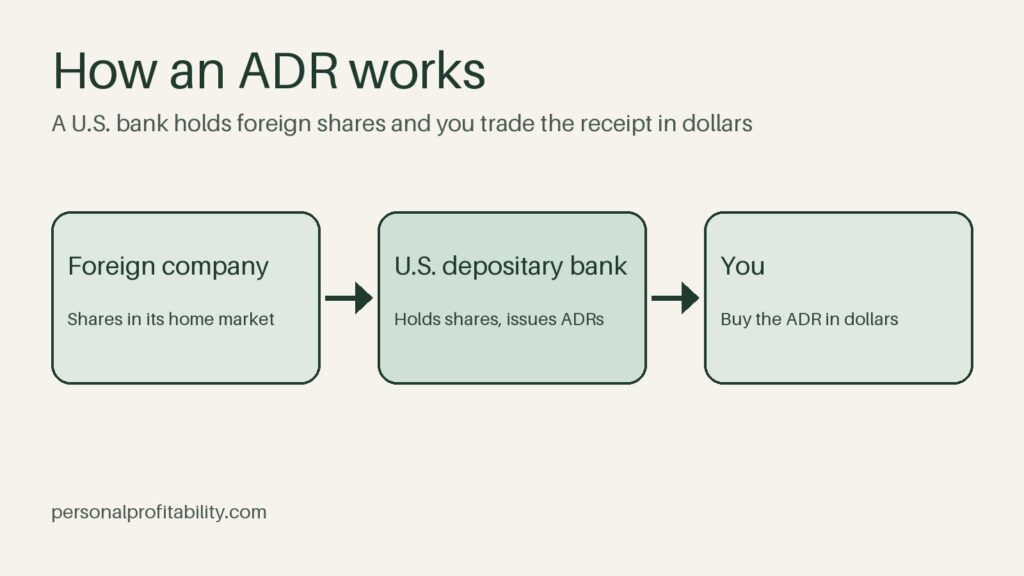
What is an ADR stock? It’s a U.S.-traded certificate that stands in for shares of a foreign company, which a U.S. bank holds overseas on your behalf. The SEC says an ADR “is a security that represents shares of non-U.S. companies that are held by a U.S. depositary bank outside the United States.” You trade it in dollars through your regular brokerage account, like any other share on the stock market.
What is an ADR stock? The meaning in plain English
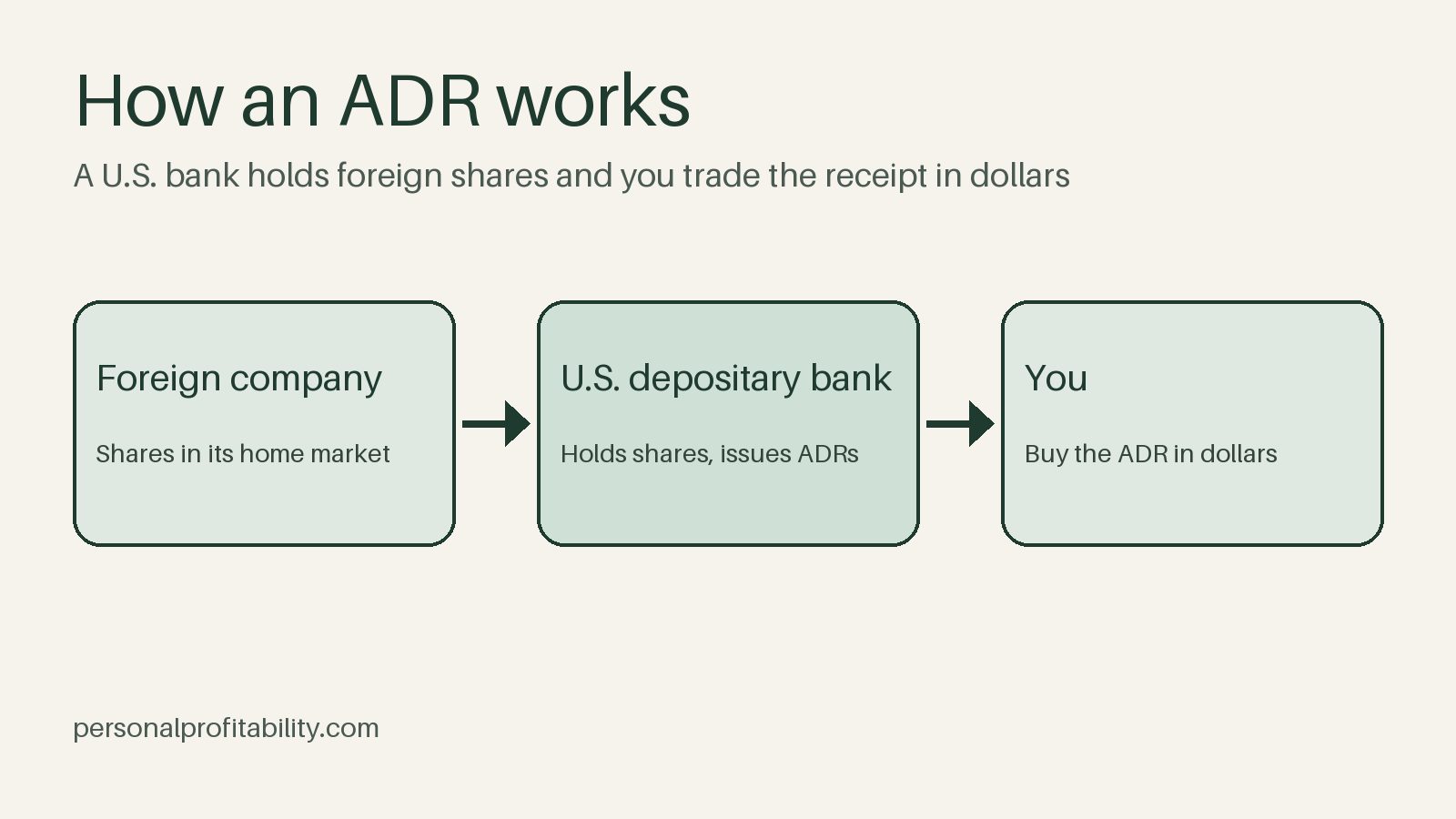
ADR stands for American depositary receipt. Think of it as a claim ticket. A U.S. bank, called the depositary bank, holds the actual foreign shares in the company’s home country and issues a receipt you can trade here.
The SEC’s investor bulletin on ADRs describes the setup this way: an ADR is a negotiable certificate that evidences ownership in American Depositary Shares, or ADSs, which in turn represent an interest in the foreign company’s shares held by a U.S. bank. People use ADR and ADS interchangeably, and so does the SEC.
Why bother? The SEC says ADRs let U.S. investors buy non-U.S. companies and give those companies easier access to U.S. capital markets. ADRs trade in U.S. dollars and clear through U.S. settlement systems, so you avoid transacting in a foreign currency. The first ADR dates to 1927. Today, the SEC counts more than 2,000 ADRs covering companies in more than 70 countries, though that figure comes from an August 2012 bulletin, so treat it as a floor and not a current count.
Learn how the stock market works, then start
Get my free 2026 guide to stocks, trades, account types, and index funds, plus a step-by-step plan for your first investment.
How a bank creates an ADR
A depositary bank creates an ADR when the foreign company, or an investor who already owns its shares, hands those shares to the bank or its custodian in the home country. The bank then issues ADRs to the investor in the U.S., and that investor can sell them on a U.S. exchange or the over-the-counter market. You can also go in reverse. Holders can surrender ADRs and take back the underlying foreign shares, though brokers and active foreign-market investors usually handle that part.
One quirk surprises new investors: one ADR doesn’t always equal one share. The SEC notes that an ADR may represent one share, a fraction of a share, or several shares. Banks choose the ratio to keep the ADR price near what U.S. investors expect to see. So don’t compare an ADR’s price with the home-market share price until you check the ratio.
Sponsored vs. unsponsored ADRs
A sponsored ADR means the foreign company signed an agreement with the depositary bank, while an unsponsored ADR doesn’t. Under a sponsored deal, the SEC says, the company arranges recordkeeping, forwarding of shareholder communications, dividend payments, and other services with the bank. Without the foreign company’s cooperation, a broker-dealer that wants a U.S. trading market may start an unsponsored ADR.
The SEC also groups ADRs into three levels, based on how far the company has gone into U.S. markets.
| Level | Where it trades | Can it raise capital? | SEC filings |
|---|---|---|---|
| Level 1 | Over-the-counter market only | No | Form F-6 only, so little issuer information on EDGAR |
| Level 2 | National securities exchange | No | Form F-6 plus annual report on Form 20-F |
| Level 3 | National securities exchange | Yes | Form F-1, F-3, or F-4 plus Form 20-F |
Level 1 is the only level that can be unsponsored. The SEC says you won’t find issuer information on EDGAR for a Level 1 ADR, so you’d look to the company’s own website. That’s a good reason to prefer a Level 2 or Level 3 ADR when you do your homework.
What ADRs cost: custody and other fees
ADR holders pay fees, and most people never see the line item. The SEC says depositary banks charge custody fees, sometimes called Depositary Services Fees, to cover inventorying the foreign shares and handling registration, compliance, dividend payment, communication, and recordkeeping.
Most depositary banks take the fee out of your dividend before you see the payout. When an ADR pays no dividend, the Depository Trust Company bills banks and brokers, and those firms pass the fee on to their customers. The SEC says banks typically charge per ADR and gives one example: a fee of $20 to $50 on 1,000 ADRs. Banks may also charge for dividend distribution, currency exchange, and share voting.
Before you buy, ask your broker which fees apply. You can also look up the deposit terms yourself. The SEC says fees appear in the Form F-6 registration statement on EDGAR, in the section usually titled “Description of American Depositary Shares.”
How to buy an ADR stock
You buy an ADR the same way you buy any U.S.-listed stock. Open a brokerage account, search the ticker, and place an order in dollars. Take these steps to stay out of trouble:
- Confirm it’s an ADR. Most brokers label ADRs on the quote page, and the company names its depositary bank on its investor-relations page.
- Check where it trades. If you find it on an exchange, you’re looking at Level 2 or Level 3. If you find it over the counter, you’re often looking at Level 1.
- Use a limit order. Few buyers and sellers trade some over-the-counter ADRs, so set the most you’ll pay with a limit order.
- Save the paperwork. Keep your broker’s year-end tax form, because you’ll need its foreign tax figure at tax time.
Pay in full from cash you can leave invested for years. I wouldn’t borrow for any single stock, ADR or otherwise.
What risks do you take on with ADR stock?
An ADR is still a foreign company, so you take on risks a U.S. stock doesn’t carry. The SEC tells investors to research the political, economic, and social conditions in the company’s home country, because conditions there shape the company’s results and stock price.
Disclosure is the other big gap. The SEC says non-U.S. companies follow disclosure rules that differ from those for U.S. public companies. Apart from the annual Form 20-F, they generally only have to disclose what their home country requires, and it may not be as extensive or comparable. You may get less information to work with, and that’s a good reason to size a position small.
Currency matters too. You pay in dollars, but you still own a stake in a company that earns in another currency, so you can gain or lose when exchange rates swing. I’d treat that as a general feature of foreign investing, not a number to predict.
How ADR dividends and taxes work
ADR dividends can arrive reduced twice, once by the custody fee and again by foreign tax. Some countries withhold tax on dividends paid to foreign holders. You may be able to claim a credit for that tax on your U.S. return. The IRS explains the foreign tax credit in Tax Topic 856 and gives individuals the full rules in Publication 514.
The IRS says Congress designed the credit to reduce the double tax burden you’d face when both the U.S. and a foreign country tax the same income. The tax must be an income tax that you legally owe and actually paid or accrued. Watch the holding period. The IRS won’t give you a credit for foreign tax withheld on a dividend unless you held the stock for at least 16 days in a 31-day window, counted from 15 days before the ex-dividend date. Check your broker’s tax form for the foreign tax paid, and ask a tax pro how to claim the credit. IRS Publication 514 has the full rules.
Should you buy ADR stocks? An index-fund view
For most readers, I’d pick a broad fund over hand-picking ADRs. I’m not here to name an individual foreign stock for you, and you shouldn’t take a stock tip from a blog. My default is the boring one: low-cost index funds and target-date funds, held for decades. With a global or international index fund, you already own foreign companies, and you skip researching each company’s deposit agreement.
That said, there are good reasons to hold a single ADR. Maybe you work for the foreign company, or you want to own one brand you know. If so, check four things first:
- Find the ADR level. Companies with Level 2 and Level 3 ADRs file annual reports with the SEC, and Level 1 companies don’t.
- Ask your broker about fees. Get the custody fee and any other charges in plain numbers.
- Read the filings. Search EDGAR for the Form F-6 and, if there is one, the Form 20-F.
- Keep the position small. With less disclosure and currency swings in play, I’d hold only a small slice.
If you’re new to this, learn how a diversified portfolio works before you buy any single ADR. Then read our post on target-date funds vs. index funds for the simple route.
ADR stock FAQ
Conclusion
An ADR stock is a dollar-priced receipt for foreign shares, backed by a U.S. depositary bank and sold through any brokerage. You pay custody fees, you get less disclosure than a U.S. company gives, and you can use the level and sponsorship to judge how much information you’ll find. For a wider view of building a portfolio, browse our investing guides, or head back to the Personal Profitability homepage. I first covered ADRs on the site in the shorter explainer What is an ADR?, and here I’ve gone deeper.
Free guide
Learn how the stock market works, then start
Get my free 2026 guide to stocks, trades, account types, and index funds, plus a step-by-step plan for your first investment.
- How a trade works, from order types to T+1 settlement.
- Why I start with low-cost index funds instead of stock picks.
- The margin rules and my own trading mistakes, so you can avoid the same errors.
Bonus: The First-Investment Checklist, the order to handle your match, debt, and savings