
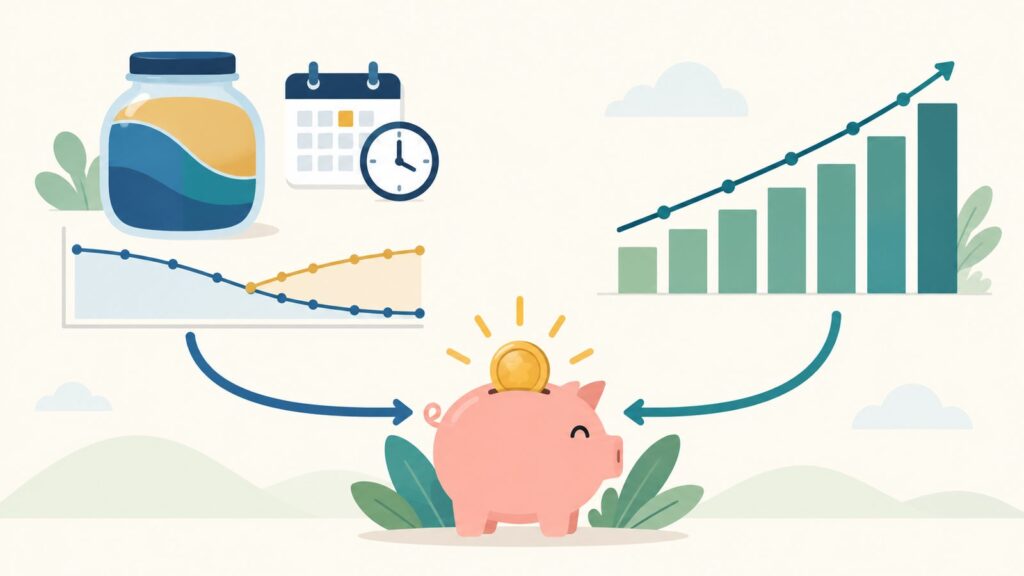
Here’s the target date fund vs index fund answer in one line: a target-date fund manages the stock-to-bond mix and rebalances it for you as retirement gets closer, while a plain index fund like an S&P 500 fund holds one static slice of the market and leaves the mix entirely up to you. Both are legitimate core holdings. The real question is how much control you want and how much you’re willing to pay someone else to handle it for you. This comparison matters the moment you pick your first 401(k) fund, and it still matters years later when you’re rebalancing a full portfolio. If you’re just opening your first Roth IRA, this is the financial decision that shapes your whole portfolio from here on.
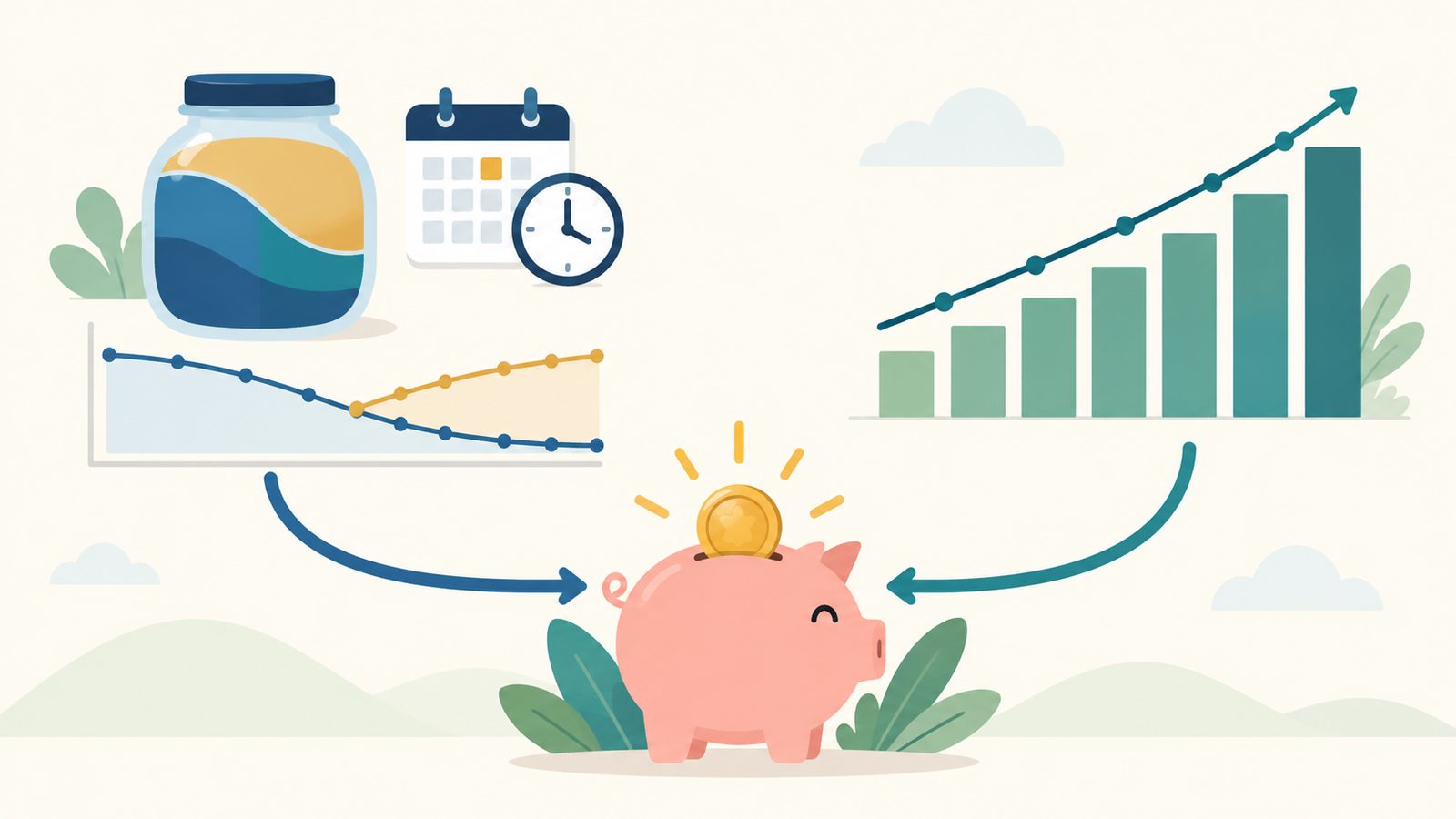
What Is a Target-Date Fund?
Think of a target-date fund as a single fund built around a specific retirement year, one that automatically shifts from mostly stocks toward more bonds as that year gets closer. You’ll see the year right in the name, like a “Target Retirement 2055 Fund.” Pick the fund closest to the year you expect to retire, put money in, and the fund manager handles the rest. Fund managers actively decide the glide path, unlike plain index funds, which are passively managed and just mirror whatever their underlying index does. Most target-date funds are structured as mutual funds, though a growing number trade as ETFs, and either version works fine inside a tax-advantaged account like a 401(k) or a Roth IRA.
That automatic shift is called the glide path, and it’s the whole point of the fund. The SEC’s investor education office warns that two funds with the same target year can still have different glide paths, meaning one fund manager might shift to bonds faster or slower than another. SEC guidance is also direct about what a target-date fund is not: it does not guarantee you’ll have enough retirement income, or any specific level of income, once you hit that date. It’s a strategy, not a promise.
“To” Funds vs “Through” Funds
Not every target-date fund handles retirement day the same way, and this is the part most people never check. One version, called a “to” fund, reaches its most conservative mix right around the target year and then holds steady. The other, a “through” fund, keeps shifting toward bonds for years after the target date, on the idea that you’ll keep drawing the money down slowly instead of spending it all at once. Vanguard, Fidelity, and T. Rowe Price all build “through” funds, so most of the big-name target-date funds you’ll run into keep de-risking well past your retirement date, not just up to it.
You can find which type your fund uses on its own summary page or prospectus, usually under a section called the glide path or asset allocation strategy. It’s worth the two minutes to check, since a “to” fund and a “through” fund with the same target year can hold noticeably different amounts of stock once you actually get there.
How Does a Plain Index Fund Work?
Plain index funds track one market index and hold the same mix forever, with no glide path and no automatic rebalancing. Index funds exist for nearly every slice of the market, from U.S. large caps to international stocks to bonds, so you can build your own mix out of a few low-cost funds instead of one all-in-one fund. Like target-date funds, most index funds are structured as mutual funds or ETFs, and both give you broad market exposure without picking individual stocks yourself.
The Vanguard 500 Index Fund, for example, just holds the S&P 500 companies in roughly the same proportions as the index itself. It doesn’t get more conservative as you age. It doesn’t know how old you are. Deciding the stock-to-bond split falls on you, whether that means one stock index fund at 100% stocks, or a mix of a stock fund and a bond fund you rebalance on your own.
Because there’s no manager making shifting decisions, a plain index fund usually costs less to run. Vanguard’s own fund page lists the Vanguard 500 Index Fund Admiral Shares (VFIAX) expense ratio at 0.04%, meaning you pay $4 a year for every $10,000 invested.
Not every index fund gives you the same exposure, either. An S&P 500 index fund only holds large U.S. companies. Total stock market index funds add small and mid-size U.S. companies on top of that, and international index funds add exposure outside the U.S. entirely. Many investors combine two or three of these to build a fuller portfolio, since a single S&P 500 fund alone skips international markets completely. Target-date funds typically bundle this diversification in for you, using a mix of U.S., international, and bond index funds behind the scenes.
Target Date Fund vs Index Fund: The Real Differences
Put side by side, a target date fund vs index fund comes down to five practical differences: who does the rebalancing, how diversified you are on day one, what it costs, how much effort it takes, and how the risk level changes over time. The key difference between the two, once you strip away the marketing, is who’s making the ongoing decisions. Compare them on these five points and the right choice for your long-term growth and retirement goals gets a lot clearer.
| What matters | Target-date fund | Plain index fund |
|---|---|---|
| Rebalancing | Automatic, built into the fund | You do it yourself, or not at all |
| Stock/bond mix | Set by the fund manager, shifts over time | Fixed and set by you |
| Diversification on day one | Already spread across stocks and bonds | Only as diversified as the single index it tracks |
| Typical cost | Higher, for the active management of the glide path | Lower, since it just tracks an index |
| Effort required | Very low, one fund does the job | Higher if you want more than one index for full diversification |
Which One Costs More?
A target-date fund almost always costs more than a comparable plain index fund from the same company, because you’re paying for the ongoing glide-path management. Even Vanguard, one of the cheapest fund families in the industry, prices its target-date funds higher than its own flagship index fund. Vanguard’s Target Retirement Funds carry an expense ratio of 0.08%, double the 0.04% you’d pay for the plain 500 Index Fund. That 0.04 percentage point gap sounds small, but fees compound the same way returns do. Held for decades in a large balance, a lower expense ratio means more of your actual return stays in your account instead of going to the fund company. Past performance never guarantees future returns, but the fee you pay is one of the few things about your investment performance you can actually control before you buy.
Other target-date providers price higher than Vanguard, so don’t assume every target-date fund costs 0.08%. Compare expense ratios on each fund’s own summary page before you buy, the same way you’d check any fund, since even a small gap in fees can reduce what you keep over a long-term investing horizon. Charging 0.5% or more doesn’t automatically make a fund a bad choice, but it’s worth knowing what you’re paying for before you commit decades of contributions to it.
When a Target-Date Fund Makes More Sense
A target-date fund makes the most sense when you want one fund to be your entire retirement account and you don’t want to think about rebalancing again. That’s exactly why it’s become the default option in most workplace 401(k) plans. The Department of Labor lists target-date funds as one of the qualified default investment options plan sponsors can use to automatically enroll workers who don’t pick their own investments. If you’ve never chosen anything in your 401(k) and money has just been landing somewhere, there’s a real chance you’re already in a target-date fund.
- You want a true “set it and forget it” account. One fund, one decision, done.
- Realistically, you’re not going to rebalance on your own. Be honest with yourself here. Most people don’t.
- Investing still feels new, and the number of choices feels overwhelming. A target-date fund removes the guesswork about how much to put in stocks versus bonds.
- Your 401(k) only offers a few fund options. It’s often the most complete single choice on the menu.
When a Plain Index Fund Makes More Sense
A plain index fund makes more sense when you want to keep costs as low as possible and you’re comfortable managing your own stock-to-bond split. Decades from retirement and comfortable staying mostly or entirely in stocks? A single S&P 500 or total market index fund can do that job for less than any target-date fund will charge you. Giving up the automatic glide path buys you full control and a lower fee.
- You want the lowest possible cost. Plain index funds almost always win on price.
- Maybe you’re building a portfolio out of a few pieces yourself. Pairing a stock index fund with a bond fund, sized the way you want.
- Perhaps you already have other accounts to balance against. A pension, real estate, or a spouse’s 401(k) that changes what your ideal mix looks like.
- You want to adjust your risk on your own schedule instead of following a preset glide path you didn’t choose.
Can You Use Both?
Yes, and plenty of people do. Many investors like the simplicity of a target-date fund during their early working years, when they aren’t yet paying close attention to asset allocation, then add index funds later as their portfolio and their investing knowledge both grow. One common approach lets a target-date fund be the core of a 401(k), where it’s often the only reasonable single-fund choice, while keeping a Roth IRA or taxable brokerage account in a plain S&P 500 index fund for lower fees and more control.
There’s no rule that says you have to pick one strategy for every account you own. The goal isn’t to find the theoretically perfect fund, it’s to actually keep investing consistently in something reasonable. Both a target-date fund and an index fund clear that bar. Deciding where new money should go next? Our guide to understanding your company’s 401(k) plan and our breakdown of how compound interest builds wealth over time are both good next reads.
Frequently Asked Questions
The Takeaway: Pick the One You’ll Actually Stick With
The target date fund vs index fund decision isn’t really about which strategy is mathematically perfect. What matters more is which one you’ll actually keep contributing to for the next twenty or thirty years. One trades a slightly higher fee for a hands-off glide path that rebalances itself, while the other trades that convenience for a lower cost and full control over your own mix. Either one, held consistently, will do more for your long-term retirement goals than the perfect fund you never got around to buying. Pick whichever one matches how hands-on you actually want to be, not the one a chart says is theoretically optimal.
If you want to go deeper on where to hold this money, read our guides on Roth IRA basics, the mega backdoor Roth for high earners who’ve maxed out the usual limits, and using an HSA as a second retirement account. Our investing guides have more if you want to keep building your plan.