
So, how does a 401k match work? Your employer adds money to your 401(k) when you contribute your own, usually a set percentage of what you put in, up to a cap tied to your pay. It’s the closest thing to free money in personal finance. New to the plan itself? Start with our guide to company 401(k) plans, then come back here for the match formula, a worked example, and the vesting rules you need to know before you quit.
What a 401(k) match is
A 401(k) match is money your employer deposits into your retirement account based on what you contribute. Skip your contributions and the match usually disappears. Contribute enough, and the full amount your employer offers lands in your account.
Your employer decides whether to offer a match at all, and it picks the formula. The IRS 401(k) plan overview calls matching an option for employers, not a requirement. Some match every dollar. Others match half. Others skip it and run a plan funded only by employee contributions. You’ll find the formula in the plan’s summary plan description, and HR can send you a copy.
Think of the match as part of your compensation. Take a $60,000 job with a 3% dollar-for-dollar match. It’s worth $1,800 more a year than the same job without one. Eric’s rule on this one is blunt: take the full match before you do anything else with extra money, because nothing else you can buy pays a guaranteed instant return.
Learn how the stock market works, then start
Get my free 2026 guide to stocks, trades, account types, and index funds, plus a step-by-step plan for your first investment.
How does a 401k match work? Reading the formula
Most match formulas have two parts: a match rate and a cap. The rate tells you how many cents your employer adds for each dollar you contribute. At the cap, your employer stops matching, and most plans state that cap as a percentage of your salary.
| Formula | What you contribute | What your employer adds | Common name |
|---|---|---|---|
| 100% up to 3% of pay | 3% of salary | 3% of salary | Dollar-for-dollar match |
| 50% up to 6% of pay | 6% of salary | 3% of salary | Half-match |
| 100% of the first 3%, plus 50% of the next 2% | 5% of salary | 4% of salary | Safe harbor basic match |
That last row comes straight from the tax code. The Treasury regulation on safe harbor 401(k) plans defines the basic matching formula as 100% of the first 3% of pay you contribute, plus 50% of the next 2%. Employers who offer a safe harbor plan skip the complex annual nondiscrimination tests, according to the IRS plan overview, and that saves a small employer administrative work.
Two plans can both say 3% and mean different things. With a 100% match up to 3%, you spend 3% of pay to collect the full amount. With a 50% match up to 6%, you spend 6% of pay to collect that same 3%. Read the rate and the cap together, and work out what you have to contribute to get the whole thing.
Worked example: a $60,000 salary
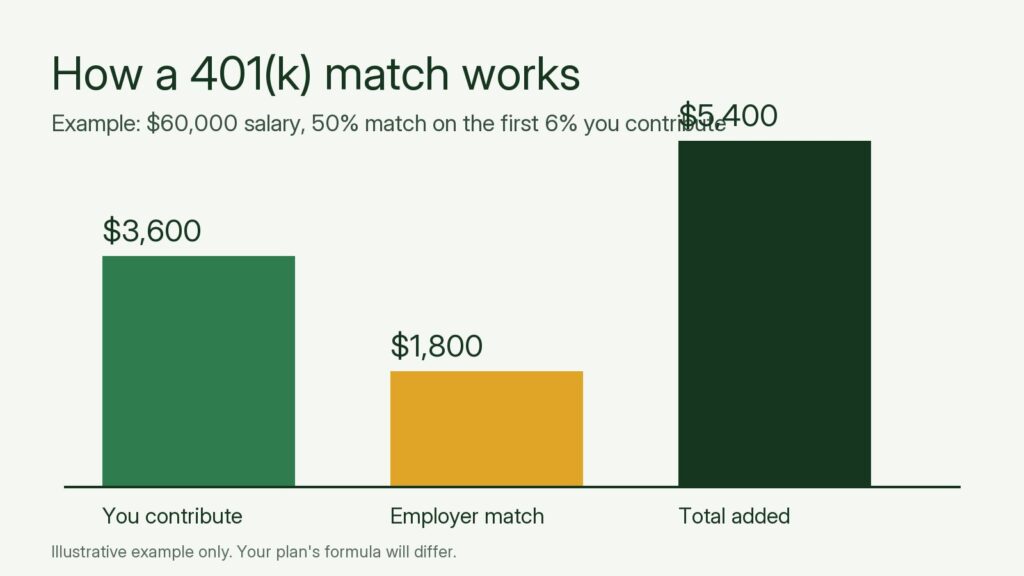
Say you earn $60,000 a year and your employer matches 50% of what you contribute, up to 6% of your pay. This is a made-up example, but every match works the same way.
- Start with the cap. 6% of $60,000 is $3,600. Your employer stops matching past that amount.
- Contribute up to the cap. You put in $3,600 over the year, about $300 a month.
- Apply the match rate. 50% of $3,600 is $1,800, and your employer deposits that amount.
- Add it up. You’ve put $5,400 into your account for $3,600 of your own money, an instant 50% return before any investment gains.
Now suppose you stop at 3% of pay, or $1,800. Your employer adds 50% of that, which is $900, and you forfeit the other $900 of match money. Stopping short of the cap costs you that amount every year.
Match timing and ownership
Most employers deposit the match into your 401(k) with each paycheck, though some deposit it once a year or at the end of each quarter. Ask HR which kind your plan uses. An employer that matches once a year may require you to be on payroll on the deposit date, so if you quit before then, you can lose that year’s match even when you contributed all year.
You own your own contributions in full from day one. The match can take longer to become yours, depending on your plan’s vesting schedule.
Vesting: when the match actually belongs to you
Vesting is the timeline your employer sets for how much of the match you keep if you leave. According to the IRS vesting guidance for matching contributions, an employer with a traditional 401(k) has to vest your match at least as fast as one of two schedules. Under a three-year cliff, you own none of the match until your third year of service ends, then the whole match. Under a six-year graded schedule, you reach 100% after six years of service.
| Years of service | Graded vesting (six-year) | Three-year cliff |
|---|---|---|
| Less than 2 | 0% | 0% |
| 2 | 20% | 0% |
| 3 | 40% | 100% |
| 4 | 60% | 100% |
| 5 | 80% | 100% |
| 6 | 100% | 100% |
Employers can offer a faster schedule than these, and plenty do. In most safe harbor plans, you own the match the day it lands, according to the same IRS guidance. One type, called a QACA, can make you wait up to two years. And your own contributions, plus anything they earn, are always 100% yours.
Vesting has a price when you leave early. Suppose you leave after two years with $4,000 of match in a graded plan. You’re 20% vested, so you keep $800 of it and forfeit $3,200. Before you accept a new job or quit, check your vested balance. Waiting a few more months to cross a vesting milestone can be worth thousands.
The 2026 contribution limit and your match
You can’t collect a match without contributing, so the IRS limit matters. In 2026, the IRS announced that the employee deferral limit rises to $24,500. If you’re 50 or older, you can add an $8,000 catch-up contribution, and workers aged 60 to 63 get a higher catch-up of $11,250.
That $24,500 counts only what you contribute, not the match. The IRS sets a separate, higher cap on the combined total of your money and your employer’s, and most savers never come close. Nearly everyone hits the plan’s formula cap long before the IRS limit.
Step by step: collecting the full 401(k) match
- Look up the formula. Find the match rate and the cap in the summary plan description or on the plan’s website.
- Do the cap math. Take your salary times the cap percentage to get the dollar amount that earns the full match.
- Set your contribution rate. Enter the percentage that reaches the cap in your payroll or plan portal, and bump it whenever a raise lands.
- Check the timing. If your employer matches per paycheck, spread your contributions evenly across the year. Front-loading your contributions can short you in a per-paycheck plan, because you hit your limit early and miss later matches, unless the plan has a true-up.
- Pick a simple investment. For the investment itself, you can’t go far wrong with a target-date fund or a broad stock index fund. Once you’ve collected the match, read our guide to the Roth question, should I max my 401k or my Roth first, to decide where the next dollar goes.
Most people on a tight budget can find 3% to 6% of pay by trimming a recurring bill. Eric’s approach is to cut one recurring expense, such as cable or an unused subscription, before touching anything one-time. That money goes to the match first. A raise is the easiest moment to bump the rate, since you never miss money you haven’t seen.
What the match does not do
A match won’t fund a whole retirement by itself, and you don’t have to stop at the cap if you can save more. You’ll owe income tax on a traditional match when you withdraw it in retirement, and you may owe a penalty on early withdrawals before age 59½ in most cases.
Working for yourself means no employer to match you. Self-employed savers can still build a plan with an employer-side contribution. Start with these guides: how a Solo 401(k) works, how a SEP IRA works, and how a SIMPLE IRA works. The IRS sets a separate match rule for SIMPLE IRAs, so the 401(k) formula doesn’t carry over.
Frequently asked questions about how a 401k match works
Conclusion
So, how does a 401k match work? You contribute, your employer adds a percentage of it up to a cap, and you keep only the vested share if you leave. Find your formula this week, set your contribution to hit the cap, and raise it with each raise. For more on retirement accounts, browse the retirement category, or head to the Personal Profitability homepage.
Free guide
Learn how the stock market works, then start
Get my free 2026 guide to stocks, trades, account types, and index funds, plus a step-by-step plan for your first investment.
- How a trade works, from order types to T+1 settlement.
- Why I start with low-cost index funds instead of stock picks.
- The margin rules and my own trading mistakes, so you can avoid the same errors.
Bonus: The First-Investment Checklist, the order to handle your match, debt, and savings