
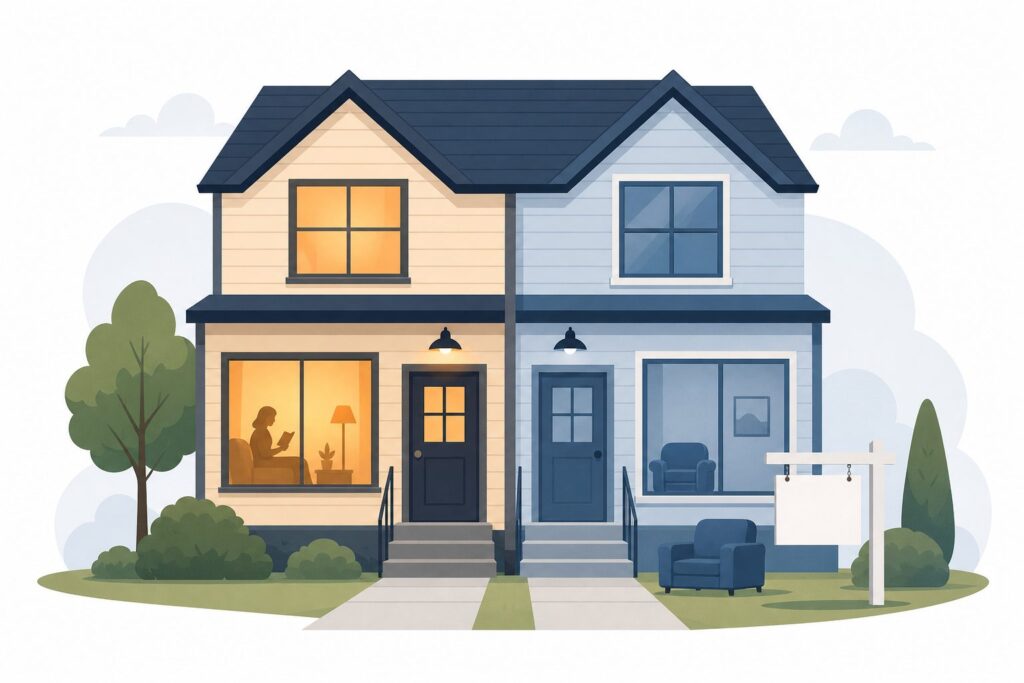
House hacking for beginners means buying a home with more than one living space. You move into one part and rent out the rest, so your tenants cover most or all of your mortgage. It’s one of the fastest ways to get into a real estate without a landlord’s usual down payment. It works with a regular home loan, not a commercial one. If you’ve read our home buyer’s guide and wondered how anyone affords a place these days, this is the move a lot of them are making.
What Is House Hacking?
House hacking is buying a property with rentable space, living in one part, and using the rent from the rest to offset your housing cost. The classic version is a duplex, triplex, or fourplex where you occupy one unit and rent out the others. It also covers a single-family home with a basement apartment, a garage conversion, an accessory dwelling unit, or extra bedrooms you rent to roommates. Zoning and permit regulations for these different unit types vary a lot by city, so check local rules before you convert a garage or add a basement unit, since an unpermitted unit can create real problems at resale or refinance. The goal is the same in every version: cut your own housing payment, sometimes to zero, while you build equity in a property you own.
House hacking for beginners isn’t a new idea. Real estate investors have rented out part of an owner-occupied property for decades. What changed recently is the financing. Lenders now let owner-occupants put far less down on a 2 to 4 unit property than they’d need for a pure rental purchase. That’s the whole reason house hacking works as a beginner strategy, instead of something you need $50,000 in savings to try. For a lot of first-time buyers, house hacking is one of the most common paths into real estate investing without a big pile of cash saved up. It’s a short-term trade: you give up some privacy and take on landlord duties for a year or two, and in exchange you build wealth through home equity and monthly cash flow instead of paying that money to someone else’s landlord business.
Steps to Start House Hacking for Beginners
Start by qualifying for an owner-occupant loan on a 2 to 4 unit property. Then let the rent from the other units cover as much of your payment as your market allows. Here’s the sequence in order.
- Check your credit and savings first. These loans still run a normal credit and income check, so know your score before you shop. Our guide to building credit from scratch covers the basics if your score needs work.
- Pick your property type. A duplex, triplex, or fourplex is the cleanest house hack because each unit has its own lease and its own door. A single-family home with a basement apartment or extra bedrooms works too, and it’s easier to find in neighborhoods that don’t have much multifamily housing.
- Get pre-approved as an owner-occupant, not an investor. Tell your lender upfront that you’ll live in one unit. These loans have lower down payments and better rates than an investment-property loan, but you have to disclose that you’re the one moving in.
- Run the numbers before you make an offer. Add up the mortgage principal, interest, taxes, insurance, and a repair reserve, then subtract the rent you can realistically collect from the other units. Use current listings for comparable rentals nearby, not a guess.
- Close and move in. Most owner-occupant loans require you to move into the property within 60 days of closing. You then stay for a set period, commonly around a year.
- Screen tenants like a real landlord. Run credit and background checks, verify income, and use a written lease even for a roommate situation. You’re living next door to whoever you rent to, so screening matters more here than in a distant rental.
- Track income and expenses from day one. Rental income is taxable, and you’ll want clean records for depreciation and repair deductions when you file.
Best Loan Options for House Hacking
FHA and VA loans offer the lowest down payments for house hacking for beginners. A conventional loan now comes close, too, after Fannie Mae cut its multi-unit down payment requirement. The three main paths compare like this.
| Loan type | Down payment | Units allowed | Who qualifies |
|---|---|---|---|
| FHA | 3.5% with a 580+ credit score | 1 to 4 units | Any qualifying owner-occupant buyer |
| VA | 0% down | 1 to 4 units | Eligible veterans, active-duty service members, and some surviving spouses |
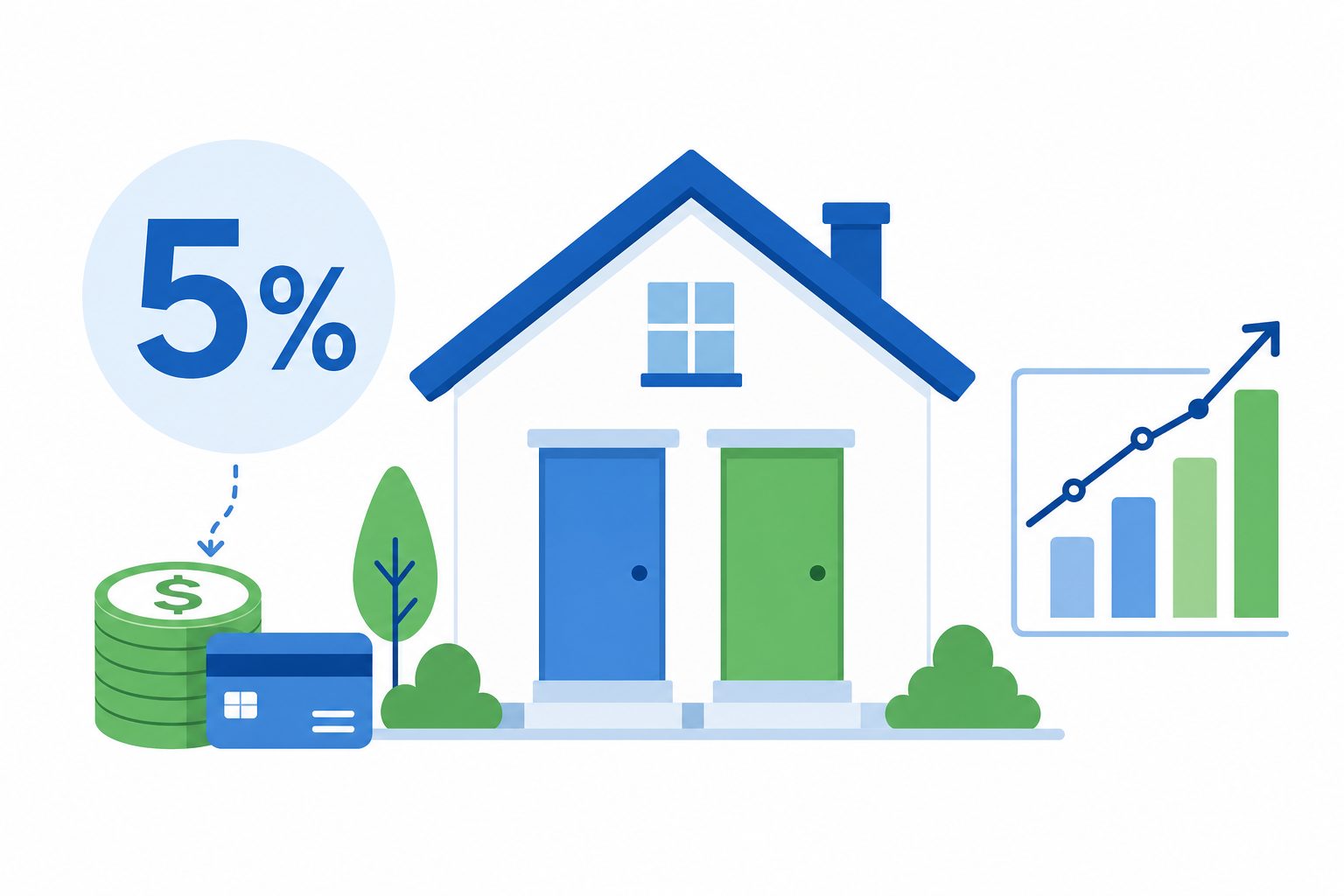
| Conventional (Fannie Mae) | 5% for a 2 to 4 unit primary residence | 2 to 4 units | Owner-occupant buyers who meet credit and income guidelines |
FHA loans, VA loans, and conventional mortgages all help you get started with far less cash than a standalone investment property would require. The FHA program insures loans with as little as 3.5% down on a one to four unit property when a 580 or higher credit score is involved. You just need to occupy at least one unit as your primary residence, according to HUD‘s FHA guidelines.
A VA loan lets an eligible veteran or service member buy a 2 to 4 unit property with no down payment at all. They just need to move into one unit, per the Department of Veterans Affairs’ occupancy rules. On the conventional side, Fannie Mae now allows just 5% down on an owner-occupied 2 to 4 unit home, down from the 15% to 25% it used to require. That change took effect in November 2023. It made house hacking realistic for a lot more buyers who don’t have VA eligibility or don’t want FHA’s mortgage insurance.
Whichever loan you use, expect the lender to count only part of the projected rent from the other units toward your qualifying income, not all of it. Also expect a 3 to 4 unit property to face a stricter income test than a duplex. The exact rules vary by lender and loan program, so confirm the current numbers with your loan officer before you assume a property will cash flow. Anything under 20% down also means private mortgage insurance until you build enough equity to drop it.
How Much Can You Save With House Hacking?
The math behind house hacking for beginners can cut your monthly housing costs to a fraction of a normal mortgage payment, and sometimes to zero, letting you live for free depending on what you can charge for the other units. Consider a simple example, using round numbers, not a promise of what any specific property will do.
Say you buy a duplex with a total monthly payment (principal, interest, property taxes, and insurance) of $2,200. You live in one unit and rent the other for $1,100 a month. Your out-of-pocket housing cost drops to $1,100, half of what you’d pay to live there alone, and less than you might pay to rent a comparable one-bedroom nearby. Add a basement apartment or a rented bedroom into that same scenario and the math improves further. This is the entire appeal of house hacking: someone else’s rent check does most of the work your paycheck would otherwise have to do.
The number that actually matters is your local rental market. A hot area with strong rental demand narrows or erases your housing costs. A soft rental market with long vacancies can leave you covering more of the mortgage than you planned. Pull the real rental potential for your neighborhood before you buy, using comparable listings, not a national average, since a “typical” house hacking result doesn’t really exist across every metro.
Taxes and House Hacking: What You Need to Know
You owe tax on the rental income from a house hack, but you also get to deduct a share of your expenses and depreciate a share of the property, which often shrinks the taxable amount by a lot. The IRS’s Publication 527, Residential Rental Property, covers exactly this situation under its section on renting part of your property.
In practice, it works like this. You report rental income and rental expenses on Schedule E. Then split your property costs, mortgage interest, property tax, insurance, repairs, and utilities, between the personal portion you live in and the rental portion you don’t, usually based on square footage or number of rooms. Only the rental-portion share of those costs is deductible against rental income. You can also depreciate the rental-portion share of the building’s value, not the land, over 27.5 years using the straight-line method, per IRS Publication 946. That turns a real, non-cash cost into an annual deduction.
Two practical notes worth flagging early. First, keep a separate log of what you spend on the rental unit versus your own space, because the IRS expects a reasonable allocation method, not a guess after the fact. Second, when you eventually sell, the rental portion doesn’t automatically qualify for the personal-home capital gains exclusion the way your living space does. A house hack sale can be more complicated than selling a single-family home you’ve always lived in alone. Talk to a tax preparer about your specific numbers before you file, especially in the year you sell.
Risks and Downsides of House Hacking
The biggest financial risk in house hacking is living next door to your tenants, not the financing itself. A bad tenant, a slow-paying roommate, or a stretch of vacancy hits you immediately, because you’re the one hearing about it at 11 p.m., not a property manager three states away.
- Vacancy risk falls straight on you. An empty unit doesn’t just cost you rental income, it means you’re covering the full mortgage payment yourself until you re-rent it. Keep a repair and vacancy reserve, not just enough for the down payment.
- You lose some privacy. Sharing a duplex wall or a house with tenants isn’t for everyone, and it’s worth being honest with yourself about that before you commit to a year-long occupancy requirement.
- Being a landlord takes real time. Screening, maintenance calls, and lease paperwork are part of the deal even when the property is small. If a repair or a tenant issue would wreck your week, budget for a handyman or a part-time property manager instead of assuming you’ll handle everything yourself.
- Selling gets more complicated. As covered above, the rental portion changes how the sale is taxed, and buyers for small multi-unit properties are a narrower pool than buyers for a standard single-family home.
- Not every market supports it. House hacking depends on local rent covering a meaningful share of the mortgage. In high-cost areas where multi-unit homes are priced far above rents, the math might not work no matter how motivated you are.
None of this makes house hacking for beginners a bad idea. It makes it a real landlord responsibility wrapped in a beginner-friendly loan. Going in with realistic expectations is what separates a house hack that works from one that turns into a headache.
Frequently Asked Questions
Conclusion: Is House Hacking Right for You?
Overall, house hacking for beginners works best as a first real estate move, not a side experiment, because the low down payment only applies while you’re living there as an owner-occupant. Whether it becomes a one-time move or the first property in a bigger real estate investment portfolio is up to you, but it’s one of the most beginner-friendly strategies for building long-term wealth. Say your local rents can realistically cover a meaningful chunk of the mortgage and you’re comfortable with the tenant side of the deal. Then it’s one of the clearest paths from renter to property owner, without needing a large pile of cash first.
Before you commit, get your finances in order the way you would for any home purchase. Read our guide to saving for your first home purchase and our guide to getting approved for a mortgage. If you’re weighing whether you want to be a landlord long-term, our guide to becoming a landlord covers what comes after the house hack.