
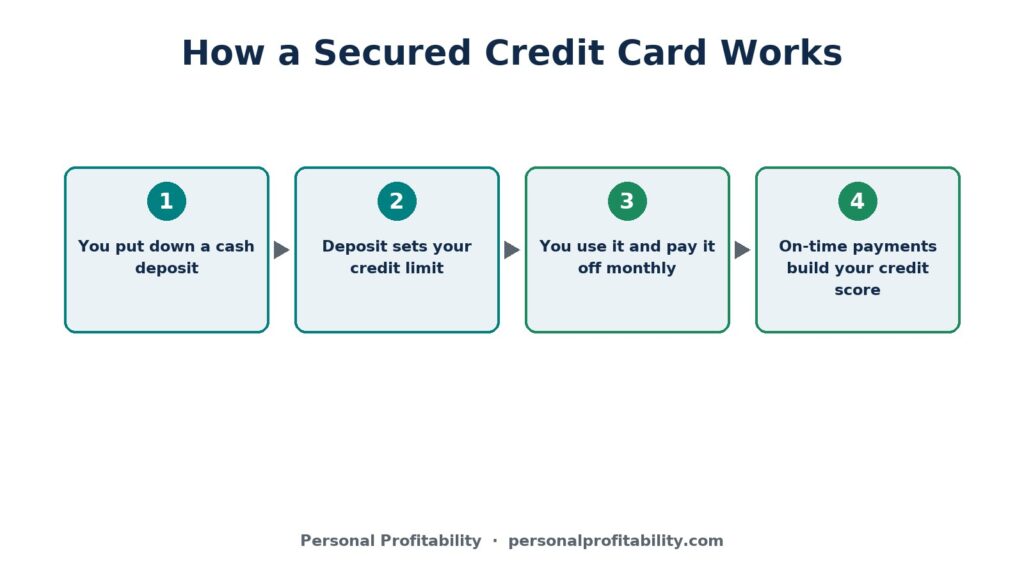
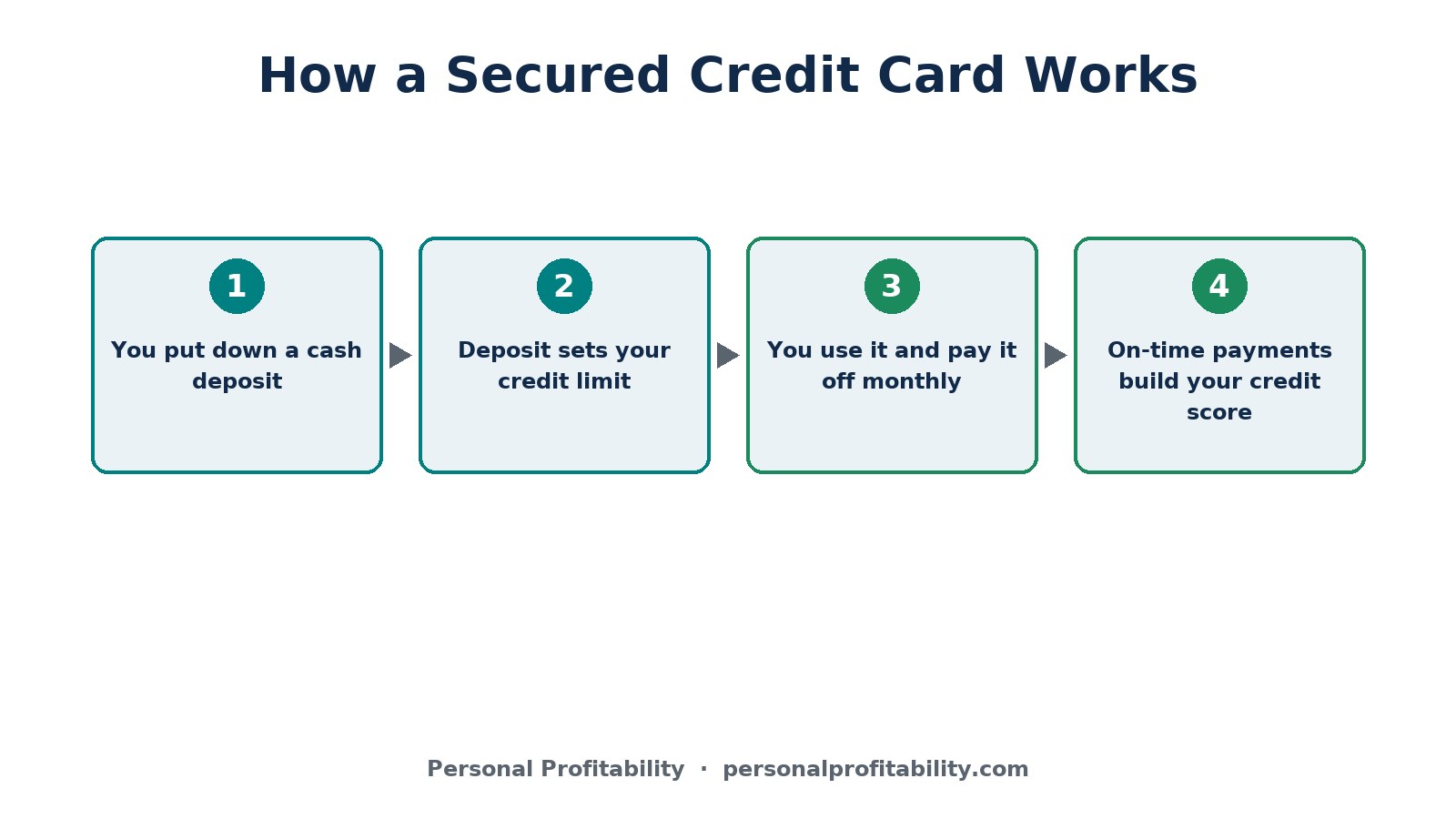
How does a secured credit card work? It works like a normal credit card, except you put down a refundable cash deposit first, and that deposit usually becomes your credit limit. You use the card and pay the bill every month, and the issuer reports those payments to the credit bureaus. That's how you build a credit score from nothing or repair a damaged one. If you're starting from zero, a secured card pairs well with the steps in our guide to building credit from scratch.
How Does a Secured Credit Card Work? A Quick Definition
A secured credit card is a credit card backed by a cash deposit you pay upfront instead of relying only on your credit history. The bank holds that deposit as collateral, so it can approve you even with no credit file or a low score. From there, it functions like any other card. You get a card number, a billing cycle, a minimum payment, and, if you carry a balance, interest charges. The word “secured” describes the collateral, not a limit on where you can use it. Swipe it anywhere a regular card works.
Secured cards exist for one job. They give people with no credit history, a thin file, or past credit damage a legitimate on-ramp to a normal, unsecured card. The Consumer Financial Protection Bureau (CFPB) tracks secured cards as one of the standard tools for building or rebuilding credit, alongside keeping your balances low and paying on time.
The Security Deposit, Explained
Your deposit sets your starting credit limit, and in most cases the two amounts match dollar for dollar. Put down $300, and your limit is usually $300. The exact minimum and maximum deposit differ widely by issuer and by card, so check the specific card's terms rather than assuming a number. The pattern holds across the market either way: more deposit, more available credit.
The deposit isn't a fee and it isn't spent on your behalf. It sits with the issuer as collateral. If you miss payments and the account defaults, the issuer can use the deposit to cover what you owe. Pay on time, and eventually close the account in good standing or get upgraded to an unsecured card, and you get the deposit back. That refund is the entire point of calling it “secured” instead of “prepaid.” It's the detail people confuse most often. A prepaid card spends down a loaded balance. A secured credit card extends credit and holds your deposit as a backstop.
Opening a Secured Credit Card, Step by Step
So how does a secured credit card work once you've decided to get one? Opening one takes less time than most people expect. Here's the process.
- Confirm it reports to all three bureaus. A secured card that doesn't report to Equifax, Experian, and TransUnion does nothing for your credit file. Check the issuer's card details page before applying.
- Apply like you would for any card. The issuer checks your identity and, for most secured cards, doesn't require good credit, though some still run a credit check.
- Fund the deposit. You'll pay the deposit by bank transfer, debit card, or sometimes a mailed check, and your credit limit is set once the funds clear.
- Use the card for small, regular purchases. A recurring bill like a streaming subscription or your phone plan works well because it's predictable.
- Pay the statement balance in full, every month. This is the single habit that determines whether the card helps or hurts you.
- Track your progress and ask about graduating. After 6 to 12 months of on-time payments, ask the issuer whether you qualify to move to an unsecured card and get your deposit back.
What Actually Builds Your Credit Score Here
A secured card builds your score the same way any credit account does. It feeds the bureaus a track record of on-time payments and low balances. According to myFICO, payment history makes up 35% of a FICO Score and the amounts you owe make up another 30%, so those two factors alone decide almost two-thirds of your score. A secured card gives you a clean, low-risk way to generate positive history in both categories at once.
The amounts-owed factor comes down to your credit utilization ratio, the share of your limit you're using at any given time. The CFPB advises keeping that ratio under 30%, and myFICO notes that staying closer to 10% tends to help even more. On a $300 secured card, that means keeping your statement balance under $90, and ideally under $30. Pay down the balance before the statement closes, not just before the due date. That timing is the move that actually lowers what gets reported.
None of this happens overnight. A secured card typically needs a few months of consistent activity before you see a meaningful score change. Building a strong file usually takes sustained good habits over a year or more, not a single billing cycle.
Secured Card vs. Credit-Builder Loan vs. Authorized User
A secured card is the most flexible of the three common credit-building tools, though it's not the only one. The right pick depends on your discipline with a revolving balance versus a fixed payment.
| Tool | How it works | Best for |
|---|---|---|
| Secured credit card | Cash deposit backs a revolving credit line you use and repay monthly. | Building history while keeping everyday spending flexible. |
| Credit-builder loan | You “borrow” money the lender holds, then make fixed payments until the funds are released to you. | People who want a forced savings habit and a fixed payment. |
| Authorized user | You're added to someone else's existing card and can inherit its history. | People with a trusted family member who has strong, long-standing credit. |
All three can report to the bureaus. Only the secured card gives you your own account, your own credit limit, and practice managing a revolving balance, exactly the skill an unsecured card will later demand.
Graduating to an Unsecured Card
Graduating means moving from a secured card to a standard unsecured card, either by upgrading the same account or qualifying for a new one, and you get your deposit back either way. Many issuers automatically review secured accounts after 6 to 12 months of on-time payments and a low balance, then offer an upgrade without you having to ask. Others require you to apply for a separate unsecured card once your score has improved enough to qualify on its own.
Either way, don't close the secured account the moment you're approved for something new if it's still in good standing. Length of credit history is one of the five FICO factors, so an older account, even a small one, keeps contributing to your file. Ask the issuer specifically whether an upgrade keeps the account open (good for your history) or closes it and opens a new one. A closed-and-reopened account starts a fresh clock.
Fees and Costs to Watch For
A secured card should cost you little beyond the refundable deposit, though some charge an annual fee, and nearly all charge interest if you carry a balance past the due date. Compare the annual fee, the APR, and whether the card charges anything just to apply or maintain the account. Those extra charges eat into the whole point of the card. Skip any card that charges a large upfront, non-refundable “processing fee.” You'll never see that money again, regardless of how well you manage the account.
The interest rate on most secured cards runs high compared to a rewards card you'd qualify for with good credit, which is exactly why the habit of paying in full every month matters more here than almost anywhere else in personal finance. Carrying a balance on a secured card is one of the most expensive ways to borrow money, and it defeats the purpose of using the card to build credit in the first place.
Conclusion: Is a Secured Credit Card Worth It?
A secured credit card is worth it if you have no credit history, a thin file, or damaged credit and you're ready to pay the statement in full every month. The deposit protects the issuer. The on-time payments build your file. Use it right, and a decent secured card gets you to an unsecured card within a year. It takes deliberate effort, not luck: put money down, pay the bill every month, and that consistency is what proves to future lenders you can handle credit.
Pair a secured card with the fundamentals. Know what credit score you're starting from, keep your balances low relative to your limit, and follow the full step-by-step plan for building credit from scratch. None of this requires a perfect score today, just a consistent habit for the next several months.