

1099 vs w2 comes down to one real tradeoff: a 1099 job pays more per hour and gives you more control, but you cover your own taxes and benefits. A W2 job pays less on paper, but your employer withholds taxes, splits your payroll tax bill with you, and often throws in health insurance and a 401(k) match. Neither status is a scam, and neither one is automatically the smarter move. It depends on your income, how much you value stability, and how comfortable you are running your own tax paperwork. I've worked both ways, salaried and self-employed, and the sticker number on an offer rarely tells the real story. Here's the actual math, plus what changed in the reporting rules for 2026. For more on building income outside a paycheck, see Personal Profitability's home base for hustlers and entrepreneurs.
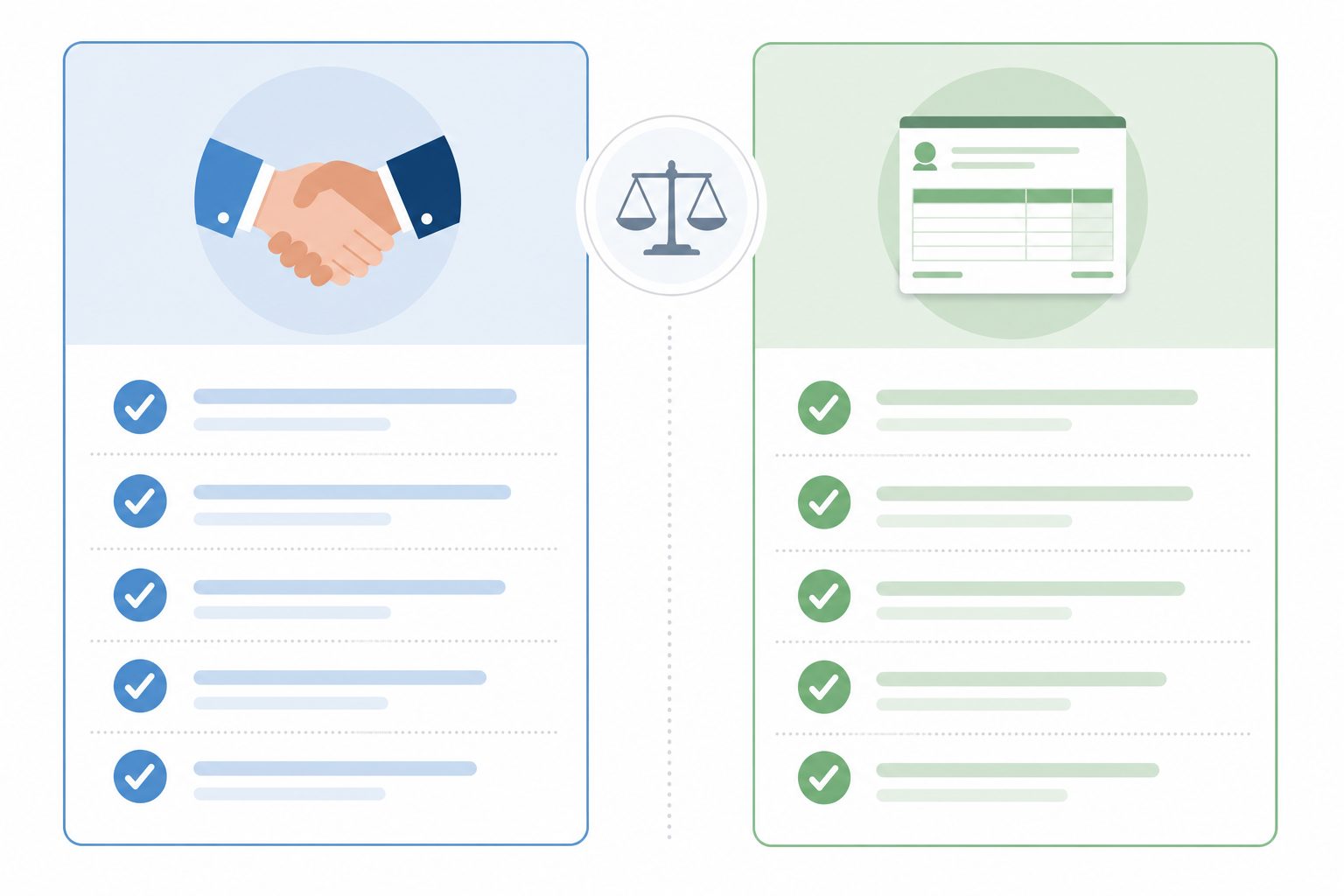
1099 vs W2, What Each Term Actually Means
A 1099 worker is an independent contractor who gets paid gross, with no taxes withheld, and files a return on their own. W2 status means an employer withholds income tax and payroll tax from every paycheck instead. IRS rules decide which one applies based on control, not on what a contract calls you. Under the common law rules, you're an employee if your company can direct not just what work gets done but how and when you do it. Genuine independent contractors usually set their own hours, tools, and process, and the client only cares about the finished product. Get this wrong and the IRS can reclassify the relationship using Form SS-8, which can trigger back payroll taxes for the business. That's mostly the company's risk, not yours, but it explains why some employers push everyone toward 1099 status even when the job looks like an employee role.
Worker classification isn't optional paperwork, it's the legal basis for the whole relationship. Get classification wrong and a business can be held responsible for back employment taxes, including FICA and FUTA, the taxes that fund Social Security, Medicare, and unemployment insurance. Think you've been misclassified as a 1099 contractor when you're really functioning as an employee? File Form SS-8 with the IRS and let it rule based on the specific facts of your situation, not just what your contract says.
The Math Splits Differently on Taxes
Taxes are where the 1099 vs w2 gap actually shows up in your bank account. Every worker owes the same 15.3% for Social Security and Medicare on their earnings, according to the IRS. The difference is who writes the check. W2 employees pay half, 7.65%, with the employer covering the other half automatically. Self-employed workers pay the full 15.3% as self-employment tax instead, filed on Schedule SE, though half of that amount is deductible as an adjustment to income.
On the Social Security side, the 12.4% portion only applies up to the annual wage base, which the Social Security Administration set at $184,500 for 2026, up from $176,100 in 2025. Earn more than that and the Social Security portion stops. The 2.9% Medicare portion never caps though. High earners also owe an extra 0.9% Additional Medicare Tax once combined wages or self-employment income cross $200,000 for a single filer or $250,000 for a married couple filing jointly, per the IRS.
Why the Same Rate Doesn't Mean the Same Paycheck
A 1099 rate and a W2 salary that look identical on paper rarely land the same in your bank account. Say a company offers $70,000 salaried or $40 an hour as a 1099 contractor for the same role. On the surface, the hourly math looks close. But the 1099 worker also covers the employer half of payroll tax and buys their own health insurance. There's no paid time off either, and you usually need to set aside 25% to 30% of every payment for taxes since nothing gets withheld automatically. Quarterly estimated payments come out of that reserve, not a surprise bill in April.
A rule of thumb a lot of freelancers use: ask for 20% to 30% more as a 1099 rate than the equivalent W2 salary would pay per hour, to cover the added tax liability and lost benefits an employer would have handled. Treat that as a starting guideline, not a formula, and run your own numbers based on your actual expenses and tax bracket.
A W2 Job Gives You Protections 1099 Work Doesn't
A W2 job hands you a safety net a 1099 contract almost never includes. Your employer handles federal and state income tax withholding automatically, so there's no quarterly guesswork and no April surprise. Many W2 jobs come with health insurance too, often with the employer covering part of the premium. A 401(k) with a partial match is common as well, which is close to free money once you contribute enough to get it.
Unemployment insurance covers you if you're laid off, and workers' compensation covers you if you're hurt on the job, protections 1099 workers don't get. Paid time off, sick leave, and short-term disability show up often too, even though none of them are legally required nationwide. None of this is guaranteed at every company, so check your actual offer letter instead of assuming.
1099 Work Gives You Control a W2 Job Doesn't
Being 1099 trades that safety net for control and, often, higher gross pay. Setting your own hours and choosing your own clients come standard with contract work, instead of being tied to one employer. Many independent contractors take project-based work instead, paid on a per-project or hourly basis, stacking several clients at once. Working 1099 also unlocks business deductions a W2 employee can't touch.
Home office costs, business mileage, software subscriptions, and professional development all come off your income on Schedule C before you calculate what you owe. Business driving gets a 2026 standard mileage rate of 72.5 cents a mile from the IRS, so tracking your miles is worth real money if you drive for work. Every deduction requires real recordkeeping though, and every dollar of profit is subject to self-employment tax unless you elect a different business structure.
New Reporting Rules to Know for 2026
The paperwork behind 1099 income changed for 2026, and it affects how much of your side income actually gets reported to the IRS. Clients now only have to send a Form 1099-NEC once they pay you at least $2,000 in the year. That's up from the old $600 threshold, effective for tax years beginning after 2025, per the IRS instructions for Forms 1099-MISC and NEC.
Getting paid through an app like PayPal or a marketplace like Etsy works differently. Those platforms only issue a Form 1099-K once you cross $20,000 in payments and 200 transactions in a year, a threshold Congress restored after a much lower rule never fully took effect.
Here's the part that trips people up: not getting a 1099 doesn't mean the income isn't taxable. Every dollar of self-employment income is taxable, form or no form. Keep whichever forms you receive for your own filing, since your tax software still wants the total income reported for each client and platform.
Deciding Between 1099 and W2 Work
The 1099 vs w2 call gets easier once you run it through a few real questions about your own financial situation instead of just comparing two paycheck numbers side by side.
- Calculate your real hourly rate. Subtract self-employment tax, health insurance, and lost benefits from a 1099 offer, then compare it to the W2 number.
- Rate your appetite for paperwork. Quarterly estimated taxes, expense tracking, and a Schedule C aren't hard, but they take real time every month.
- Weigh how much stability you need right now. A mortgage application, a new baby, or a thin emergency fund all argue for the steadier W2 paycheck.
- Check whether you can get benefits elsewhere. A spouse's health plan or a marketplace policy can make 1099 work far more workable.
- Decide if this is temporary or permanent. Plenty of people take a 1099 contract for a year to build a portfolio, then convert to W2 once they land the job they want.
1099 vs W2 Side-by-Side Comparison
Here's the whole 1099 vs w2 relationship broken down factor by factor, side by side, so you can scan the total picture in one place before you decide.
| Factor | 1099 (Independent Contractor) | W2 (Employee) |
|---|---|---|
| Who withholds taxes | You do, no automatic income tax withholding | Employer withholds federal and state income tax each paycheck |
| Payroll tax rate | Full 15.3% self-employment tax (half deductible) | 7.65% employee share, employer pays the other 7.65% |
| Benefits | None provided, you buy your own | Often includes health insurance, 401(k) match, paid time off |
| Unemployment insurance | Not covered | Covered if you're laid off |
| Deductions available | Home office, mileage, software, and more on Schedule C | Very limited for employees |
| Tax form received | Form 1099-NEC (over $2,000) or 1099-K (over $20,000 and 200 transactions) | Form W-2 |
| Flexibility | Sets own hours and clients | Hours and process set by employer |
Frequently Asked Questions
The Real Answer: It Depends on Your Situation
1099 vs w2 isn't a contest with one universal winner. It's a tradeoff between control and security that only you can weigh. Take the 1099 route if you can command a rate that covers your own taxes and benefits and you don't mind running the paperwork. Take the W2 route if predictable pay, automatic withholding, and employer benefits matter more right now. Either way, run the actual numbers before you sign anything, not just the headline rate.
Two guides worth reading next: how self-employment tax actually works, and how to pay quarterly estimated taxes so April doesn't blindside you. Once you've made the leap, learn how to pay yourself as a business owner and whether an LLC or sole proprietorship fits your setup better. Browse the Taxes category for more.