
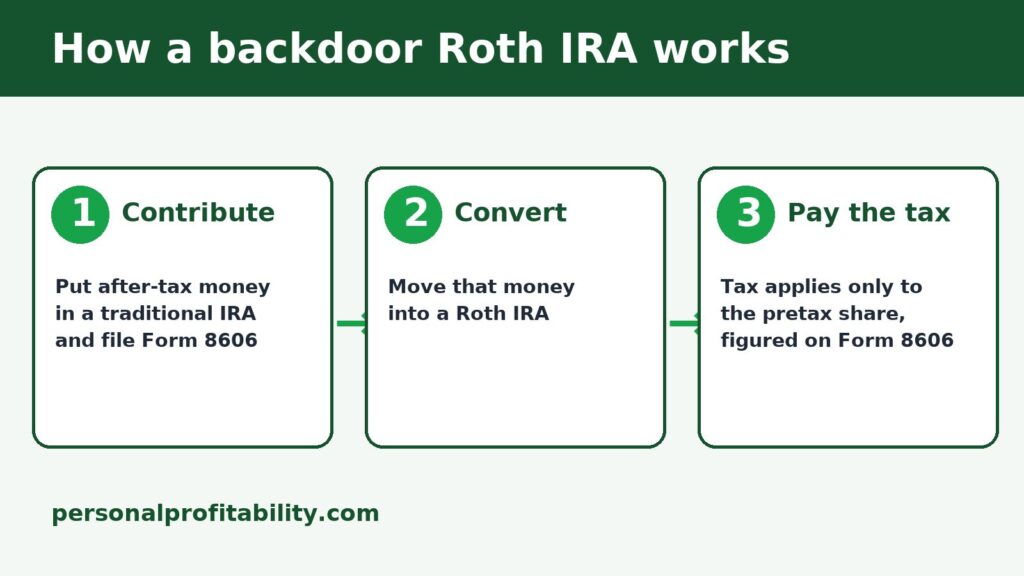
How does a backdoor Roth IRA work? You put after-tax money into a traditional IRA, convert that money to a Roth IRA, and report both steps on Form 8606. That lets you fund a Roth even when your income is too high to contribute directly. The catch is the tax bill on the conversion, which you figure from every traditional IRA dollar you own. If you already understand a plain Roth IRA conversion, you know most of the machinery. I’ll walk through the steps, the 2026 numbers, and the one rule you can’t skip.
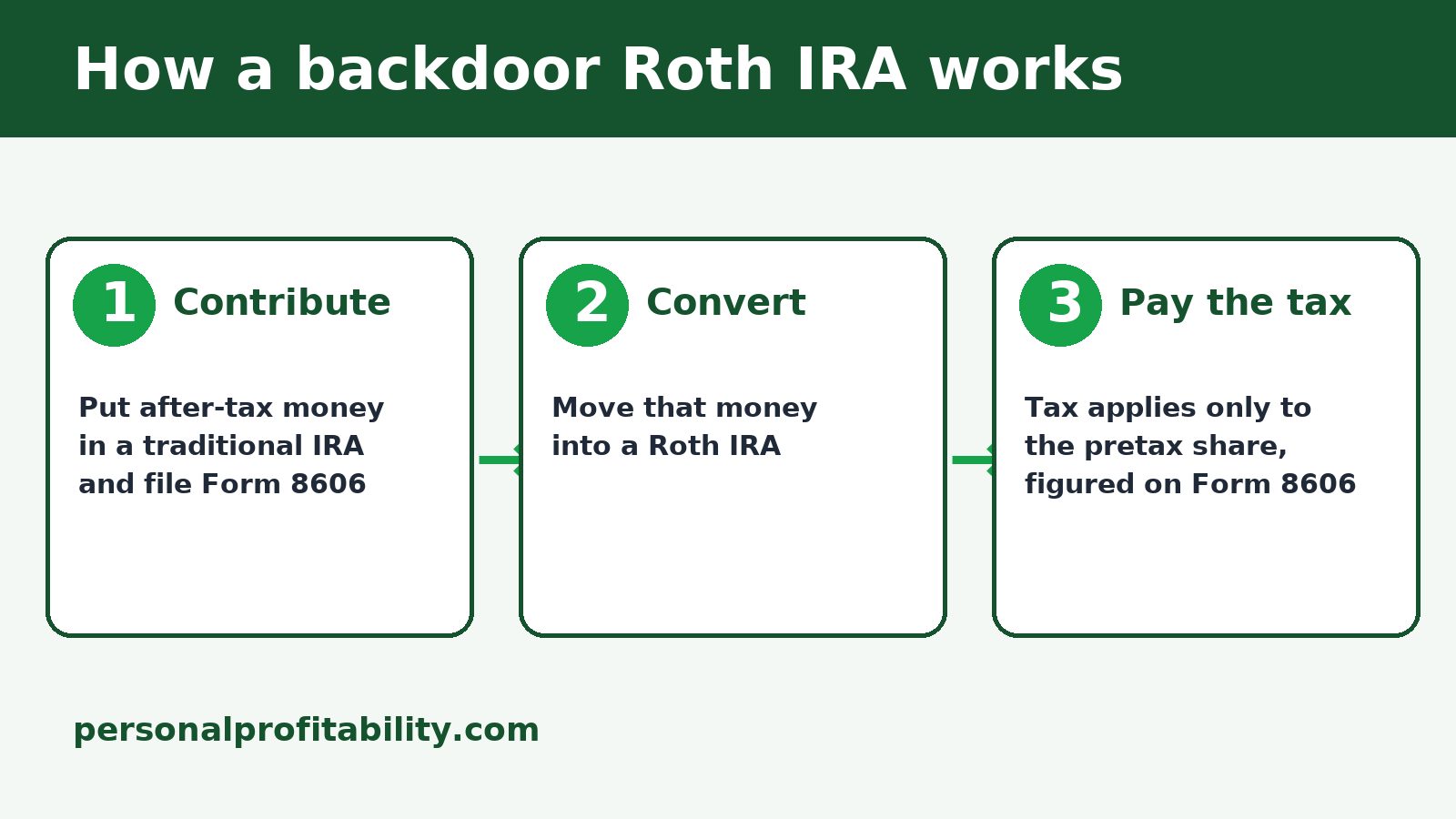
Who needs a backdoor Roth IRA in 2026?
With a modified adjusted gross income (MAGI) above the IRS limit for direct Roth contributions, you need a backdoor Roth IRA. For 2026, the IRS lets you contribute up to $7,500 to an IRA, or $8,600 if you are 50 or older, per the IRS announcement of the 2026 limits. The IRS lists the phase-out ranges for Roth contributions in Publication 590-A.
| Filing status | Reduced limit starts | No direct contribution |
|---|---|---|
| Single or head of household | $153,000 | $168,000 or more |
| Married filing jointly | $242,000 | $252,000 or more |
| Married filing separately (lived with your spouse) | Above $0 | $10,000 or more |
Below the lower number, you can skip all of this and contribute to a Roth directly. Inside the range, you can make a reduced direct contribution. At or above the top number, the backdoor route is the one left. The IRS applies those ranges to Roth contributions only. People use the backdoor because of those limits, so check your MAGI before you begin the steps.
Learn how the stock market works, then start
Get my free 2026 guide to stocks, trades, account types, and index funds, plus a step-by-step plan for your first investment.
How does a backdoor Roth IRA work, step by step?
You take five steps to complete a backdoor Roth IRA. Keep them in order, since you report each one on your return.
- Open a traditional IRA and a Roth IRA. Many brokerages let you open both in one sitting. Open them at the same firm if you can, so the transfer between them takes a click.
- Make a nondeductible contribution to the traditional IRA. Put in up to your yearly limit, even when your income is too high for a deduction, per Publication 590-A. You already paid tax on this money, so you take no deduction.
- Leave the money in cash for a short time. If it sits in an investment first, you owe tax on any growth before the conversion.
- Convert the traditional IRA balance to the Roth IRA. You tell your brokerage to move the money, and most firms offer a conversion form or button.
- Invest inside the Roth. Once you move the money in, put it to work. A broad S&P 500 index fund or a target-date fund is my default recommendation.
The usual mistake is skipping the paperwork, and you’ll see why in the sections below. One more detail before you start: the IRS doesn’t let you reverse a conversion made after 2017 by moving it back to a traditional IRA, per Publication 590-B. Treat every Roth conversion as final.
The pro-rata rule: why your other IRAs matter
Under the pro-rata rule, the IRS counts all your traditional IRA money together when you figure how much of your conversion is taxable, not just the account you used for the backdoor. On Form 8606, you enter the year-end value of all your traditional IRAs on line 6 and the amount you converted on line 8. In the form instructions, the IRS says the term “traditional IRA” there includes traditional SEP IRAs and traditional SIMPLE IRAs. Employer plans such as a 401(k) aren’t on that list.
Here is an example with round numbers, not a prediction. Say you have $92,500 of pre-tax money in a rollover IRA at year end. You make a $7,500 nondeductible contribution and convert $7,500. Your total traditional IRA money is $100,000, and your after-tax share is 7.5%.
| Item | Amount |
|---|---|
| Pre-tax money in other traditional IRAs | $92,500 |
| Nondeductible contribution (after-tax basis) | $7,500 |
| Total traditional IRA money | $100,000 |
| After-tax share of the total | 7.5% |
| Nontaxable part of your $7,500 conversion | $562.50 |
| Taxable part of your $7,500 conversion | $6,937.50 |
Instead of a nearly tax-free conversion, you add $6,937.50 to your taxable income. With the other 92.5% sitting in pre-tax money, you pay tax on most of the conversion. Someone with no other traditional, SEP, or SIMPLE IRA money converts the same $7,500 with almost nothing taxable, apart from growth between the contribution and the conversion.
Watch your earnings. Say your nondeductible contribution earns $50 before the conversion. You owe income taxes on that $50, because you never paid tax on earnings inside a traditional IRA. Roth conversions of pre-tax money and earnings are taxable, which is why many people convert quickly and keep the contribution in cash.
Some people clear the pre-tax balance first by rolling it into an employer plan, since the form counts only IRAs. Not every plan accepts those rollovers, so ask your plan administrator before you rely on that route. For your situation, a fee-only CPA can run the numbers in one short meeting.
How to report a backdoor Roth IRA on your tax return
You report a backdoor Roth IRA on Form 8606, which you file with your Form 1040 for the year of the contribution and conversion. On the form, you track your basis, which the IRS defines as the total of your nondeductible contributions and other nontaxable amounts. Your brokerage will send you a Form 1099-R for the conversion, and on Form 8606 you show the IRS how much of it is taxable. Read the Form 8606 instructions for a line-by-line walkthrough.
- Part I reports your nondeductible contribution and your running basis.
- Part II reports the conversion and works out the taxable amount.
- The penalty for skipping it: the IRS charges $50 for failing to file a required Form 8606 unless you show reasonable cause, and $100 for overstating nondeductible contributions.
Keep every Form 8606 you file. You carry basis forward each year, and you take the line 2 amount on next year’s form from your last one. With tax software, you still enter the contribution, the year-end balance, and the conversion yourself.
Backdoor Roth IRA vs. a direct Roth IRA contribution
With a direct Roth contribution, you take one step, and you file no extra tax form. With the backdoor, you add a conversion and Form 8606. Both draw from the same 2026 contribution limit, so you gain no extra room. You gain access when a high income shuts you out of the direct route.
| Feature | Direct Roth contribution | Backdoor Roth IRA |
|---|---|---|
| Income limit | Phases out between $153,000 and $168,000 (single) or $242,000 and $252,000 (joint) | None on the strategy itself |
| 2026 contribution limit | $7,500 ($8,600 if 50 or older) | $7,500 ($8,600 if 50 or older) |
| Steps | Contribute to the Roth | Contribute to a traditional IRA, then convert |
| Extra tax form | None for the contribution | Form 8606 |
| Tax on the money | Already paid before you contribute | Tax on the pre-tax share of the conversion |
If you land inside the phase-out range, compare a reduced direct contribution with a backdoor contribution for the rest of your room. Either way, you hold the money in the same Roth account.
Is a backdoor Roth IRA worth the effort?
A backdoor Roth IRA is worth it when you earn above the Roth limit, hold little or no other traditional IRA money, and want tax-free growth for decades. I lean Roth for younger earners, and with the backdoor you keep that option after a big raise. In retirement, you don’t pay tax on Roth withdrawals when you meet the IRS requirements, so you hedge against higher future tax rates.
Hold off when you have a large pre-tax IRA, because under the pro-rata rule you could owe tax on most of the conversion. You also don’t need the backdoor if you can contribute to a Roth directly. If your employer lets you make after-tax contributions to its plan, read about the mega backdoor Roth. Take the full employer match first, since that is free money. Then decide between a traditional IRA and a Roth for the rest.
Backdoor Roth IRA mistakes to avoid
- Forgetting Form 8606. You owe a $50 penalty unless you show reasonable cause, and you lose your paper trail for basis.
- Ignoring old IRAs. If you forgot a rollover IRA from a past job, you owe tax on more of every conversion.
- Investing before converting. Growth between the contribution and the conversion is taxable. Leave the money in cash until the conversion clears.
- Contributing above the limit. The 2026 cap applies to all your IRAs combined, so a traditional contribution also uses up your Roth room.
- Converting without a tax plan. You report the taxable part on your return for the year of the conversion, so set money aside for the tax bill.
Conclusion
A backdoor Roth IRA is a two-step workaround, and you’ll want to know your other IRA balances before you decide. Check your other IRA balances, file Form 8606, and keep the money in cash until the conversion clears. For the basics, start with Roth IRA for beginners, and see more guides in our investing section or on the Personal Profitability homepage. This post is general education, not tax advice for your situation.

Free guide
Learn how the stock market works, then start
Get my free 2026 guide to stocks, trades, account types, and index funds, plus a step-by-step plan for your first investment.
- How a trade works, from order types to T+1 settlement.
- Why I start with low-cost index funds instead of stock picks.
- The margin rules and my own trading mistakes, so you can avoid the same errors.
Bonus: The First-Investment Checklist, the order to handle your match, debt, and savings