
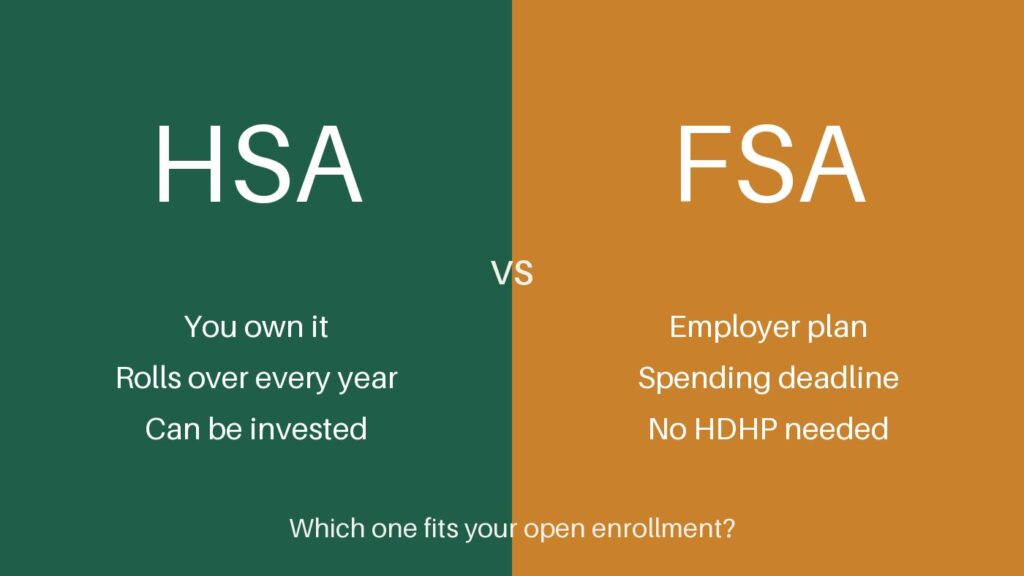
The short answer on hsa vs fsa: an HSA is the better account if you qualify, because the money is yours, it rolls over forever, and it can grow like a retirement account. An FSA is the better pick when you don’t have a high-deductible health plan, since it’s the only one of the two you can use without one. With either one you pay medical costs with pre-tax dollars, and you choose at open enrollment. Below you’ll find the 2026 and 2027 IRS numbers and a simple way to decide. You can find more money guides on the Personal Profitability homepage.
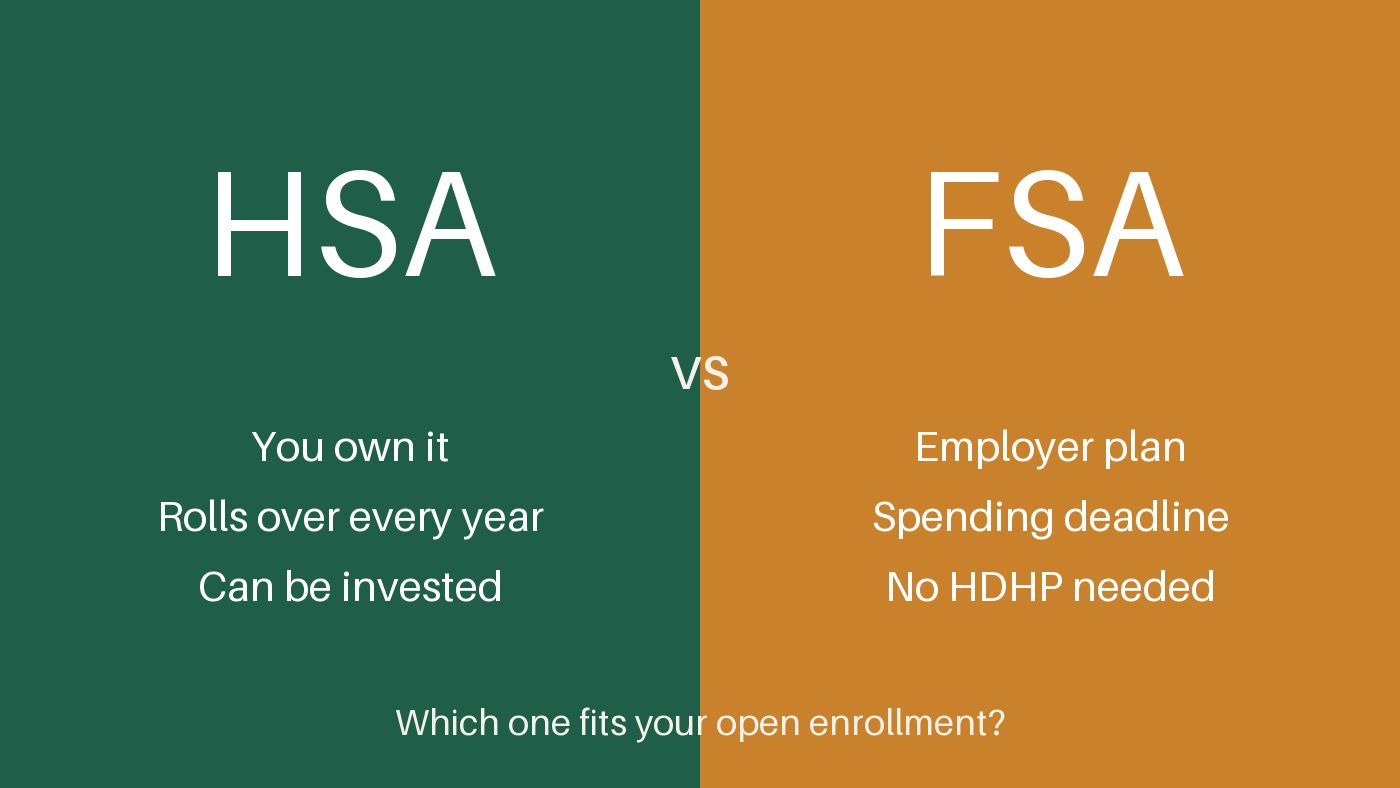
HSA vs FSA: the differences at a glance
A health savings account (HSA) is a personal account you own and take with you. A flexible spending account (FSA) is an employer benefit with a spending deadline. Almost everything else in the table below follows from that one difference.
| Feature | HSA | Health FSA |
|---|---|---|
| Who can open one | Anyone covered by a qualifying high-deductible health plan and no disqualifying coverage | Anyone whose employer offers one |
| Who owns the money | You do | The employer’s plan, under its rules |
| Does the balance roll over? | Yes, with no limit on how long | Only a limited carryover or a grace period, if the plan offers one |
| Can you invest the balance? | Yes, if your HSA provider offers investments | No |
| 2026 contribution limit | $4,400 self-only, $8,750 family | $3,400 |
| 2027 contribution limit | $4,500 self-only, $9,000 family | Not published yet |
| Do you keep it if you quit? | Yes | Usually not, unless COBRA applies |
The IRS published the 2027 HSA figures in Revenue Procedure 2026-24 and the 2026 FSA figure in Revenue Procedure 2025-32. The 2026 HSA limits sit in Revenue Procedure 2025-19.
Turn your skills into freelance income
Learn how I found clients, raised my rates and went full-time freelance in 2016. Get the free 2026 edition, tax basics included.
What is an HSA?
An HSA is a tax-advantaged account for medical costs that you can only open if you have a qualifying high-deductible health plan (HDHP). Your contributions are tax-deductible. The money grows tax-free. Withdrawals for qualified medical expenses are tax-free too. That triple tax break is why many money writers call the HSA the best account in the tax code.
The IRS sets what counts as an HDHP each year. For 2027, the plan needs a deductible of at least $1,750 for self-only coverage or $3,500 for family coverage. Its out-of-pocket maximum can’t exceed $8,700 for self-only or $17,400 for family. Ask your insurer or check your benefits portal to see if your plan qualifies.
The 2027 HSA contribution limit is $4,500 for self-only coverage and $9,000 for family coverage. If you’re 55 or older, you can add a $1,000 catch-up contribution. Your employer’s contribution counts toward the limit, so add it to yours before you set a number.
Once you enroll in Medicare, you can’t contribute to an HSA. You generally can’t contribute while you have a general-purpose health FSA either. If you want to read about using the account for the long game, see our guide on the HSA as a retirement account or the walkthrough on how to set up an HSA.
What is an FSA?
An FSA lets you set aside pre-tax salary for medical costs through your employer, and you don’t need a high-deductible plan to use one. You choose a yearly amount during open enrollment. Your employer takes it out of each paycheck. You then spend it on eligible costs like copays, prescriptions, glasses, and dental work.
For plan years that begin in 2026, the IRS caps health FSA salary reductions at $3,400. The IRS hadn’t published the 2027 figure yet, so check your benefits guide before you pick a number. Each spouse with their own FSA gets a separate limit, and your employer can set a lower cap than the IRS does.
The catch is the deadline. Money you don’t spend by the end of the plan year can disappear. Employers can soften that in one of two ways. They can let you carry over a limited amount (up to $680 from a 2026 plan year), or they can give you a grace period of up to two and a half months. They can offer one or the other, not both, and they can offer neither.
HSA vs FSA: which one is better?
The HSA wins on almost every feature when you’re eligible, and the FSA wins when you aren’t. Three things make the HSA stronger.
- It rolls over. You never lose the balance at year end, so you can contribute with no pressure to spend it.
- You own it. It stays with you when you change jobs, retire, or switch health plans.
- You can invest it. After you keep a cushion for near-term bills, you can put the rest in low-cost index funds, which fits a simple long-term plan.
The FSA’s strength is access. Plenty of employers offer an FSA and no HDHP, and some people can’t avoid a traditional plan. If you know you’ll spend money on the doctor, the dentist, or new glasses next year, you still skip the income tax on that spending with an FSA.
An HSA only helps if the high-deductible plan itself makes sense for you. A lower premium doesn’t help if you have regular expensive care and can’t cover a big deductible. Run the numbers on total yearly cost, premiums plus the likely out-of-pocket spending, before you switch plans just to open an HSA.
Can you have an HSA and an FSA at the same time?
Usually not, but you can pair an HSA with a limited-purpose FSA. If you can use a general-purpose health FSA for most medical costs, the IRS treats you as ineligible for HSA contributions. With a limited-purpose FSA you can claim only dental, vision, and preventive care costs, so you stay eligible.
If your employer offers a limited-purpose FSA next to an HDHP, it’s a clever way to shelter dental and vision costs while your HSA keeps growing. Your spouse’s coverage matters too. If your spouse can use a general-purpose FSA to pay your medical bills, you lose HSA eligibility too. Ask HR before you sign up for both.
How to choose during open enrollment
First see if your employer offers a qualifying HDHP. Then work through these steps.
- Check your plan options. Look for the words “HSA-eligible” or “HDHP” in your benefits guide.
- Estimate your yearly medical spending. Add up last year’s copays, prescriptions, and dental and vision costs.
- Compare total cost. Add premiums to your likely out-of-pocket costs for each plan, not just the premium alone.
- Pick an HSA if you can cover the deductible. Keep an emergency fund in a regular savings account so a bad year doesn’t force you to drain the HSA.
- Pick an FSA only for spending you can predict. Choose an amount below your expected costs, so you don’t lose money to the deadline.
- Set the contribution. Count your employer’s HSA deposit toward the yearly limit.
Self-employed people can open an HSA on their own too, with no employer involved. Your HDHP just has to meet the same rules. If you buy your own coverage, also look at the self-employed health insurance deduction.
Mistakes that cost you money
- Overfunding an FSA. Money left at the deadline can vanish. Use last year’s receipts as your guide.
- Treating the HSA as a spending account only. If you can afford to pay bills out of pocket, letting the balance grow is the stronger move. Save your receipts and reimburse yourself later.
- Using the HSA for non-medical costs. If you withdraw money for anything other than qualified medical expenses before age 65, you owe income tax plus an extra 20% tax, per IRS Publication 969.
- Contributing after Medicare starts. Once you enroll in Medicare, your HSA contribution limit drops to zero.
- Ignoring the last-month rule. If you qualify only on December 1 and fund the full year, you must stay eligible through the testing period (December 31 of the next year) or owe tax plus a 10% additional tax.
HSA vs FSA FAQ
Conclusion
Pick the HSA if you can get a qualifying high-deductible plan and cover the deductible from your savings. Pick the FSA when you can’t, and only fund what you know you’ll spend. Either way, open enrollment is a one-time yearly choice, so give it an hour. To keep a cash cushion beside either account, read our guide to building an emergency fund. If you want to see how the HSA fits a long-term plan, compare it with a Roth IRA for beginners. You can browse more in the Taxes category.
This post is general education, not tax or medical advice. Check your plan documents and the IRS pages before you decide.

Free guide
Turn your skills into freelance income
Learn how I found clients, raised my rates and went full-time freelance in 2016. Get the free 2026 edition, tax basics included.
- How to land your first paying client, with a checklist
- The rate-increase email I've sent clients, ready to copy
- 2026 tax basics: 1099s, quarterly due dates and the $400 rule
Bonus: The Side Income Starter Sheet, 20 ideas rated by cost and speed