
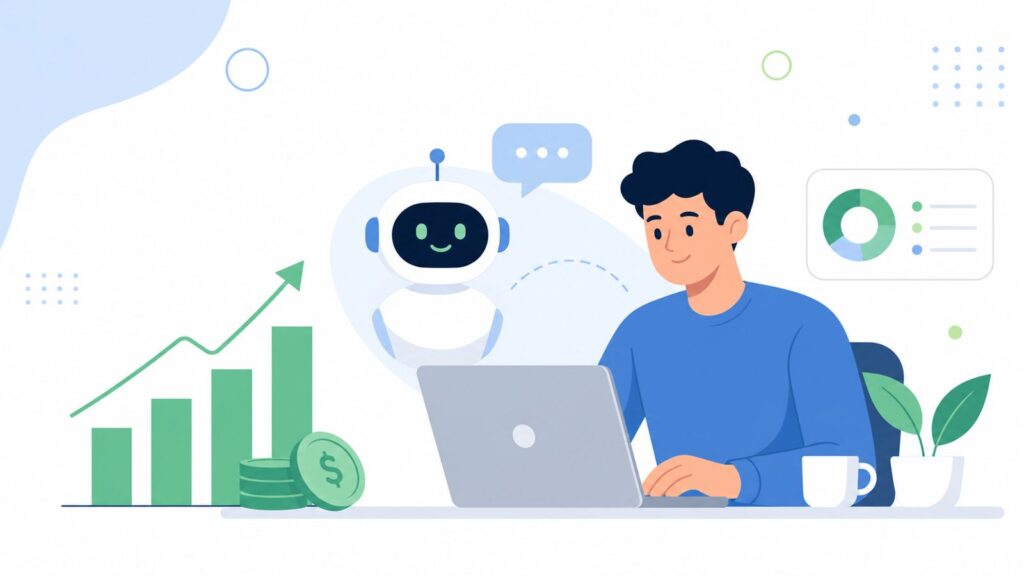
AI side hustles that actually make money sell your judgment and a finished result, not a ChatGPT subscription. Right now, the real ones are AI-assisted freelance writing and editing, prompt-based design and video work, chatbot and automation builds for small businesses, and AI data labeling and annotation gigs. Each one pays because you’re doing something the software can’t do alone: picking the right prompt, catching the wrong answer, and packaging the output so a client can actually use it. If you’ve read our guide on how to start a side hustle with no money, this is the fastest lane in right now. These tools are free or cheap, and clients are actively hunting for people who can run them well.

What Makes an AI Side Hustle Different From the Hype
An AI side hustle looks different from a normal side gig for one reason: the barrier to entry dropped, so the competition showed up overnight. Everyone has access to the same tools you do. ChatGPT, Midjourney, and a dozen other apps are one signup away for anyone with a phone. That means raw AI output, by itself, has close to zero market value. Anyone can generate a paragraph or an image in ten seconds, so nobody will pay you just to click a button.
What actually sells is the layer on top: editing raw AI output into something accurate and on-brand, knowing which prompts get useful results instead of generic ones, catching a wrong answer before a client does, and packaging the result so it’s ready to use. No one is quietly making six figures by prompting a chatbot in their sleep. That pitch is marketing copy for a $497 course, not a real business. Picture a real AI side hustle as a normal freelance service with an AI-shaped shortcut built into the workflow. It’s still work, and it still takes a skill you bring to the table.
Turn your skills into freelance income
Learn how I found clients, raised my rates and went full-time freelance in 2016. Get the free 2026 edition, tax basics included.
AI Side Hustles That Actually Make Money
Upwork’s 2026 In-Demand Skills report found that freelance work tied to applying AI on the job grew 109 percent year over year in 2025, with AI video editing up 329 percent, AI integration work up 178 percent, and AI data labeling and annotation up 154 percent. That’s real hiring activity, not hype. Here are six categories worth trying, in roughly the order most beginners can start them.
- AI-assisted writing and editing. Clients want blog posts, email newsletters, and product descriptions fast, but raw AI drafts read generic and get flagged by readers and by Google. You get hired to create content with AI and then edit hard: match the client’s voice, fact-check every claim, and cut the filler a model always adds.
- Prompt-based design and video. Etsy templates, print-on-demand designs, YouTube thumbnails, and social media marketing content all lean on tools like Midjourney and Canva’s AI features now. Composition and brand fit are what actually sell, not the prompt itself. Someone who knows what looks good beats a hobbyist who just types more words into the box.
- Chatbot and automation builds for small businesses. Plenty of local business owners want a simple customer-service bot or an email automation and have no idea how to build one. No-code tools like Zapier and Make let you wire one together without writing code. Basic logic and patient testing are what you need, because a bot that breaks on the first weird question costs you the client.
- AI data labeling and annotation. AI companies pay real people to label images, text, and audio so their models learn correctly. It’s not glamorous, but it’s real, paid work with a low skill floor. Follow the labeling spec exactly, every time, without getting sloppy on hour six, and that’s really the whole job.
- AI-powered virtual assistant work. Solo founders, small startups, and content creators need inbox triage, scheduling, and meeting notes handled, and AI tools make you faster at all three. You’re still selling your judgment and your reliability. AI just means you can take on more clients without working more hours.
- Reselling AI-built digital products. Templates, spreadsheets, Notion systems, and printables get built faster with AI tools, then sold on Etsy or Gumroad. Picking a niche people actually search for is the skill that matters here, not the AI part of the build.
- AI consulting and training for small businesses. Plenty of small business owners are non-technical and don’t know where to start with AI tools. You get hired to understand their existing process, then walk them through workflow setup, tool selection, and basic staff training, turning your own experience into a paid service that protects their time and revenue instead of free advice on social media. A short case study from your first client makes the next one easy to close.
Start One of These This Week
Pick a hustle from the list above and start now, not after you’ve watched ten more YouTube videos about it. Here’s the move, step by step.
- Pick the hustle that matches a skill you already have, not the newest tool you just discovered. Writers should start with AI-assisted writing, not chatbot builds.
- Set a real, tiny income goal for your first month. Something specific, like $200, beats “make some extra money” because it tells you when you’re actually on track.
- Do the work once for a real client, even at a steep discount or for free in exchange for a testimonial. One finished project beats a portfolio full of practice pieces.
- List the service on one marketplace (Fiverr or Upwork) or pitch five small businesses directly by email. Don’t spread yourself across five platforms at once.
- Track every dollar and every hour from day one. This counts as self-employment income to the IRS the moment a client pays you, so the paper trail starts now, not at tax time.
- Raise your price after your first three paying clients. Your intro rate was a foot in the door, not your actual worth.
Realistic Pay for AI Side Gigs
Pay varies enormously by skill and niche, so anyone quoting you a flat hourly rate for “AI side hustles” is guessing. Your rate is set by the underlying skill, not by the AI itself. A freelance writer who uses AI to draft faster still charges writer rates. A designer who prompts for concepts still charges designer rates. There’s no separate “AI rate” you can look up, and you should be skeptical of anyone who claims there is.
What you can trust is the demand signal. That double-digit growth means real clients are actively posting this work right now, which is what actually matters when you’re picking where to start. Most of the tools cost little or nothing to use. ChatGPT, Canva, and Zapier all have free tiers, so your early cost is time, not money. What a client actually pays for is quality control: a human who reviews the AI-generated draft, catches the awkward line or the wrong fact, and delivers a finished result they don’t have to touch again. That’s the real opportunity here, and it’s also why the hustles on this list hold up better than a course promising passive income for zero work. Use the table below to match a hustle to how fast you can realistically land a first client and start to earn.
Recurring monthly clients pay more reliably than one-off projects, and you don’t need to build an agency to land them. One small business willing to pay for a custom chatbot or a monthly batch of content can turn into steady, predictable income once you deliver good work the first time. Charge based on your existing knowledge and the traditional rate for that type of work, then raise it once you have a few recurring clients on the books.
| Side hustle | Time to first client | Skill that actually sells |
|---|---|---|
| AI-assisted writing and editing | Fast (days) | Voice-matching, fact-checking |
| Prompt-based design and video | Fast (days) | Composition, brand fit |
| Chatbot and automation builds | Medium (weeks) | Basic logic, patient testing |
| AI data labeling and annotation | Fast (days) | Attention to detail, following spec |
| AI virtual assistant work | Fast (days) | Client communication, reliability |
| Reselling AI-built digital products | Slow (weeks to months) | Niche research |
Taxes on AI Side Hustle Income
The IRS treats AI side hustle income exactly like any other self-employment income the moment a client pays you. There’s no separate “AI income” category and no exemption for small or informal work. Report your profit on Schedule C, then use Schedule SE to calculate self-employment tax once your net earnings from self-employment hit $400 for the year. That tax is 15.3 percent on top of the regular income tax you owe on the profit, and it covers your own Social Security and Medicare contributions.
If you get paid through a marketplace or a payment app, it only has to send you a Form 1099-K once you cross $20,000 in payments and 200 transactions in a year, a threshold the IRS reinstated for tax year 2025 and beyond. Falling under that number doesn’t mean the income is tax-free. You still have to report it, the 1099-K is just a paperwork trigger, not the line where taxable income begins. Read our full breakdown of self-employment tax before you file, and once you land steady clients, our guide to pricing your freelance work can help you build tax into your rate instead of getting surprised by it in April.
The Mistakes That Sink an AI Side Hustle
Most AI side hustles fail for one of five avoidable reasons. Watch for these before you build a habit around them.
- Selling unedited AI output. Clients can tell, and it burns the trust that gets you repeat business.
- Ignoring a platform’s AI-disclosure rules. Some marketplaces and clients require you to say AI was involved. Read the terms before you list anything.
- Chasing an oversaturated niche because a course promised “no skill required,” without doing basic market research first. Most courses selling that dream skip the taxes and the actual client work, and they skip explaining that traditional freelance skills still set the price. If a hustle sounds effortless in an ad, assume a thousand other people saw the same ad.
- Underpricing because “the AI does the work.” Your judgment is the product. Pricing yourself like a tool operator instead of a professional leaves real money on the table.
- Skipping the bookkeeping because the hustle feels casual. It’s taxable from the first dollar, whether you treat it that way or not.
Frequently Asked Questions
Conclusion: Pick One and Start Today
AI side hustles that actually make money are still side hustles. They take real skill, real client work, and real bookkeeping. AI just speeds up your first draft. Pick the one closest to a skill you already have, land one paying client this week, and reinvest that first check into better tools instead of chasing every new AI trend that shows up in your feed. For more ways to build income on the side, read our guide to retail arbitrage, dig into how to price your freelance work once you land a client, and browse the full side hustle archive for more ideas.
Free guide
Turn your skills into freelance income
Learn how I found clients, raised my rates and went full-time freelance in 2016. Get the free 2026 edition, tax basics included.
- How to land your first paying client, with a checklist
- The rate-increase email I've sent clients, ready to copy
- 2026 tax basics: 1099s, quarterly due dates and the $400 rule
Bonus: The Side Income Starter Sheet, 20 ideas rated by cost and speed