So, how does a Roth 401k work? You put money into a separate Roth account inside your employer plan, pay income tax on it now, and take qualified withdrawals tax-free later. If your employer offers the option, you can use the Roth side no matter how much you earn. If you are still sorting out the basics of your plan, start with the guide to company 401(k) plans, then come back for the limits, the tax rules, and the new 2026 catch-up twist.
What a Roth 401(k) is
A Roth 401(k) is a designated Roth account, which the IRS describes as a separate account in a 401(k), 403(b), or governmental 457(b) plan that holds Roth contributions. You pay tax on the money when you contribute, and you take qualified withdrawals, growth and all, without paying tax.
It sounds like a different product, but it is not. Your employer runs one 401(k) plan and adds a Roth option next to the usual pre-tax one. You keep the same paycheck, investment menu, and paperwork. You only change how the IRS taxes your own contributions.
Your employer decides whether to offer a Roth option, and not every plan does. Ask HR or open your plan’s summary plan description and look for “Roth” or “designated Roth” beside the contribution choices.
Learn how the stock market works, then start
Get my free 2026 guide to stocks, trades, account types, and index funds, plus a step-by-step plan for your first investment.
How does a Roth 401k work? Step by step
You can set this up in about five minutes and then leave it on autopilot. Here is the sequence.
- Choose the Roth option. In your plan’s online portal or enrollment form, split your contribution between pre-tax and Roth, or send all of it to Roth.
- Pick a percentage. Your employer takes the contribution from each paycheck after withholding income tax, so your take-home pay drops by more than it would with pre-tax contributions.
- Choose your investments. The IRS notes that investment choices in a designated Roth account are “as offered by the plan,” so you pick from the plan’s menu. A target-date fund or a broad S&P 500 index fund is a sensible default.
- Let it grow. You do not pay tax on earnings inside the account year to year.
- Withdraw after you qualify. A qualified withdrawal is tax-free. You owe tax on part of a withdrawal that is not qualified, as the next section explains.
Roth 401(k) contribution limits for 2026
The 2026 employee contribution limit is $24,500, according to the IRS contribution limits page. That is the same limit as for a traditional 401(k), and you can split it between pre-tax and Roth in any proportion your employer allows. The IRS designated Roth FAQ says the limit covers the combined amount you put into Roth and pre-tax accounts in a year, so you cannot contribute $24,500 to each.
| Limit | 2026 amount | Who qualifies |
|---|---|---|
| Employee deferral | $24,500 | Everyone in the plan |
| Standard catch-up (50+) | $8,000 | Workers who turn 50 or older |
| Higher catch-up, ages 60 to 63 | $11,250 | Workers who turn 60, 61, 62, or 63 in the year |
| Total annual additions | $72,000 | Your contributions plus employer money, before catch-ups |
On the same page, the IRS puts the total annual additions limit at $72,000 in 2026, and at $80,000 with the catch-up, or up to $83,250 for people aged 60 to 63. Your match and any profit-sharing money count toward that total. They do not count toward your $24,500.
Roth 401(k) contributions have no income cutoff. The IRS says there are no limits on your income in determining whether you can make designated Roth contributions. That is the big difference from a Roth IRA, where the 2026 phase-out runs from $153,000 to $168,000 for single filers and $242,000 to $252,000 for married couples filing jointly.
How the IRS taxes Roth 401(k) withdrawals
You pay no tax on a Roth 401(k) withdrawal when it is a qualified distribution. Per the IRS FAQ, that means you have completed a five-taxable-year period of participation and you are at least 59½, disabled, or deceased. The five-year clock starts in the first taxable year you make designated Roth contributions.
The IRS says the five-year period is separate for each Roth account. If you leave a job and start a Roth 401(k) at a new employer, you start a fresh five-year clock with the new plan. You track your Roth IRA on a separate clock.
If a withdrawal is not qualified, you take out a mix of contributions and earnings. You owe tax on the earnings portion, and the IRS says contributions and earnings come out in proportion. That is a harsher rule than a Roth IRA, where contributions come out first. If you treat the account as retirement money, you will rarely face that pro-rata tax.
Your employer also decides, in the plan’s terms, when you can take money out. The IRS lists withdrawals from a designated Roth account as allowed “only when allowed by the terms of the plan,” and loans as available only if the plan terms include loans. Check your plan document before you count on a withdrawal or a loan.
Roth 401(k) vs traditional 401(k)
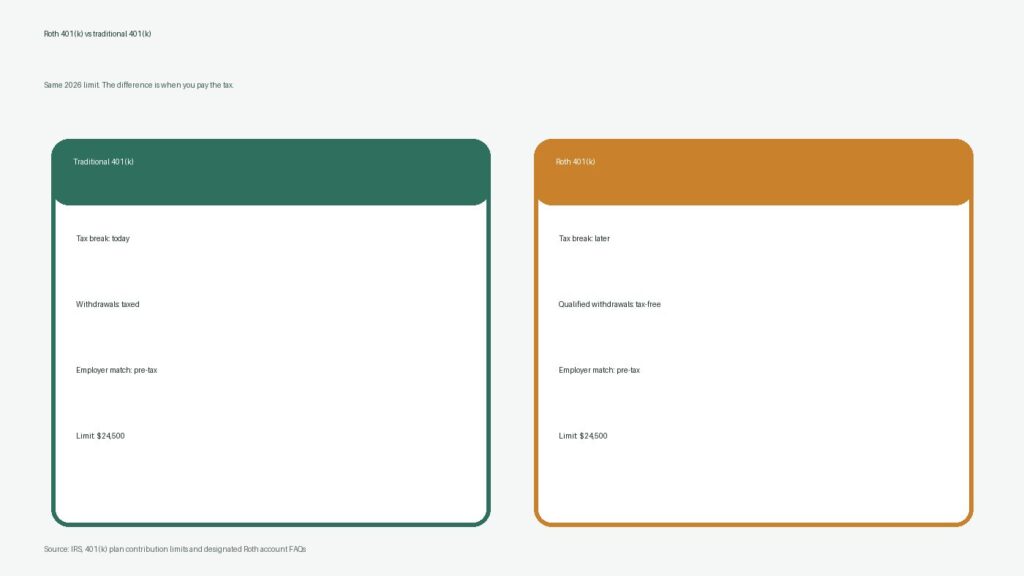
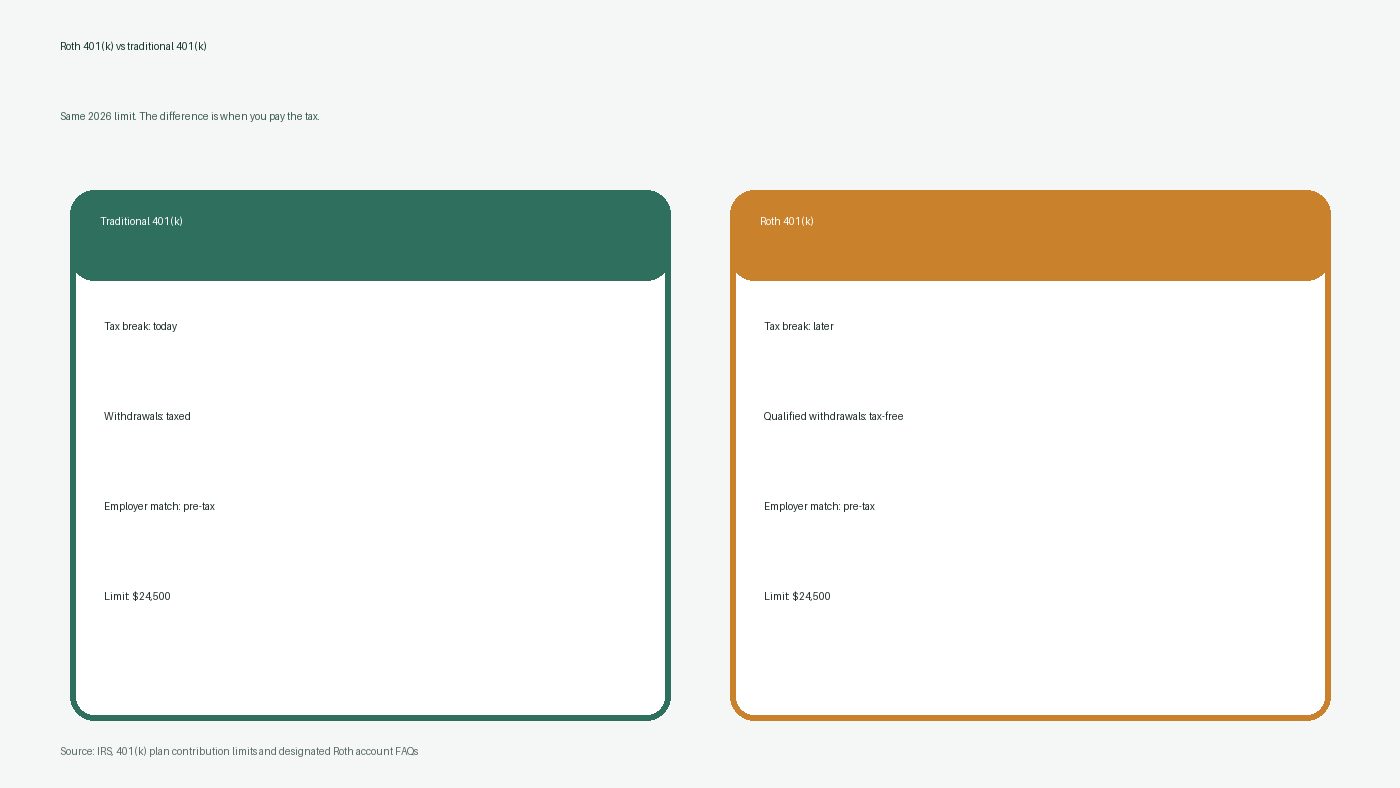
You can boil the choice down to one question: do you want your tax break now or later? Both accounts share the same contribution limit, so you choose when you pay the IRS, not how much you can save.
| Feature | Traditional 401(k) | Roth 401(k) |
|---|---|---|
| Tax on contributions | Deducted from taxable pay now | Taxed now |
| Tax on qualified withdrawals | Taxed as ordinary income | Tax-free |
| Income limit to contribute | None | None |
| Employer match | Pre-tax, unless your employer offers a Roth match | Pre-tax, unless your employer offers a Roth match |
| 2026 deferral limit | $24,500 | $24,500 (shared) |
Eric’s default is Roth for younger earners, because they usually sit in a lower tax bracket now than they will later. A 25-year-old earning an entry-level salary pays a modest tax rate today and gets decades of tax-free growth. As you earn more, you save more with the pre-tax option, since you skip tax at a higher rate on each dollar you defer. If you split contributions between the two, you get tax diversification, which is a fair hedge when nobody knows future tax rates.
For more depth on the maxing-out decision, read the 2015 post on whether to max out your Roth 401(k). Whatever you choose, capture the full match first. You can see how the formula works in the 401k match guide.
What happens to your employer match
By default, your employer puts the match in a pre-tax account, not the Roth side. The IRS FAQ on designated Roth accounts still reads “your employer must allocate any contributions to match designated Roth contributions into a pre-tax account.” Congress opened a second path in SECURE 2.0. Since then, the IRS lets plans allow employees to designate matching contributions made after Dec. 29, 2022, as Roth. If your employer offers a Roth match and you elect one, you pay income tax on the match for the year your employer deposits the money, and your plan administrator reports that amount on Form 1099-R.
Plan for that detail in two ways. First, unless you elect a Roth match, you will hold both Roth and pre-tax money in the same plan, which is fine. Second, with a pre-tax match you can’t get to 100% Roth from a 401(k) alone, so think about how you’ll draw down that pre-tax balance in retirement.
The 2026 Roth catch-up rule for higher earners
Starting in 2026, workers who earned more than $150,000 the prior year with their plan sponsor must make their catch-up contributions as Roth. The IRS set that prior-year wage threshold at $150,000 for 2026 on its catch-up contributions page. The IRS ties this rule to plans with a Roth feature. If your employer hasn’t added one and you cross the threshold, ask your plan administrator how you can still make a catch-up.
Congress aimed this rule at the catch-up only, not the first $24,500. Say you are 55, earned $180,000 in 2025, and your employer offers a Roth feature. You can still make your regular deferrals pre-tax, but you must put the extra $8,000 in as Roth. If you earned $120,000, you can choose either type for the catch-up. Check with your plan administrator to see how your plan is applying the rule.
What happens at retirement: RMDs and rollovers
You no longer have to take required minimum distributions from a Roth 401(k) while you are alive. In its Employee Plans news, the IRS confirms that for 2024 and later years, RMDs are no longer required from designated Roth accounts in a 401(k) or 403(b) plan. Beneficiaries still face RMD rules, according to the IRS RMD FAQ.
You can also move the money. When you leave your employer, you can roll a Roth 401(k) into a Roth IRA, and the IRS says you can roll the basis into a Roth IRA if you finish the rollover within 60 days of a payout. Eric’s standing advice on old 401(k)s is to roll them into an IRA you control instead of leaving them scattered at past employers. For a refresher, see the post on rolling over your old 401(k). If you have a pre-tax balance you would like to convert, read how a Roth IRA conversion works.
Who should choose a Roth 401(k)
Three kinds of savers tend to get the most from a Roth 401(k). This is general guidance and not tailored advice, so check your own numbers.
- Younger earners who expect higher pay and a higher tax bracket later.
- High earners shut out of a Roth IRA who still want tax-free growth, since the 401(k) has no income cap.
- Savers who want tax diversification and plan to hold both pre-tax and Roth money in retirement.
You may come out ahead with a traditional 401(k) if you are in a high bracket today and expect a lower one in retirement. If you cannot decide, split the contribution and revisit it each year. Either way, grab the full match, pick low-cost index or target-date funds, and keep contributing through market dips.
Roth 401(k) FAQ
Conclusion
So, how does a Roth 401k work? You pay tax now, you let the money grow inside your employer plan, and you take qualified withdrawals tax-free, with no income cap and no RMDs during your lifetime. Ask HR whether you can pick the Roth option, decide your split, and take the full match. For more on retirement accounts, browse the retirement category, or head to the Personal Profitability homepage. If you are comparing account types, the Roth IRA for beginners guide is the natural next read.

Free guide
Learn how the stock market works, then start
Get my free 2026 guide to stocks, trades, account types, and index funds, plus a step-by-step plan for your first investment.
- How a trade works, from order types to T+1 settlement.
- Why I start with low-cost index funds instead of stock picks.
- The margin rules and my own trading mistakes, so you can avoid the same errors.
Bonus: The First-Investment Checklist, the order to handle your match, debt, and savings